How to Detect AI Writing in 2026
Detection accuracy can range from 65% to 99%, depending on the method and the type of text being tested. Pure AI and pure human writing are generally easier to classify than hybrid writing or very short passages.
That range changes the practical question. Instead of asking whether a detector can “prove” that someone used AI, ask whether its result adds useful evidence to a broader review. A score can help you prioritize a document for inspection, but it shouldn't decide an academic, editorial, procurement, or employment outcome by itself.
AI writing detection is best treated as a probabilistic assessment. Text length, genre, editing depth, language background, and the generator used can all change the result. The workflow that works for a long, untouched essay may perform poorly on a short product description that a human has heavily revised.
Table of Contents
- Why Detecting AI Writing Is Harder Than You Think
- Linguistic Signals and Technical Patterns
- Top Detection Tools and How They Compare
- When Detection Fails and Why
- Real-World Case Studies and Applications
- Building Your Detection Workflow
Why Detecting AI Writing Is Harder Than You Think
A common expectation is that an AI detector will return a clean classification: human or machine. In practice, the system estimates whether a collection of linguistic patterns resembles the material it has learned to associate with generated text. That makes the output useful as a signal, but not as authorship evidence.
Early testing illustrates the problem. A 2023 clinical evaluation of GPTZero, using 20 ChatGPT-generated text pieces, reported 65% sensitivity, 90% specificity, and 80% overall accuracy. In practical terms, the detector missed 35% of the AI samples while also producing false positives. A later study using 500 writing samples reported 89% to 93% accuracy for mixed-origin writing and 95% to 99% accuracy for human or fully AI-generated writing, showing that hybrid text remains harder to classify. These findings are reported in the comparative AI-writing detection study.
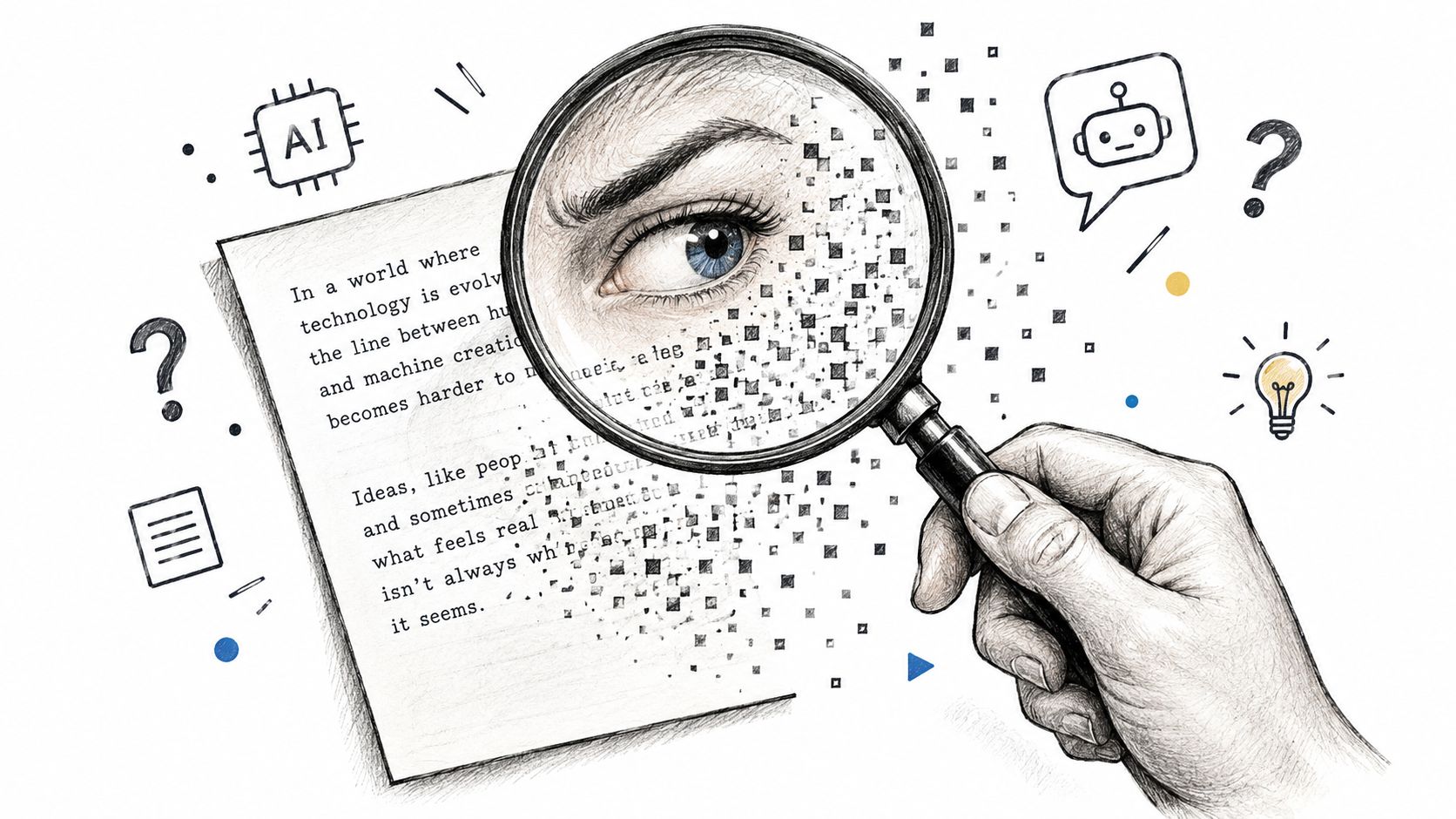
The authorship spectrum matters
A document rarely falls into only two categories. It might be:
- Fully human, drafted and edited by one person.
- AI-assisted, with brainstorming, outlining, or sentence suggestions from a model.
- Hybrid, where a person combines generated passages with original writing.
- Humanized AI, where generated copy has been rephrased or structurally edited.
- Fully AI-generated, with minimal human intervention.
Those categories create different detection conditions. A model may recognize the statistical regularity of an untouched output, yet lose confidence when a writer changes the introduction, inserts examples, rewrites transitions, and adds personal observations. The result can contain both machine-like and human-like signals without offering a reliable boundary between them.
Practical rule: A detector score should tell you what to review next, not what conclusion to reach.
Why a single score misleads
Detection systems typically preprocess text, extract lexical, syntactic, semantic, and discourse features, then calculate a score with a classifier or statistical method. Token probability, token-rank variation, and negative log-likelihood curvature can contribute to that score. A threshold then converts a continuous estimate into a label such as likely AI or likely human.
That label looks definite even when the underlying evidence isn't. Prompt style, subject matter, document genre, and local writing conventions can shift the score. A calibrated threshold may work on the data used to test it and fail after a generator change or a round of human editing.
The right mindset is simple: detection identifies resemblance, not intent. If the decision carries consequences, combine the score with drafts, revision history, source notes, interviews, writing samples, or a conversation about the work. Never confuse a polished probability label with a forensic finding.
Linguistic Signals and Technical Patterns
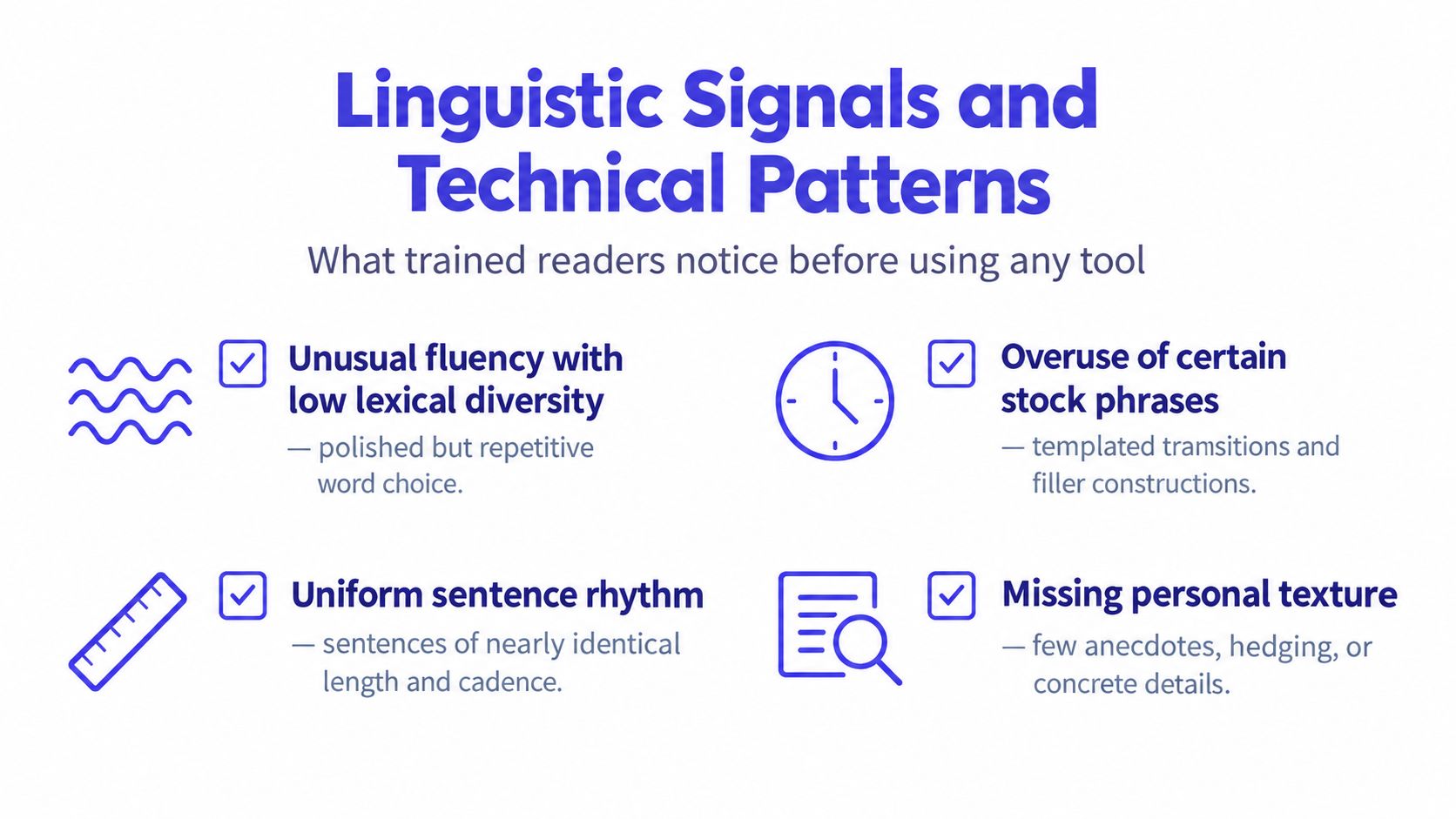
Manual inspection remains useful, especially before you upload a document to a detector. Trained reviewers often notice a cluster of signals rather than one suspicious phrase. The strongest clue isn't that a sentence sounds polished. Human writers produce polished prose every day. The clue is a repeated pattern of smoothness, generic structure, and missing specificity across the document.
Look first at the language. AI-assisted drafts often move through familiar transitions, explain obvious points with balanced phrasing, and maintain a remarkably even rhythm. They may use a polished vocabulary without adding concrete observations, local knowledge, sensory detail, or a defensible point of view.
Three evidence layers
Linguistic signals provide the first layer. Look for low lexical variety beneath a fluent surface, stock transitions that appear at regular intervals, repeated sentence patterns, and conclusions that restate the introduction without adding a sharper implication. None of these proves AI authorship. They become more useful when several appear together and conflict with the writer's known style.
Tool-based analysis supplies a second layer. Run a sufficiently long, representative passage through more than one detector, then compare the explanations rather than selecting the most alarming label. If tools disagree, record the disagreement. It may indicate a borderline document, a genre problem, or a weakness in the detectors.
Manual inspection adds the context machines can't establish. Ask whether the writer can explain why a claim appears, identify the source behind a detail, describe the revision process, or reproduce the same reasoning in conversation. A person who owns the thinking can usually expand, qualify, and correct the text.
Common Linguistic Indicators
| Signal Type | What to Look For | Confidence Level |
|---|---|---|
| Lexical variety | Fluent wording that repeatedly relies on the same safe terms | Low on its own |
| Stock phrasing | Predictable transitions, disclaimers, and filler constructions | Low to moderate in a cluster |
| Sentence rhythm | Similar sentence lengths and a consistently balanced cadence | Low to moderate |
| Personal texture | Few concrete experiences, judgments, hesitations, or unusual details | Context dependent |
| Argument depth | Broad claims with limited evidence, friction, or original analysis | Context dependent |
| Technical fingerprints | Repeated scripts, framework conventions, or asset patterns in a website build | Useful for website analysis, not proof of text authorship |
Technical signals deserve separate treatment. A website may expose framework conventions through its HTML, CSS classes, script tags, headers, cookies, CDN references, or bundled assets. An AI-first builder can leave recognizable implementation patterns, but that indicates something about the site's production stack, not necessarily who wrote the visible copy.
Top Detection Tools and How They Compare
No detector wins across every document type. GPTZero and Originality.ai are designed for fast content checks, while Turnitin is commonly used in academic environments where similarity review and institutional workflows also matter. Their labels, thresholds, training conditions, and handling of hybrid text differ, so comparing a headline number from one tool with a headline number from another can create false confidence.
A large benchmark changed the scale of evaluation by testing 672,000 texts across 11 domains, 12 large language models, and 12 adversarial attacks. On that benchmark, GPTZero identified 95.7% of AI-written text and misclassified 1% of human writing, as described in the RAID benchmark research. Those results are valuable, but they describe a defined test environment. They don't guarantee the same performance on short landing-page copy, edited reports, multilingual writing, or a new model.
Detection Tool Comparison
| Tool | AI Detection Rate | False Positive Rate | Best For |
|---|---|---|---|
| GPTZero | 95.7% on the cited RAID benchmark | 1% on the cited benchmark | Triage and comparative review, with manual follow-up |
| Originality.ai | Not stated in the verified benchmark data | 12.9% across 449 human-written essays in the cited review | Editorial screening where reviewers can inspect flagged passages |
| Turnitin | In one academic comparison, it labeled 100% of fully AI-generated papers as false negatives | Not stated in the same comparison | Institutional similarity and integrity workflows, not standalone proof |
| GPTZero on hybrid academic papers | 0.0% accuracy in the cited hybrid-paper test | Not stated in that comparison | Not reliable as a sole decision tool for mixed authorship |
The academic comparison found that GPTZero labeled 70% of fully AI-generated papers as false negatives and 30% as partial false negatives, while it recorded 0.0% accuracy on hybrid papers. The comparative detector evaluation shows why the tool and the document must be evaluated together.
For a practical overview of how free scanning tools fit into a broader review, see this guide to free AI detector workflows. Use any result as a prompt for investigation. Don't treat a green or red label as a substitute for authorship evidence, especially where the writer could face disciplinary, professional, or reputational consequences.
When Detection Fails and Why
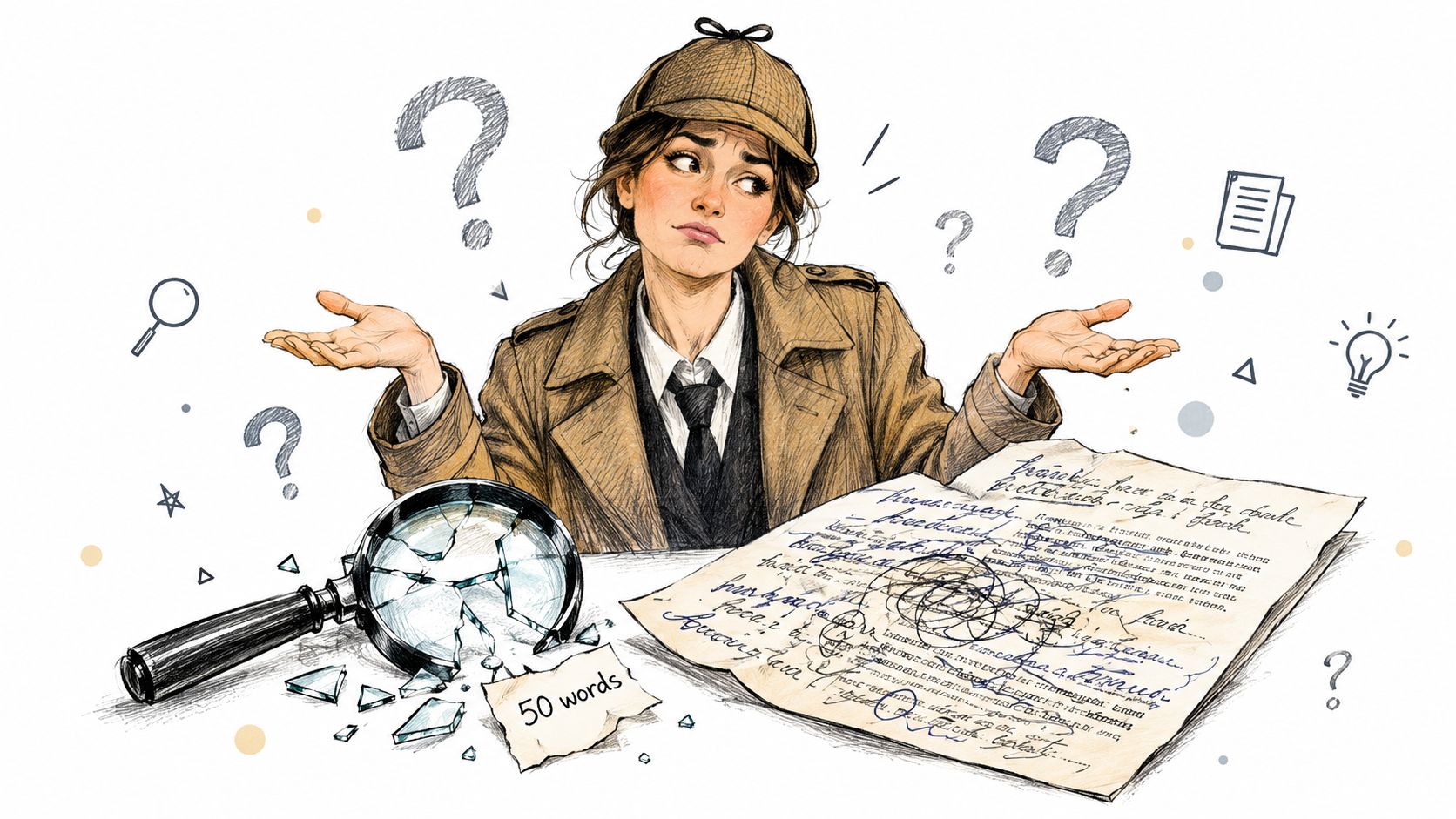
The most revealing detector result is often the one that doesn't fit the document. Short passages provide little evidence to analyze. Heavy editing removes or rearranges the statistical patterns that detectors rely on. A writer using English as an additional language may produce formal, predictable prose that a detector mistakes for generated text.
The NBER research on AI detectors and text length found that commercial tools perform much better on longer passages than on ultra-short passages and stubs of 50 words or fewer. The same research also identified vulnerability to humanizer tools. That matters for web teams because headlines, meta descriptions, email snippets, product bullets, and short landing-page sections are precisely the formats where confidence can become weakest.
The language fairness problem
Non-native English writing creates a serious operational risk. Recent research found that authentic TOEFL essays by non-native English speakers were misclassified at a mean false-positive rate of 61.3% across seven detectors. The same body of research also examined 135,389 pre-edited and post-edited non-English documents, with false-positive results ranging from 0% to 100% depending on the detector. The research on detector performance for non-native and edited writing makes the risk difficult to dismiss.
A formal style isn't evidence of machine authorship. Neither are careful grammar, consistent paragraphing, or the use of conventional transitions. Reviewers should compare the document with the writer's other work, ask for supporting drafts, and give the writer a chance to explain the reasoning before escalating a concern.
The distinction between AI assistance and plagiarism also needs care. A useful discussion of AI use and plagiarism from Contesimal separates questions of originality, attribution, policy, and unauthorized copying. Detection can sometimes support that conversation, but it can't answer the policy question on its own.
A reviewer facing an uncertain score should preserve the original file, record the tool and date, test a representative passage rather than a fragment, and seek human review. For website teams, a guide to Grammarly AI detection can help clarify why editing tools and writing assistants complicate simple human-versus-AI judgments.
The following video offers another perspective on the limitations of automated assessment. Treat it as context, not as a replacement for document-specific review.
Real-World Case Studies and Applications
Detection becomes more useful when the question is specific. A digital marketer may want to understand whether a competitor's website relies on an AI-first builder. A product manager may need to verify whether a freelancer's portfolio reflects custom implementation or a template workflow. An editor may be deciding whether a submitted article deserves a deeper source and authorship review.
These are different problems, even though people casually call all of them “AI detection.”

Competitive research
Suppose a marketer finds a competitor page with unusually generic copy and wants to know whether the site was assembled with an AI-first builder. Text analysis alone won't answer that. The marketer can inspect the source, scripts, asset paths, framework conventions, headers, and hosting signals, then compare those findings with the page's visible language.
The resulting decision might be practical rather than accusatory. If the site uses a recognizable builder, the marketer can study its implementation constraints, estimate how quickly the competitor could publish variations, and separate the site's technology from the quality of its editorial strategy.
Vendor and freelancer review
A product manager reviewing a freelancer's portfolio shouldn't ask a detector whether the freelancer “really built” a site. The better question is what evidence supports the claimed work. A technical stack review can identify a CMS, framework, builder, hosting layer, analytics tools, and reusable platform patterns. A conversation can then establish which parts the freelancer designed, configured, coded, or edited.
That process protects both sides. A builder-based project may still involve strong information architecture, original design decisions, accessibility work, and careful conversion writing. Conversely, a custom-looking presentation doesn't prove that every page was created from scratch.
Editorial review
An editor receives a polished article with vague examples and no visible drafting history. A detector flags it, but another detector returns an uncertain result. The editor should examine source quality, ask the writer to explain key claims, request revisions, and compare the submission with authenticated samples.
The outcome should focus on editorial standards, attribution, and accuracy. A detector can prioritize the review queue, but it shouldn't replace an editor's judgment about whether the article is useful, supported, original, and suitable for publication.
Building Your Detection Workflow
A defensible workflow starts by defining the decision you need to make. “Detect AI writing” is too broad. Are you checking a student submission, validating a freelancer's process, reviewing a publisher's content, or analyzing the technology behind a website? Each use case needs different evidence and a different tolerance for false positives.
Start with a representative sample
Use enough text to reflect the document's normal style, not just the opening paragraph or a conspicuous sentence. Preserve the original version before editing, note the document genre, and record whether the writer used grammar software, translation support, or an AI assistant. Those details explain why two apparently similar documents may produce different scores.
Establish a local baseline with authenticated human writing from the same team, subject area, and language context. A detector that frequently flags your own writers is not automatically useless, but its output needs more cautious interpretation in that environment.
Combine signals instead of stacking labels
Run an initial scan, then inspect the language manually. Look for recurring transitions, generic claims, missing source trails, and abrupt changes in voice. Compare the result with revision history, drafts, citations, and the writer's ability to discuss the argument.
For website research, use a separate technical workflow. A website builder checker can help identify implementation signals, but a platform fingerprint answers a different question from whether the page copy was AI-generated. Keep those findings in separate columns in your review record.
Evidence note: Record the tool, version if available, passage tested, result, threshold, date, and reviewer interpretation.
Make the decision proportional
A borderline score may justify a conversation or a request for drafts. It shouldn't justify an automatic rejection. A high-confidence result can still be wrong when the passage is short, heavily edited, unusually formal, or written by someone outside the detector's dominant language patterns.
Document the final decision and the evidence that supported it. Teams comparing automated research products can also use this checklist for comparing data enrichment tools to assess coverage, explainability, and workflow fit rather than choosing on a single headline claim.
AI Website Detector analyzes websites for AI-first builder fingerprints and underlying technology-stack signals, returning an AI probability score, verdict, and detected reasons rather than judging the site's written copy. Visit AI Website Detector when you need a separate, explainable check of how a website was built.