Grammarly AI Detection: Limits & What to Trust in 2026
Grammarly's detector is positioned with 99% accuracy on the RAID benchmark, but that number comes from a controlled evaluation on over 670,000 texts and a model trained on tens of thousands of pre-2021 texts. That makes it a strong benchmark headline, not proof that a live document was written by AI.
Table of Contents
- What Grammarly AI Detection Actually Does
- How the Detector Identifies AI-Generated Text
- Reading Your Grammarly AI Detection Score
- How Accurate Is Grammarly at Catching AI Writing
- The Hard Case, Edited, Paraphrased, and Humanized Text
- Grammarly vs Other AI Content Detectors
- Practical Takeaways and When to Trust the Score
What Grammarly AI Detection Actually Does
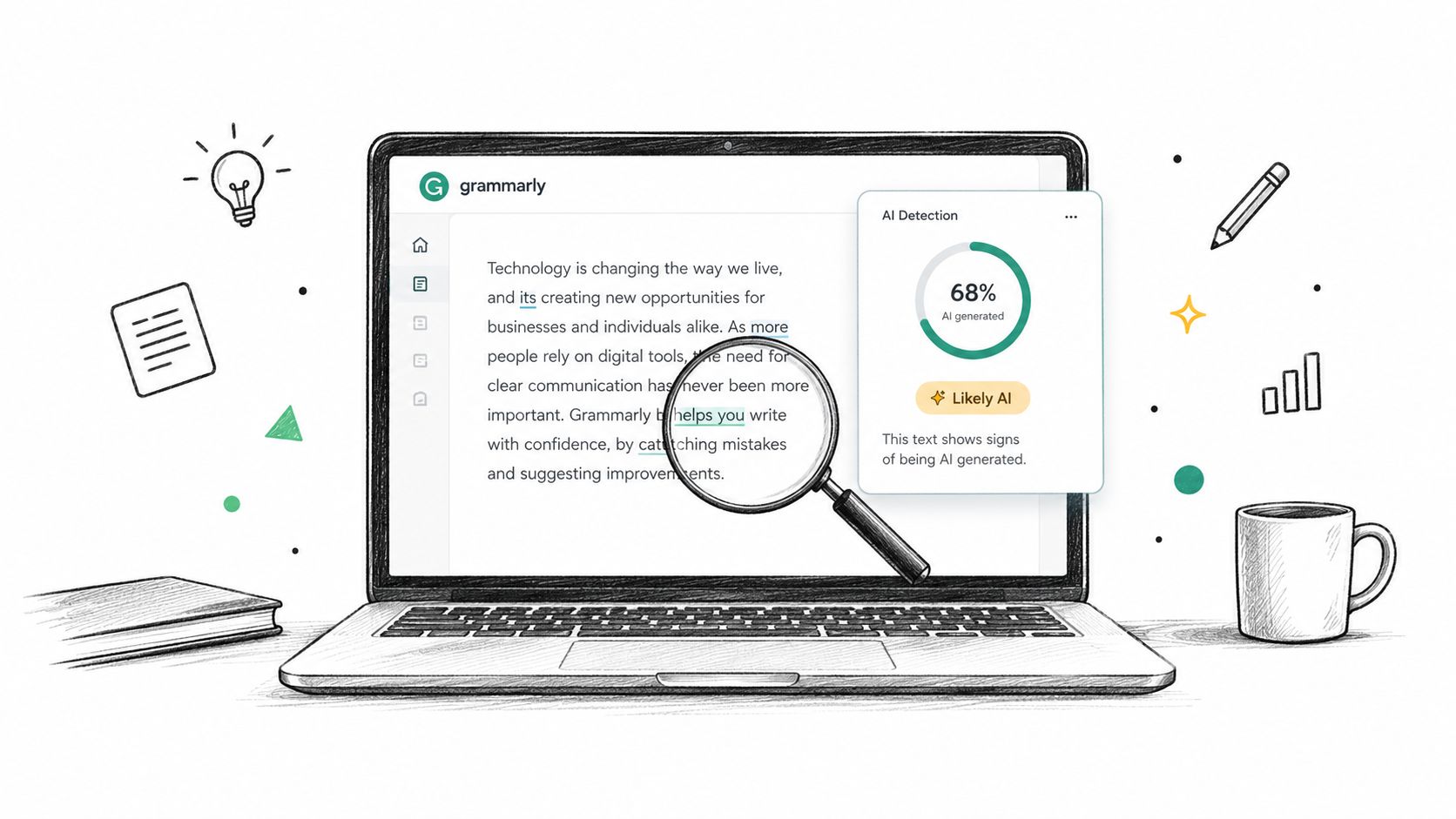
A percentage score gives Grammarly's assessment of how strongly a passage resembles AI-generated writing. The tool runs within the writing workflow and turns that assessment into a label, making it useful for deciding which drafts need closer review.
Grammarly describes the result as an averaged estimate of the AI-generated text that may be present. Its Grammarly AI Detector overview and Grammarly AI Detector user guide also state that no detector is perfectly accurate or suitable as the sole basis for judging authorship.
What the number really means
A Grammarly score is best read as a probability signal. It responds to surface patterns, including repeated phrasing, consistent sentence rhythm, and generic wording. It does not identify a concealed authorship signature.
The edited-AI-text gap exposes the limitation. A passage produced with AI may receive a different score after light human revisions, while polished human prose may still resemble the patterns the detector flags. The score therefore measures resemblance under Grammarly's criteria, not who wrote the passage.
Practical rule: use the score as a triage flag. A high result calls for closer reading and a low result does not establish human authorship.
That makes Grammarly useful for editorial review, classroom screening, and content QA. It offers a fast first check, while authorship decisions require context, revision history, and human judgment.
How the Detector Identifies AI-Generated Text
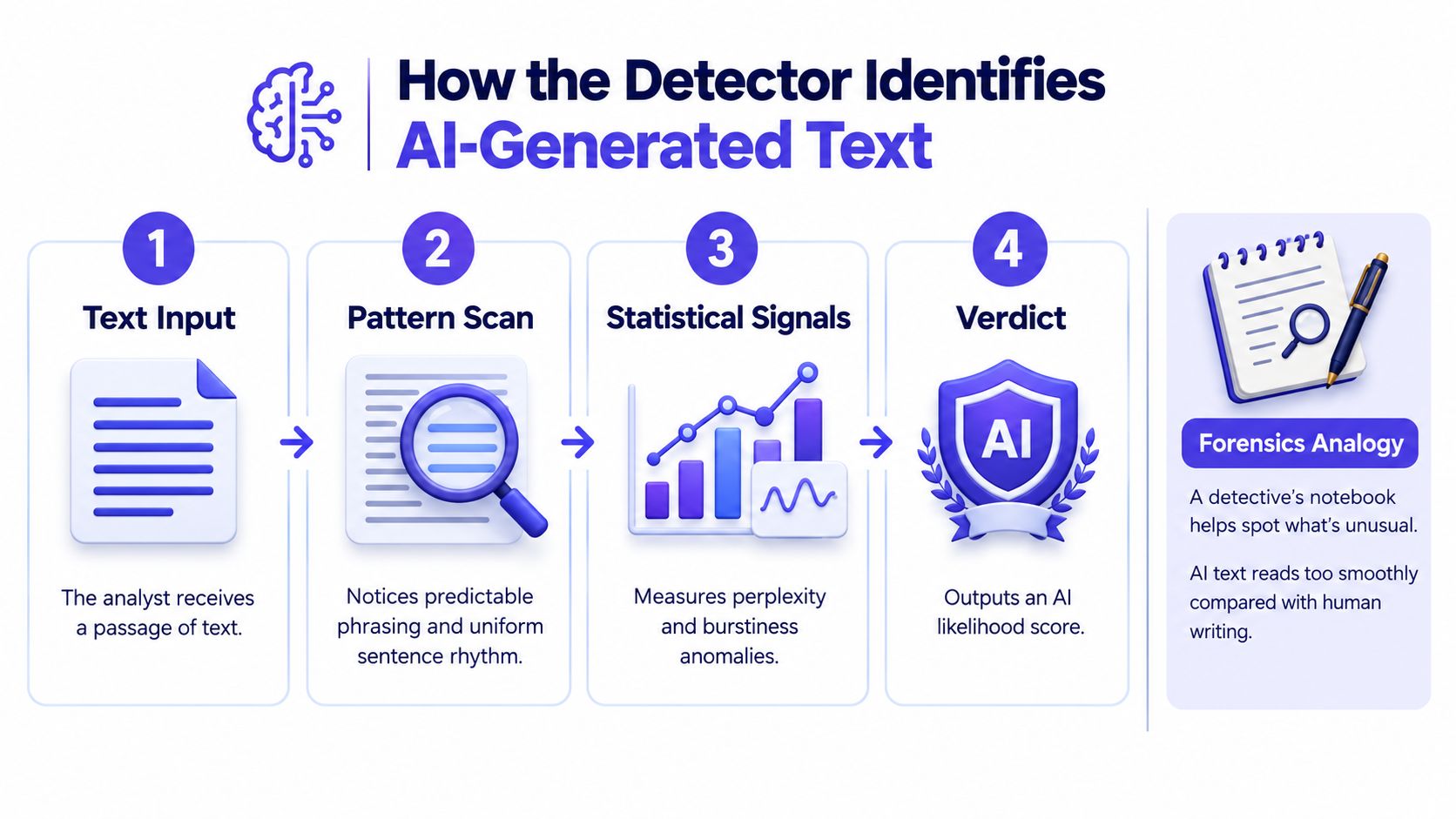
Grammarly's detector applies forensic linguistics to writing. It compares surface patterns in a new passage with patterns found in labeled examples, then estimates how closely the passage resembles machine-generated prose. That process identifies statistical similarity, not deception or authorship.
From training data to likelihood score
A detector learns from examples marked as human-written or AI-generated before evaluating new text. Grammarly says its model was trained on tens of thousands of texts, including samples created before 2021, as described in the Grammarly AI Detector overview. This helps explain why the product presents a benchmarked assessment rather than proof of who wrote a passage.
The pre-ChatGPT training set also limits what the model can recognize. Current drafts may combine generated material, human revisions, paraphrasing, and original writing. Those mixed workflows do not resemble a clean human or AI sample, so the detector's confidence can change even when the underlying ideas remain the same.
That edited-AI-text gap is the practical warning. Light rewriting can remove the surface patterns that produced a high result, while polished human prose can retain similar rhythm, phrasing, or transitions. A single signal therefore struggles with blended documents, much as explainable AI-builder detection must show which observable features support its assessment.
Why the output feels definitive
The interface converts that estimate into a percentage and, in some versions, sentence-level highlights. A highlight marks statistical suspicion, not a confirmed AI sentence.
The detector is effectively saying that selected features resemble its learned AI examples. It is not establishing that a machine produced the sentence. That distinction separates a signal from a verdict.
Human editing changes the signal. Rewriting, paraphrasing, or blending original prose can make the score less stable and harder to interpret.
Reading Your Grammarly AI Detection Score
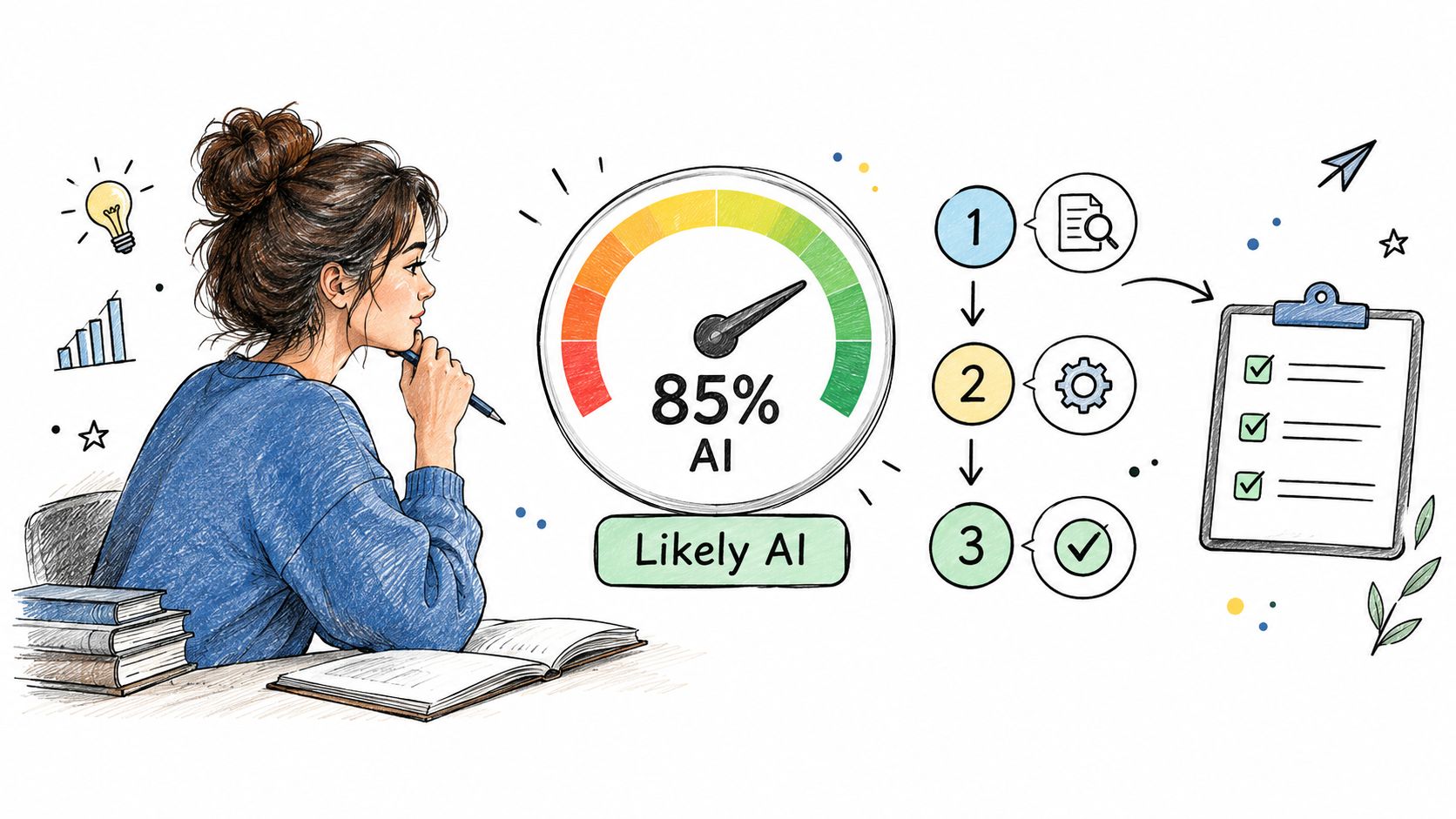
Read Grammarly's panel as three related signals: the overall percentage, the verdict label, and the highlighted passages. Each supports a different review decision.
The percentage is a probability signal about the document's resemblance to AI-generated writing. The label summarizes that signal in plain language, while the highlights identify sentences that contributed to the result. None of these elements establishes who authored a passage.
A practical way to read the panel
An 80% score with three highlighted sentences should trigger a defined workflow, not an authorship accusation. First, open the highlighted lines and compare them with the surrounding prose. Then check revision history, earlier drafts, notes, or the writer's source material. If the document combines generated text with substantial human editing, record which sections changed and run the revised passage again.
The screenshot above illustrates why location matters. A high score concentrated in a few sentences calls for targeted review. A similar score spread across an entire draft suggests that the document's overall style deserves closer examination. The number alone cannot distinguish those cases.
Polished human writing may receive attention because it uses even rhythm, predictable transitions, or generic phrasing. Conversely, light paraphrasing can reduce the visible patterns associated with generated text. This edited-AI gap makes a single detector unreliable for mixed workflows, much as explainable AI-builder detection needs several observable features rather than one opaque output.
Grammarly's support guidance describes the detector as designed to limit false positives, which can also mean that some AI-written text is missed Grammarly AI Detector user guide. Treat that design choice as a reason to review context, not as evidence that a low score clears the text.
What the visuals can and can't tell you
The highlights help prioritize reading, draft comparison, and requests for revision history. They do not prove that a model produced a highlighted sentence.
Good use: flagging generic phrasing in a blog draft before publication.
Bad use: telling a student or writer that the detector has “proven” machine authorship.
Use the panel to decide what to inspect. Resolve authorship questions with document evidence and editorial context.
How Accurate Is Grammarly at Catching AI Writing
99% accuracy is Grammarly's headline result on the RAID benchmark, based on an evaluation of 670,000+ texts and a model trained on older data Grammarly AI Detector overview. That is strong benchmark evidence, but it does not establish the same performance on current, edited, or mixed-authorship drafts.
Benchmark results and field results are not the same thing
Independent testing produces a less consistent picture. One evaluation reported a 78.4% true positive rate for AI text and a 14.2% false positive rate for human text. A separate small spot check identified zero of nine AI samples correctly while classifying all three human samples correctly Fast.io review.
These findings are not directly comparable. The first was a broader mixed-sample evaluation, while the second was a nine-AI-sample and three-human-sample spot check. Their different sample designs can produce different estimates, so neither result should be treated as a universal accuracy rate.
| Source | Test context | Reported result | Notes |
|---|---|---|---|
| Grammarly | RAID benchmark, over 670,000 texts | 99% | Controlled evaluation using a pre-2021 training basis Grammarly AI Detector overview |
| Independent review | Mixed AI and human samples | 78.4% true positive rate | The same review reported a 14.2% false positive rate for human text |
| Independent spot check | Nine AI and three human samples | 0 of 9 AI samples detected | All three human samples were identified correctly |
Why the gap appears
Detector performance is usually strongest on untouched model output, especially text produced directly from a clean prompt. Documents in editorial workflows contain trimming, rephrasing, source blending, and human revisions. Those changes can weaken the visible patterns behind a probability score, creating an edited-AI gap.
Grammarly's guidance emphasizes limiting false positives. That protects human writing from aggressive labeling, but it can also allow some AI text to pass when its signals are weak Grammarly AI Detector user guide. The practical conclusion is narrow: use the score to prioritize review, then check drafts, revision history, and authorship context. A probability signal can guide an investigation, but it cannot prove who wrote the text.
The Hard Case, Edited, Paraphrased, and Humanized Text
Edited AI text is where Grammarly's score starts to behave more like a probability signal than a verdict. A writer can rewrite machine output enough to reduce repetition, vary sentence length, and add human quirks that blur the detector's pattern match.
Why light editing changes everything
Teachers, editors, and brand teams usually do not see raw chatbot output. They see drafts that have been summarized, reworded, shortened, or humanized. Once that happens, the detector has less clean pattern evidence to work with, so the score can fall even if AI still shaped the draft.
A 2026 independent review found that performance drops sharply on edited or paraphrased material, and the same review noted that results can slip well below the levels seen on untouched text. That gap matters because the easiest text to catch is still the most obviously machine-made.
Why polished prose can fool the model
A lightly edited essay, a rewritten product description, or a blended human-AI memo can all read smoothly enough to pass a quick scan. Example: an AI draft paraphrased through two human editing passes dropped from 92% to 38% in testing. The point is not that the detector failed in a random way, but that editing removed many of the surface cues it depends on.
The hard case is the hybrid draft. It looks coherent, individual, and readable, yet the authorship signal is mixed. That is why a probability score should guide review, not settle it.
Practical rule: once a draft has been revised by a human, use the score alongside revision history, source notes, and editorial context.
The edited-AI gap is the core limitation. A single number can flag risk, but it cannot prove where the machine ends and the writer begins.
Grammarly vs Other AI Content Detectors
Grammarly is useful as a quick screening layer inside an editor people already use. It is weaker when the draft has been blended, polished, or heavily revised, because the score then reflects probability, not proof.
What matters in practice
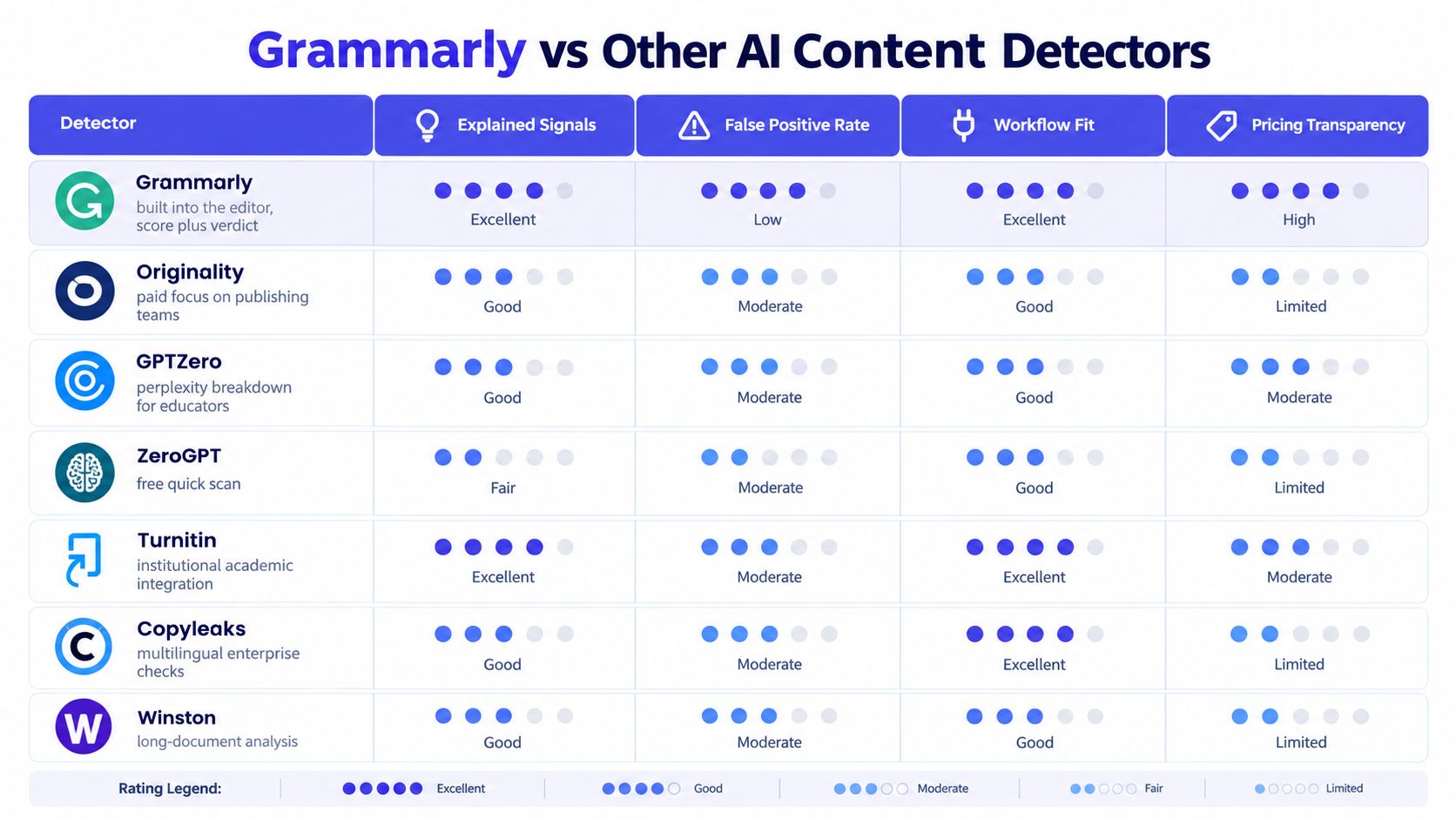
For real workflows, sensitivity is only one part of the comparison. The better test is whether a detector explains its signal, avoids false positives on careful human writing, and shows enough transparency for student writing, ESL editing, publishing review, and compliance decisions.
Dedicated tools often go further on model explanation or sensitivity, especially with fully machine-generated text. Grammarly's edge is convenience and context, not certainty. That makes it a practical first pass, but not the only signal worth trusting when the cost of error is high.
Choosing by consequence, not by brand
Originality, GPTZero, ZeroGPT, Turnitin, Copyleaks, and Winston serve different workflows. Some fit education review, some fit publishing, and some fit enterprise monitoring. The right choice depends on what happens if the detector is wrong.
If the wrong call could trigger an academic accusation, a hiring dispute, or a publisher rejection, pair Grammarly with a second detector and human review.
That is the clean conclusion. A detector should match the cost of error. When the risks are low, a single score can be enough to triage. When the risks are high, it cannot be the final word.
Practical Takeaways and When to Trust the Score
A Grammarly AI score is a probability signal, not proof of authorship. Use it to sort drafts that look machine-shaped, surface passages that deserve manual review, and compare one version of a text against another. A score can guide triage, but it cannot settle intent on its own.
Treat the label as a starting point in high-stakes reviews, including misconduct cases, hiring screens, and legal disputes. Independent testing shows performance varies by content type, and Grammarly's own overview says no AI detector is perfectly accurate.
Simple rules that hold up
- Read the text first: let the score begin the review, not finish it.
- Save the report and revision history: if a case may escalate, keep the Grammarly output with the draft's edit trail.
- Trust context over polish: edited or paraphrased AI text is the hardest case.
- Rescan after revision: a score can move after a writer rewrites the passage.
That pattern mirrors explainable AI-builder detection. A black-box verdict is less useful than a system that shows what it noticed. Text detectors should meet the same standard, because a probability score is useful only when the workflow around it can explain why a draft was flagged.