AI Code Detector: How to Spot AI-Generated Code in 2026
Modern AI code detectors can reach ROC-AUC 0.995 and F1 0.971 on large benchmark datasets, but their reliability drops fast when the code is short, mixed, or edited by both humans and machines (benchmark paper, ACM study). That's why the key question isn't whether an ai code detector can be accurate in the lab, it's whether it can earn your trust on messy code in the wild.
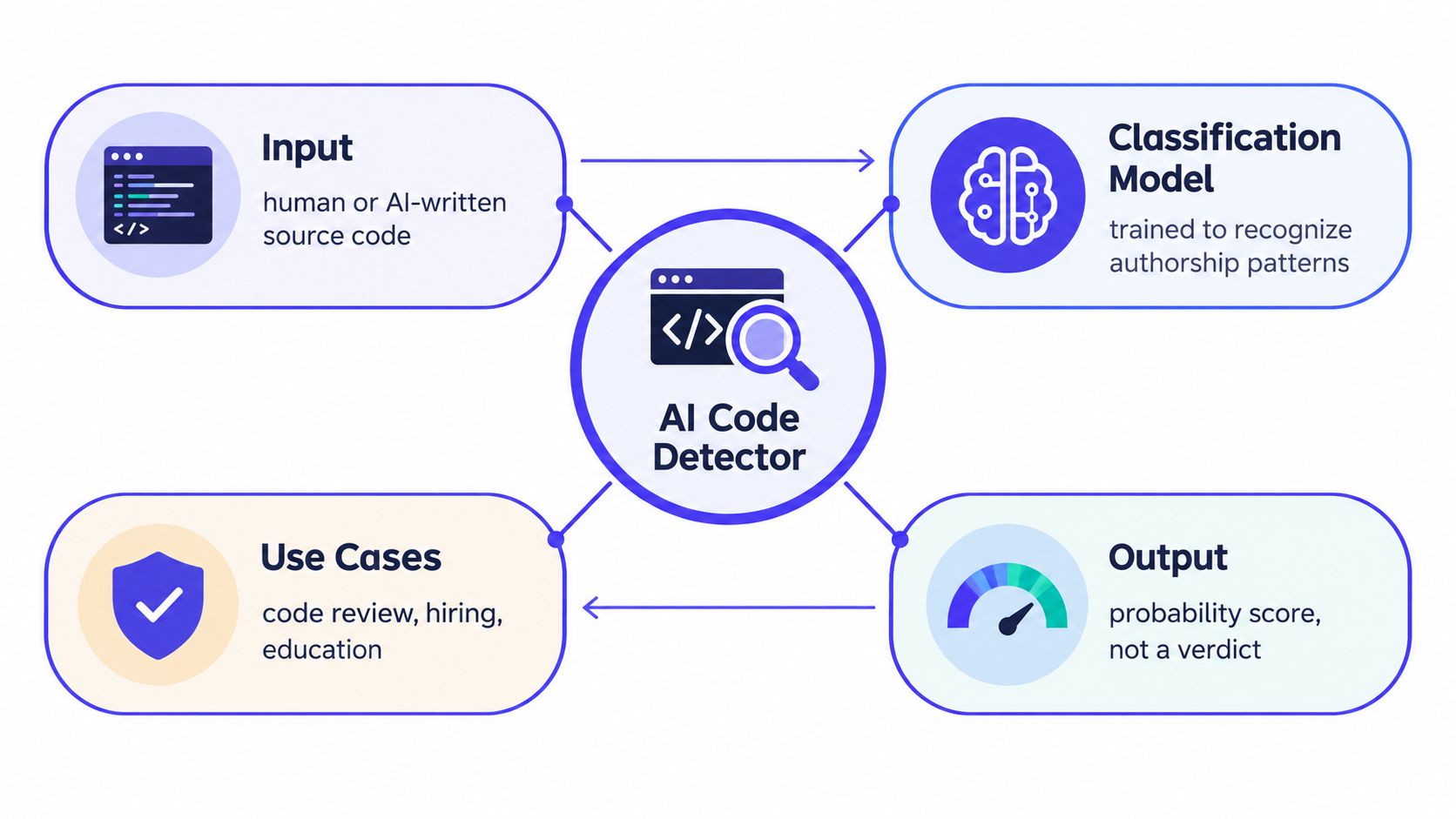
Table of Contents
- What Is an AI Code Detector?
- How Detection Algorithms Analyze Code
- Comparing Detection Methodologies
- Why Detectors Fail on Real-World Code
- How to Interpret Detector Results
- Integrating Detectors into Development Workflows
- Frequently Asked Questions
What Is an AI Code Detector?
An AI code detector is a classifier that estimates whether source code was written by a person, generated by an AI system, or produced by a mix of both. It doesn't “read intent” the way a reviewer does. It looks for patterns that correlate with authorship and turns those patterns into a probability score.
That distinction matters because modern benchmarks can look almost perfect while still hiding weak spots. One large study used 600,000 human-written and AI-generated code samples, and feature-based models reached ROC-AUC 0.995, PR-AUC 0.995, and F1 0.971. Even CodeBERT-based embedding models stayed near that level, with ROC-AUC 0.994, PR-AUC 0.994, and F1 0.965 (benchmark paper). Strong scores like that are real, but they describe controlled datasets, not every repository your team ships.
The hidden tension
The field is benchmark-heavy because detectors have to generalize across languages and models, not just memorize one generator's style. That becomes obvious once code leaves a clean evaluation set and enters a real repo with lint rules, reused helpers, formatting conventions, and human edits.
Practical rule: Treat the detector's output as a signal, not a verdict.
The most useful mental model is simple. An ai code detector is closer to a specialized risk scorer than a judge. It can tell you, “this snippet looks unusual compared with the patterns I've seen,” but it can't prove authorship on its own.
How Detection Algorithms Analyze Code
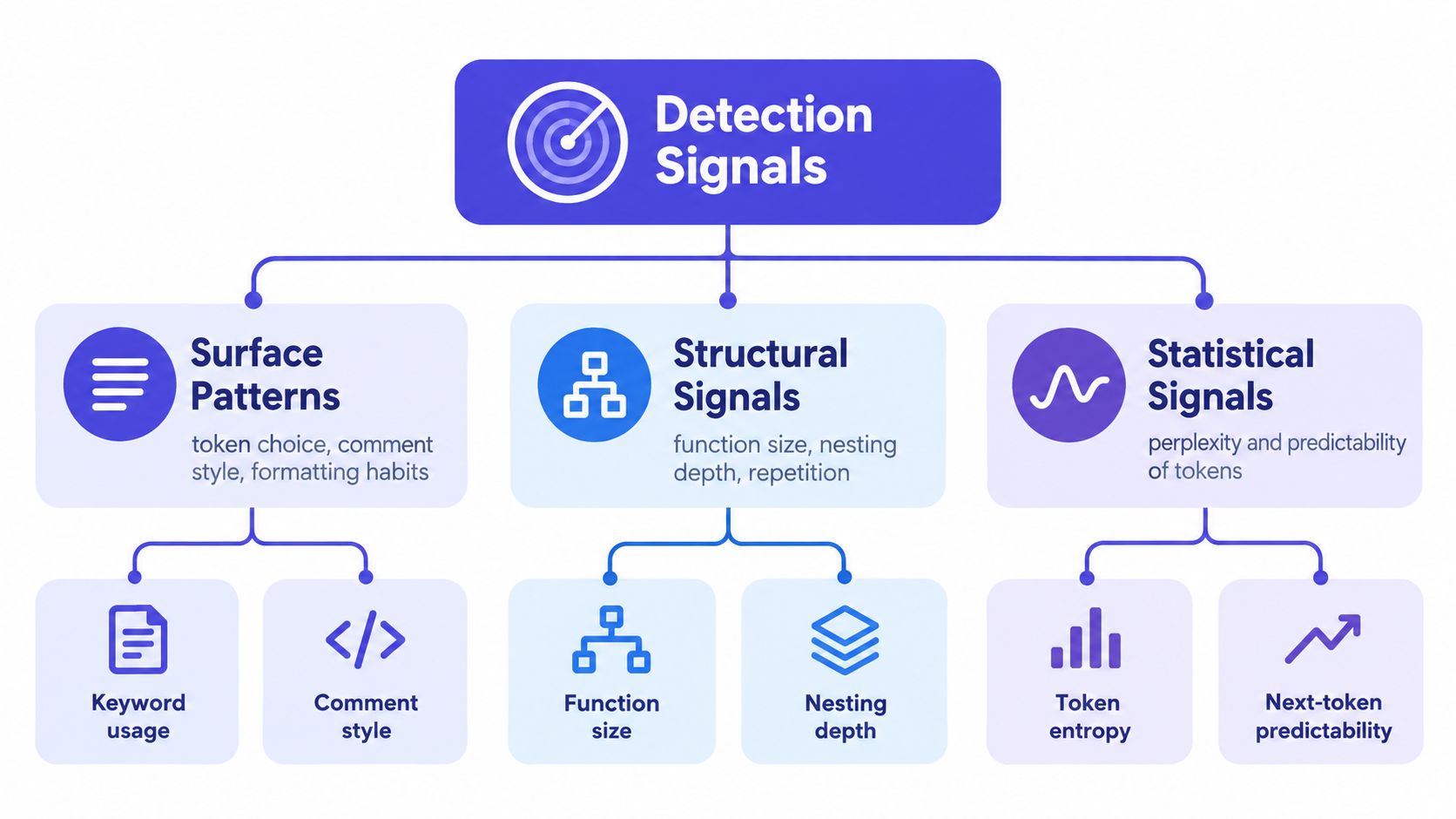
At a high level, detectors read code through three lenses: what it looks like, how it's structured, and how predictable it is. The reason the same snippet can confuse different tools is that each lens weights evidence differently.
Surface patterns
Surface signals are the easiest to miss because they feel too small to matter. Yet the benchmark paper explicitly notes that whitespace and indentation are unusually informative, which tells you a lot about how these systems work (benchmark paper). A detector may notice a consistent indent style, comment tone, import ordering, or formatting habit that resembles the output patterns of a generator.
A human reviewer usually ignores those details unless the code is obviously messy. A detector does the opposite. It treats formatting as evidence, especially when the snippet is too short to reveal deeper structure.
Structural and semantic signals
Structural methods look beyond the text and into the code's shape. That often means AST analysis, where the detector inspects nesting depth, repeated branches, function size, and the overall arrangement of statements. Semantic methods then map code into embeddings, which lets the model compare the meaning and intent of a snippet against known examples.
The key point is that these layers can disagree. A tiny helper with clean indentation may look machine-made on the surface, while a longer generated function can look human once it has been edited heavily. That's why short snippets are tricky, and why a detector's confidence should drop when the evidence is thin.
For readers comparing code-linguistic detection with other fingerprinting work, the broader logic is similar to browser fingerprint detection research, where multiple weak signals become useful only when they're combined carefully.
A detector often behaves like a weighted vote across those clues, not a single yes-or-no rule. That's also why different vendors can disagree on the same file.
Need a language-specific comparison of detection behavior? The patterns get even more interesting in a programming language detector.
Comparing Detection Methodologies
The main methodologies differ less in their goal than in the kind of evidence they trust. Feature-based systems are fast and transparent, embedding-based systems are deeper and more flexible, and hybrid systems try to keep the strengths of both without inheriting all the weaknesses.
| Methodology | How It Works | Accuracy Strengths | Best Use Case |
|---|---|---|---|
| Feature-based detection | Scores token choices, formatting, import patterns, and other surface cues | Works well on clean, structured benchmarks, and can be highly interpretable | Fast triage, simple review queues, and environments where explainability matters |
| Embedding-based detection | Uses learned representations such as CodeBERT-style embeddings to compare code meaning and patterns | Captures richer context and can stay strong on benchmark data, with the benchmark study showing near-perfect results (benchmark paper) | Deeper analysis when you can afford more compute and want less hand-built logic |
| Hybrid detection | Combines surface features with learned representations | Better at balancing shallow cues and deeper context | Production review pipelines that need both speed and nuance |
Feature-based detectors are easier to audit because you can often trace why they flagged a file. Embedding-based systems can be more powerful, but they also hide more of the decision process inside the model. Hybrid approaches are the practical compromise, especially when teams need defensible output instead of raw scores.
If you want a product view of the same tradeoff, the free AI detector market usually exposes the same pattern, one signal path is rarely enough on its own. A nearby analogy is modern code review automation, where a tool may flag a repo because of structure, while another tool notices a formatter pattern that a human wouldn't think twice about.
Decision criterion: Choose the method based on the consequence of being wrong, not just the convenience of the scan.
For teams building or evaluating detection pipelines, an AI code detector should be judged on the kind of code it sees most often, not on a benchmark chart alone.
Why Detectors Fail on Real-World Code
Independent studies make the uncomfortable part clear. Detectors can look excellent on tidy datasets and still fall apart once the code changes language, style, or source distribution. One ACM study found that existing tools often performed poorly, with accuracy frequently below 0.6, and another study on ChatGPT-generated code reported average AUC values of 0.58 and 0.46, with false-positive and false-negative rates as high as 0.32 and 0.66 (ACM study).
Short and boilerplate-heavy snippets are the worst case
The hardest files to classify are often the least interesting ones. Short snippets, boilerplate, and partial edits leave too little evidence for any model to trust itself. A recent benchmark summary notes that text-only classifiers missed Copilot-generated code more than 60% of the time in one evaluation, and that short AI snippets can be indistinguishable from human code in practice (Codequiry benchmark summary).
That failure mode makes intuitive sense. If a snippet is mostly common scaffolding, the detector sees generic code patterns instead of authorship clues. If a human edited the AI output, the signal gets even noisier.
Real repositories are messy by design
Real projects include shared utilities, copied patterns, generated files, and style rules that make human code look machine-like. The empirical chapter on educational use goes further and calls current tools unreliable for educational use (Springer chapter). That warning matters because the consequence of a wrong call can be serious, from academic discipline to hiring decisions.
The safest interpretation is conditional. A detector may be useful for flagging a file that deserves review, but it's a weak foundation for punishment, rejection, or automated escalation. The code itself has to be inspected.
How to Interpret Detector Results
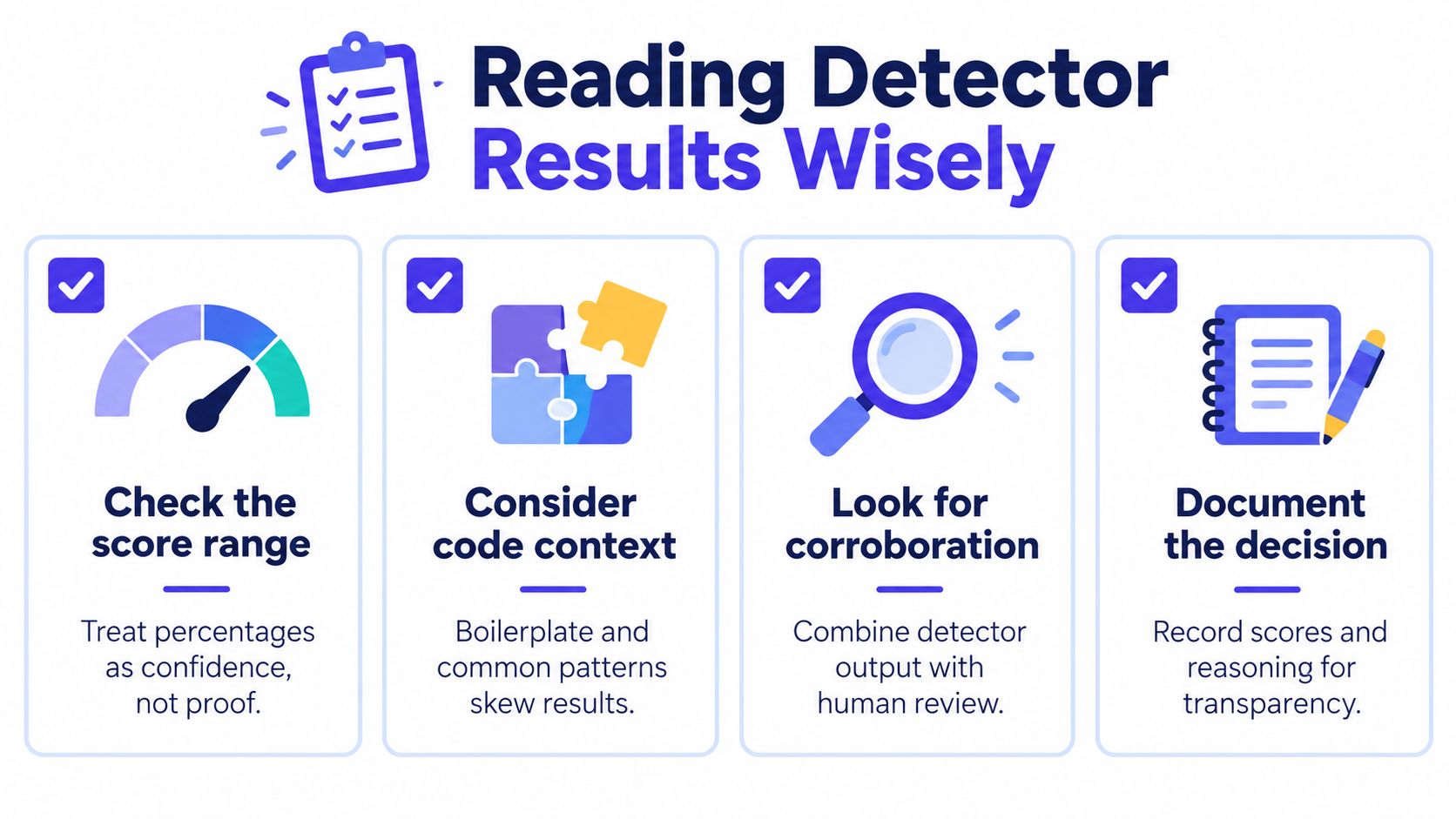
A score is only useful if you know what decision it supports. A high probability might justify a closer review, while a middling score may tell you the model doesn't have enough evidence to be confident either way.
Read the score as confidence
Percentages and probability labels should be treated as confidence, not proof. The same file can produce different results depending on the tool, the training data, and the code context. That's why a score should never be read in isolation.
The how scores work explanation is useful here because it reinforces the right mindset, the number is a guide to scrutiny, not a final answer. In practice, the right question is, “What level of uncertainty is acceptable for this decision?”
Use a short checklist
- Check the surrounding code: Boilerplate and common helper patterns can distort the result.
- Inspect the flagged section manually: Look at imports, formatting, and repeated structures before drawing conclusions.
- Look for corroboration: Combine the detector output with review notes, commit history, or other signals.
- Record the reasoning: Document the score, the context, and why the final decision was made.
Practical rule: If the consequence is serious, the detector can't be the only reviewer.
For teams mapping this into a broader workflow, a practical AI development roadmap helps frame where automated checks belong and where human judgment has to stay in control. The same applies in code review, where a suspicious result should trigger a second look, not an automatic outcome.
A good detector workflow doesn't eliminate ambiguity. It makes ambiguity visible early enough for a person to handle it carefully.
Integrating Detectors into Development Workflows
The right place for an ai code detector is inside a workflow, not above it. In code review, it should flag suspicious files for deeper inspection. In hiring, it can help surface claims that deserve verification, but it can't prove who wrote a take-home task. In education, it should support discussion about authorship and process, not replace instructor judgment.
The strongest pattern is human-in-the-loop validation. A reviewer sees the score, checks the code, and asks whether the result fits the surrounding context. That approach reduces the chance that a detector becomes a blunt instrument.
GitHub's code scanning now shows AI-powered detections directly on pull requests, and those findings are informational rather than merge-blocking, which is a useful design cue for the broader industry. It reflects the right operating model, the detector contributes evidence, but the team owns the decision.
For teams that want a practical tool in this space, AI Website Detector scans websites and returns an AI probability score with the detected signals, which makes it a relevant example of explainable detection in a different domain. The common principle still holds, use the output to focus attention, not to skip judgment.
A good policy is simple:
- flag first,
- review second,
- decide last.
That sequence keeps false positives from turning into bad process. It also gives teams a defensible record when they need to explain why they trusted, or didn't trust, a result.
Frequently Asked Questions
Can an ai code detector prove authorship? No. It can estimate how similar a snippet is to known human or machine-generated patterns, but it can't prove who wrote it. That's why the best tools return probability, not certainty.
Why do short snippets confuse detectors so much? Short code often lacks enough signal. If a snippet is mostly boilerplate, the detector has little to separate common human code from AI output, so confidence drops.
Are embedding-based models always better than feature-based ones? Not always. Embedding-based models can capture deeper meaning, but feature-based approaches can be easier to explain and can still perform very strongly on benchmark data (benchmark paper). The right choice depends on the code you review and the consequence of a false call.
What should teams trust most? Trust the combination of signals, the surrounding context, and a human review. The field is moving toward multi-signal methods because no single method holds up reliably across languages, code lengths, and mixed edits.
If you want to see how explainable detection feels in practice, visit AI Website Detector and compare how its probability score, confidence notes, and detected signals turn a black box into something you can review. It's a useful way to think about AI detection as evidence gathering, not guesswork.