What Is a Directory Site: From Curated Listings
A directory site is an organized, categorized listing of websites, businesses, or resources that helps users discover and browse content through structured categories rather than automated search algorithms. Recent directory-market commentary claims that roughly 12,000 active web directories exist, which suggests the model has evolved rather than disappeared.
The popular advice says directories are outdated versions of the Yellow Pages. That description misses what makes a modern directory useful. A strong directory doesn't merely collect links. It applies a clear classification system, maintains useful information, helps visitors compare options, and creates a trusted path between a specific audience and relevant resources.
The difference matters in 2026, when people may discover a business through search, an AI recommendation, a review platform, or a highly focused directory. The directory model still works when it solves a narrower discovery problem better than a general search engine can.
Table of Contents
- Understanding What a Directory Site Actually Is
- The History and Evolution of Directory Sites
- Types of Directory Sites That Exist Today
- How Directory Sites Make Money
- SEO Implications of Directory Sites
- Real-World Examples of Successful Directory Sites
- Frequently Asked Questions About Directory Sites
- Getting Started Building Your Own Directory Site
Understanding What a Directory Site Actually Is
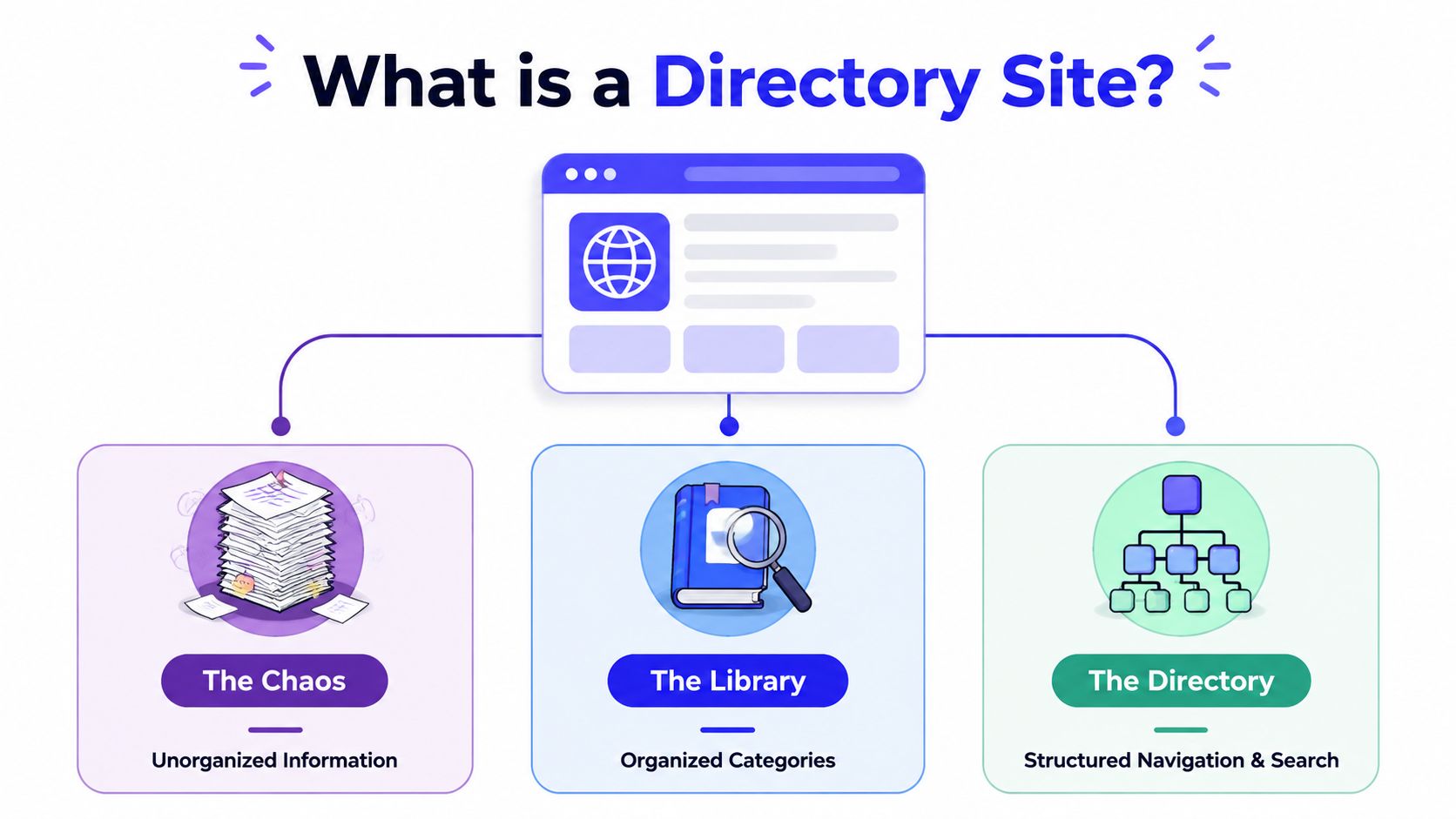
Walking into a huge library without a catalog creates an immediate problem. The books may be valuable, but finding the right one becomes slow and frustrating. A directory acts like the library's guide, grouping information into shelves, subjects, and subcategories so visitors can browse with a purpose.
A directory site is an online catalog of websites, businesses, or other web resources organized into categories and subcategories. Visitors can browse that classification system instead of relying only on keywords. Seobility's explanation of web directories also distinguishes directories from fully automated search indexes because directories may be assembled or reviewed by editors.
Directory versus search engine
A search engine generally discovers pages through automated crawling and retrieves results in response to a query. A directory begins with a taxonomy. Someone creates categories such as “Restaurants,” “Web Design,” or “Environmental Services,” then places entries inside the most relevant branches.
That changes the visitor's behavior. A person searching for “Italian restaurants in a city” may use a search engine, while someone exploring a local food directory can browse cuisine, neighborhood, dietary options, and service type. The first experience starts with a phrase. The second starts with an organized map.
Directory versus an ordinary website
A blog publishes posts. An online store presents products and supports buying. A directory's central purpose is different: it helps people find and evaluate multiple external listings or resources.
For example, an app-based portal directory from NZ Apps organizes resources so visitors can browse a collection rather than read a single publisher's article. A directory can include descriptions, categories, contact details, filters, reviews, or submission forms, but the defining feature remains structured discovery.
The same principle helps when assessing a website's origin and technology. A tool such as the website authenticity checker can help researchers examine how a site was built, while the directory itself organizes what visitors can find.
Practical rule: If removing the listings would remove the site's primary purpose, you're probably looking at a directory. If the listings merely support articles, products, or transactions, the site may be a content hub, store, or marketplace instead.
The History and Evolution of Directory Sites
The directory model started before the web. In the United States, Reuben H. Donnelley produced the first official Yellow Pages directory in 1886, establishing an information structure based on business categories and locations. A reader could turn to a relevant section rather than search through an undifferentiated list of names.
The web adapted that same logic during the mid-1990s. Yahoo's directory began in 1994 as “Jerry and David's Guide to the World Wide Web.” It organized websites into a browsable hierarchy at a time when the internet lacked the mature search infrastructure people now take for granted. By the late 1990s, Yahoo reportedly charged commercial websites a $299 submission fee, showing that directory inclusion had already become a commercial service. These historical details are documented in the history of Yahoo Directory.
DMOZ, also known as the Open Directory Project, launched in 1998 and became the best-known human-edited directory model. At its peak, it grew to more than 5 million listings, with roughly 90,000 volunteer editors working across more than 1,000 topic categories. That scale reveals an important point: early directories weren't simple pages of links. They were large editorial systems that classified the web through human judgment.
Why the old model changed
Search engines eventually made keyword-based discovery faster and more thorough for many tasks. A user no longer needed to understand a directory's category structure before finding a page. Automated indexing shifted the center of web discovery away from curated hierarchies.
Yahoo announced that it would close the directory on September 26, 2014, and the service shut down on December 31, 2014. The closure ended one of the web's most influential broad directories, but it didn't eliminate the underlying need for organized discovery.
Modern directories have narrowed their focus. Instead of attempting to classify the entire web, they often concentrate on a location, profession, industry, audience, or emerging technology. That specialization gives them a clearer reason to exist.
Types of Directory Sites That Exist Today
A local directory answers the question, “Who serves this place?” A niche directory answers, “Who belongs to this interest or subject?” A vertical directory answers, “Which providers understand this industry?” The interfaces may look similar, but the audience and information requirements differ.
| Type | Focus | Example Audience | Common Revenue Model |
|---|---|---|---|
| Local directory | Businesses in a defined location | Residents, visitors, and local buyers | Featured listings, subscriptions, advertising |
| Niche directory | A focused interest, community, or topic | People seeking specialized resources | Paid inclusion, sponsorships, premium profiles |
| Vertical directory | A particular professional or commercial sector | Buyers who need industry-specific providers | Lead fees, subscriptions, featured placement |
Local directories
Local directories organize businesses by geography and service. A visitor might browse restaurants, hotels, tradespeople, clinics, or retailers in a specific area. The useful details often include location, opening hours, contact information, service categories, and customer feedback.
A telephone directory such as this resource for finding business contacts in Mauritius illustrates the geographic discovery model. The visitor isn't trying to explore the entire web. They're trying to identify relevant contacts in a particular market.
Niche directories
Niche directories serve a defined interest. Examples include directories for AI tools, independent publishers, sustainable brands, freelance writers, or specialist software. Their advantage comes from focus. A visitor expects the entries to meet a shared relevance standard.
Recent directory-market commentary claims that AI-specific directories have grown 340% since 2023 (Backlynk's directory statistics commentary). The underlying opportunity is easy to understand qualitatively: people need help distinguishing and comparing an expanding range of AI products.
Vertical directories
Vertical directories go deeper than broad business listings. A healthcare directory might organize providers by specialty, treatment, insurance, and location. A legal directory may distinguish practice areas, jurisdictions, and client needs. A real estate directory can include property type, neighborhood, amenities, and agent information.
The right model depends on the problem. Local directories win through geographic relevance, niche directories through curation, and vertical directories through specialized data.
How Directory Sites Make Money
A directory earns from the connection it creates between an audience and the organizations, professionals, or products listed there. The visitor gets a useful way to compare options. The operator charges for added exposure, ongoing tools, access to information, or completed transactions.
A free basic profile can attract broad participation. A restaurant might receive a standard page, while a paid profile receives stronger placement, more images, or additional calls to action. Paid placement should remain clearly labeled, and it must appear in relevant categories. Otherwise, the directory starts to resemble a shop selling shelf space rather than a trusted guide.
Subscriptions make revenue more predictable. Businesses may pay for profile management, analytics, lead tools, review controls, or category access. A membership directory can charge users for restricted information, professional resources, or advanced search features.
Common revenue choices
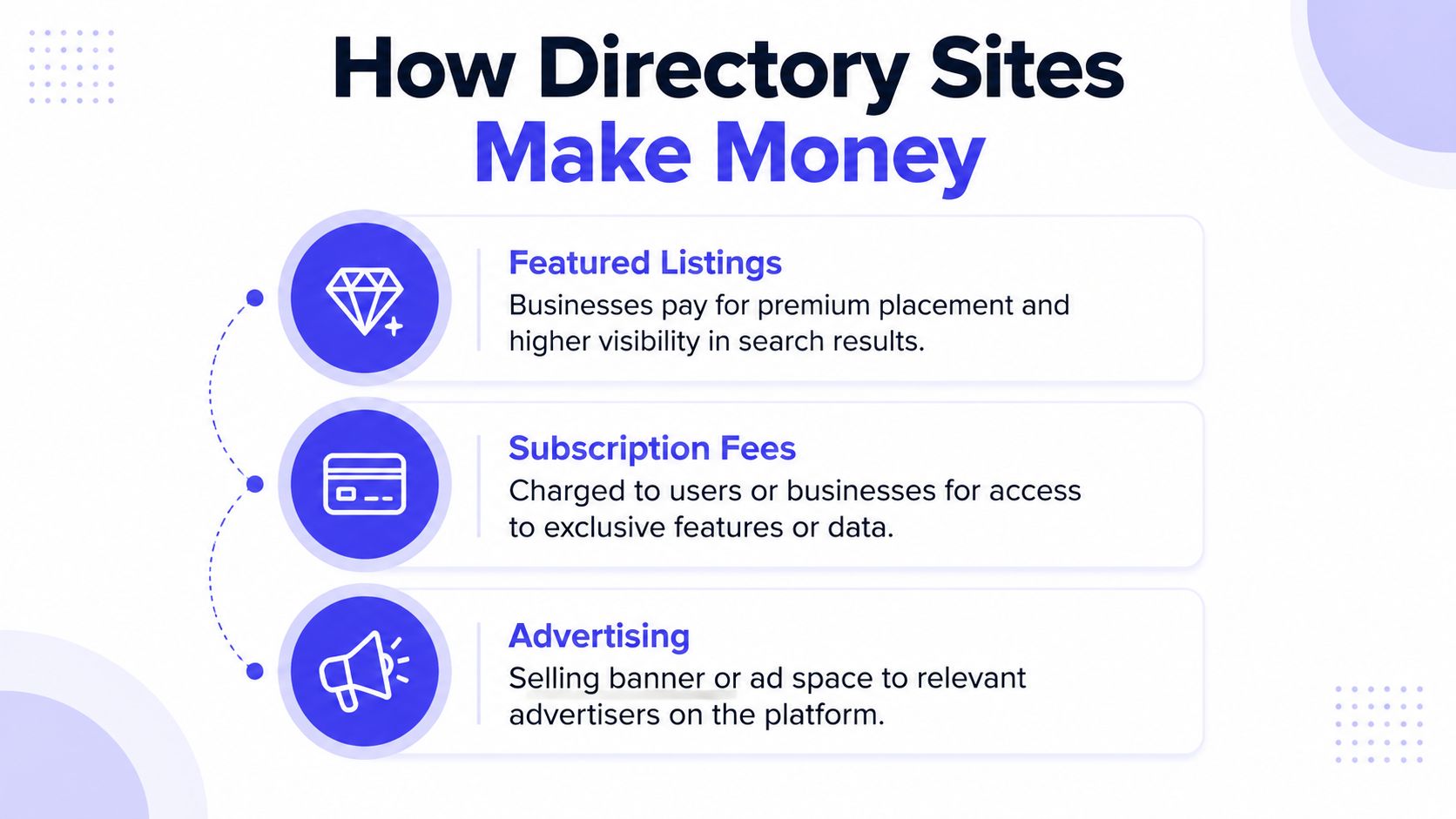
- Featured listings: Businesses pay for premium placement and greater visibility within relevant categories.
- Subscription fees: Users or businesses pay for continuing access to enhanced tools, data, or profile features.
- Advertising: The operator sells banner placements or sponsored space to advertisers that fit the directory's audience.
- Freemium profiles: Basic listings stay free, while galleries, lead generation, or review management require payment.
- Transaction commissions: The directory receives a fee when visitors book, buy, or submit a qualified request through the platform.
Each choice changes what the product must deliver. Advertising depends on audience volume and attention. Subscriptions depend on recurring value. Lead generation depends on accurate contact details and a clear handoff. Transaction models depend on a reliable booking or payment process.
A directory should earn trust before charging for visibility. Clean categories, current listings, useful filters, and transparent labels give visitors a reason to return. Those foundations also separate a working directory from a thin collection of links.
SEO Implications of Directory Sites
Directory pages can shape a site's architecture because they create category paths, listing pages, filters, and internal links. A well-designed structure lets visitors and search systems move from broad topics to specific entries without getting trapped in confusing parameter variations.
Google explains that sitemaps can help it learn about new or updated pages, but they don't guarantee indexing. Search Console also supports sitemap submission and individual URL requests. For a public directory, that makes clean crawl paths and meaningful internal links important. A private server-side directory listing that shouldn't appear publicly should be disabled or marked noindex, as outlined in Google's crawling and indexing documentation.
What makes a listing useful for SEO
Directory value often depends on legitimacy signals. Relevant backlinks, consistent business name, address, and phone details, commonly called NAP, and broad local citation coverage can support local visibility. Independent SEO summaries report that quality directory listings can improve local visibility and rankings, although outcomes vary by source and methodology, as discussed in this directory submission analysis.
That doesn't make every directory beneficial. A page with copied descriptions, broken links, irrelevant categories, and no editorial standards provides little value to users. Search engines and visitors both have reasons to distrust it.
Use a website SEO audit guide when reviewing the technical structure, but also inspect the human experience. Can someone find the right category? Does each profile contain original, current information? Are sponsored placements disclosed? A directory earns stronger signals by being useful, not by creating more listing URLs.
Real-World Examples of Successful Directory Sites
Successful directory sites do more than collect links. They organize choices around a specific decision, then add context that helps visitors judge those choices. TripAdvisor demonstrates this model clearly. It groups hotels, restaurants, and attractions, while reviews, photos, location details, and comparison tools help travelers move from broad discovery to a considered choice.

Product Hunt applies the same underlying structure to products and startups. Categories, launches, listings, and community responses turn a large collection of new products into a browsable discovery system. The editorial and participation layers give visitors a reason to return instead of searching for each product name separately.
GitHub shows how directory behavior can support technical work. Developers browse repositories through language, topic, and popularity labels, which make a large resource base easier to explore. Here, the directory functions as a navigation layer rather than a local business index.
Across these platforms, several decisions create lasting utility:
- Defined audience: Each site serves a recognizable discovery need.
- Structured classification: Categories and labels narrow the available choices.
- Useful profile data: Listings include meaningful details, not only a name and link.
- Participation: Reviews, votes, submissions, or repository activity add context.
- Repeat utility: Changing information gives visitors a reason to return.
A smaller local business directory follows the same logic. Accurate listings, clear categories, consistent contact details, and useful profiles help visitors make progress. The operator's job is to organize information around a real task, not just publish more pages.
Directory SEO also depends on trust signals, including authoritative backlinks, consistent NAP details, and local citation coverage. Quality listings may support local visibility and rankings, although reported results vary by source and methodology. A directory earns value through usefulness, maintenance, and clear organization.
The following video provides another visual explanation of directory-based discovery and organized listings.
Frequently Asked Questions About Directory Sites
Are directory sites still viable in 2026?
They can be, especially when they focus on a defined audience and provide information that general search doesn't organize well. Recent market commentary claims roughly 12,000 active web directories and says about 27% require paid listings, while 15% churn out each year (the referenced directory-market commentary). Those figures point to specialization and monetization, not automatic success.
What's the difference between a directory and a thin link list?
A true directory classifies entries, applies a clear inclusion logic, and helps visitors evaluate what they find. A thin link list places URLs on a page, often without meaningful descriptions, review, maintenance, or category depth.
A citation page may exist mainly to confirm a business name and address. A review marketplace adds ratings, user-generated content, and sometimes bookings or transactions. A directory can evolve into one of these models, but its core identity changes when listings become secondary to reviews, transactions, or editorial content. This distinction is often overlooked in basic directory website explanations.
How long does a directory take to gain traction?
There isn't a universal timeline. Progress depends on the niche, the quality of submissions, the frequency of updates, the usefulness of the categories, and the operator's ability to attract both visitors and listing owners.
What makes a directory valuable?
Curation, data quality, and usability. Remove dead entries, prevent irrelevant submissions, explain categories clearly, and make profiles useful on mobile devices. A smaller, trustworthy collection can serve visitors better than an enormous unmaintained database.
Getting Started Building Your Own Directory Site
Start with the audience and taxonomy, not the software. Decide who will use the directory, what they're trying to find, which fields matter, and how you'll review or update entries.
WordPress offers a flexible foundation for this type of project because it supports directory-specific plugins and a wide range of design options. You can use Namecheap for domain registration, then choose hosting such as Kinsta or SiteGround based on your operational needs.
For the application layer, Jetpack can support performance and security tasks, WooCommerce Marketplace can help add commerce capabilities, and WP Job Manager fits directories involving job listings or applications. Elementor provides drag-and-drop page design, while Rank Math supports on-page SEO workflows. The 2026 guide to choosing a website builder can help you compare WordPress with other approaches before committing.
Keep the first version narrow. Launch with a useful category structure, verify the initial listings, and measure whether visitors can find what they need before adding memberships, reviews, or paid placement.
AI Website Detector helps you investigate the technology behind websites, including AI builders, CMS platforms, hosting providers, plugins, themes, and frameworks. Visit AI Website Detector to scan a directory or competing site and review the detected signals behind its technology profile.