Enterprise Data Marketplace: A Complete Business Guide
An enterprise data marketplace is a governed data-product delivery layer, not a searchable catalog, combining discovery, access control, licensing, quality evidence, and consumption workflows. The category was valued at approximately USD 1.5 billion in 2024 and is projected to reach USD 5.7 billion by 2030, with a projected 25.2% compound annual growth rate from 2025 through 2030 (MarketIntelo's market estimate).
That growth matters because many organizations already have plenty of data. Their problem is finding information that people can trust, understand, access lawfully, and use without a chain of emails, tickets, and technical workarounds. A marketplace addresses that problem by treating data as a managed product with an owner, description, quality evidence, usage terms, an access path, and an operating commitment.
The distinction is practical. A catalog can tell you that a table exists. A working marketplace helps you decide whether the table is suitable for a business question, request it under explicit policies, receive it through an approved interface, and report whether the product continues to meet expectations.
Table of Contents
- Why Enterprises Are Building Data Marketplaces
- What an Enterprise Data Marketplace Actually Is
- Core Components and Architecture Explained
- Governance and Compliance Without the Bottleneck
- How SourceX Can Help
- Implementation Roadmap and Integration Patterns
- Measuring Value and ROI Beyond Dataset Counts
- Common Pitfalls, Vendor Selection, and Real-World Examples
- Your Next Steps Toward a Working Marketplace
Why Enterprises Are Building Data Marketplaces
Data is usually abundant inside an enterprise, while trusted, reusable data is difficult to locate. A marketing analyst may find customer information in the CRM, support platform, billing system, and warehouse, yet still lack a reliable answer to a basic question: which source should support the campaign? The analyst also needs to know how current the data is, who owns it, whether its use is permitted, and what each field means.
An enterprise data marketplace gives these decisions a consistent home. It presents data products with business descriptions, technical metadata, ownership, access rules, quality indicators, and consumption instructions. The user is evaluating a managed offering, rather than scanning a list of tables and opening another support ticket.
Market momentum signals a change in role
The category has moved beyond the idea of an experimental portal. One market estimate also places the broader platform market at USD 1.9 billion in 2026 (MarketIntelo's analysis). Projections are not guarantees, but they show how marketplaces are being positioned as infrastructure for data procurement and reuse.
Large enterprises generated nearly 57% of market revenue in 2024, according to Grand View Research's data marketplace assessment. The concentration is understandable. Organizations with extensive data estates often already have governance teams, identity systems, compliance processes, and many internal consumers that can support a formal exchange layer.
The market also includes smaller organizations. North America accounted for more than 41.6% of global data-marketplace-platform revenue in 2024, while the SME segment was estimated at USD 628.7 million globally in the same year and projected to reach USD 2.5 billion by 2030. A marketplace can help these organizations access curated external data without building a complete sourcing and licensing operation themselves.
Practical rule: Treat the marketplace as an operating service for data products rather than a redesigned catalog front end.
That operating model requires clear product definitions, named responsibility, automated controls, and access instructions that a non-technical employee can follow. It also requires measures beyond published dataset counts. Teams need to see whether people can independently evaluate and obtain a product, whether it is used after publication, and which owner is accountable when quality or access falls short.
A working marketplace therefore connects discovery with decisions and outcomes. A catalog entry may attract a search. A governed product must help a user choose confidently, gain approved access, and demonstrate value after consumption. Without those capabilities, the platform risks becoming a catalog graveyard with a more attractive interface.
What an Enterprise Data Marketplace Actually Is
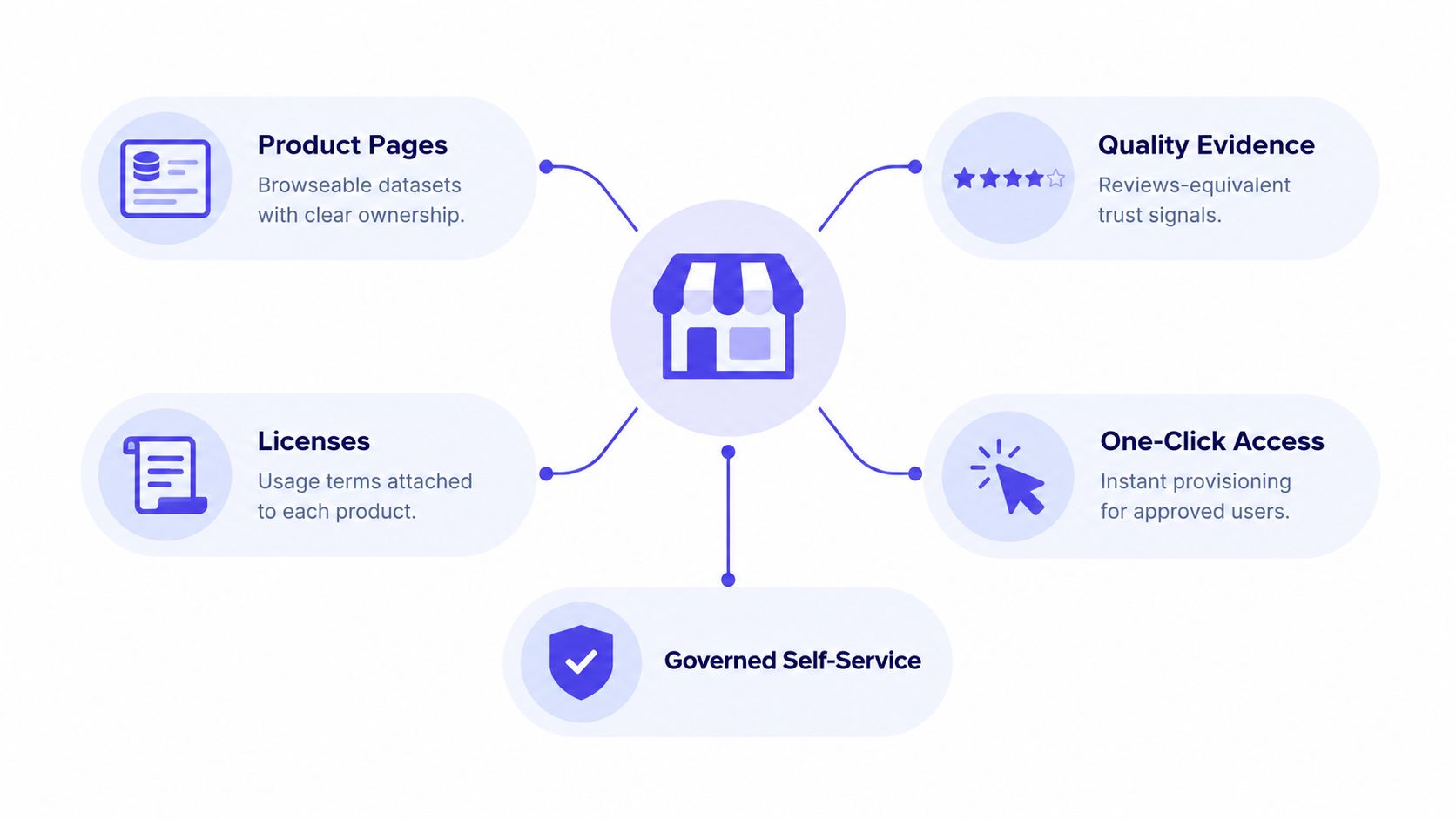
The simplest analogy is an app store for governed data. An app store gives users product pages, descriptions, compatibility details, permissions, payment terms, and a controlled installation path. An enterprise data marketplace applies the same product logic to datasets, APIs, streams, models, dashboards, and other data services.
A product page might explain that a customer-retention dataset contains account activity, support interactions, and subscription status. It should also identify the owner, define terms such as “active customer,” show freshness and quality evidence, state permitted uses, and explain how an approved consumer can connect.
An enterprise data marketplace is a governed data-product delivery layer that combines discovery, access control, licensing, quality evidence, and consumption workflows.
A data catalog primarily helps people find and describe assets. A marketplace adds the transaction and operating layer around those assets. It can support evaluation, request handling, licensing, provisioning, monitoring, usage tracking, and retirement. The catalog answers “What exists?” The marketplace must also answer “Can I use it for this purpose, under what conditions, and how do I consume it?”
Why data products change the conversation
A raw dataset is an asset. A data product is an asset prepared for a defined consumer need.
Product thinking forces the producer to make commitments:
- Purpose: Which decision, workflow, or application does the product support?
- Ownership: Who understands the domain and answers questions about meaning?
- Quality: Which checks demonstrate that the data remains fit for use?
- Interface: Will consumers use a query, file delivery, stream, dashboard, or API?
- Change management: How will schema changes and deprecation be communicated?
- Support: What happens when freshness, completeness, or availability falls below expectation?
That structure creates a supply-and-demand relationship. Producers publish something intended for reuse, while consumers can compare products and select the one that fits their work.
Large enterprises often extract value by connecting internal domains that have historically operated as separate repositories. A finance team might publish a governed revenue product, while sales, planning, and risk teams consume it under the same definitions. Smaller firms can use the model to obtain external datasets through standardized delivery and licensing rather than negotiating every source from scratch.
A marketplace succeeds when the user can move from business question to trusted consumption with little ambiguity. If the experience ends at search results, the organization has a catalog with marketplace branding.
Core Components and Architecture Explained
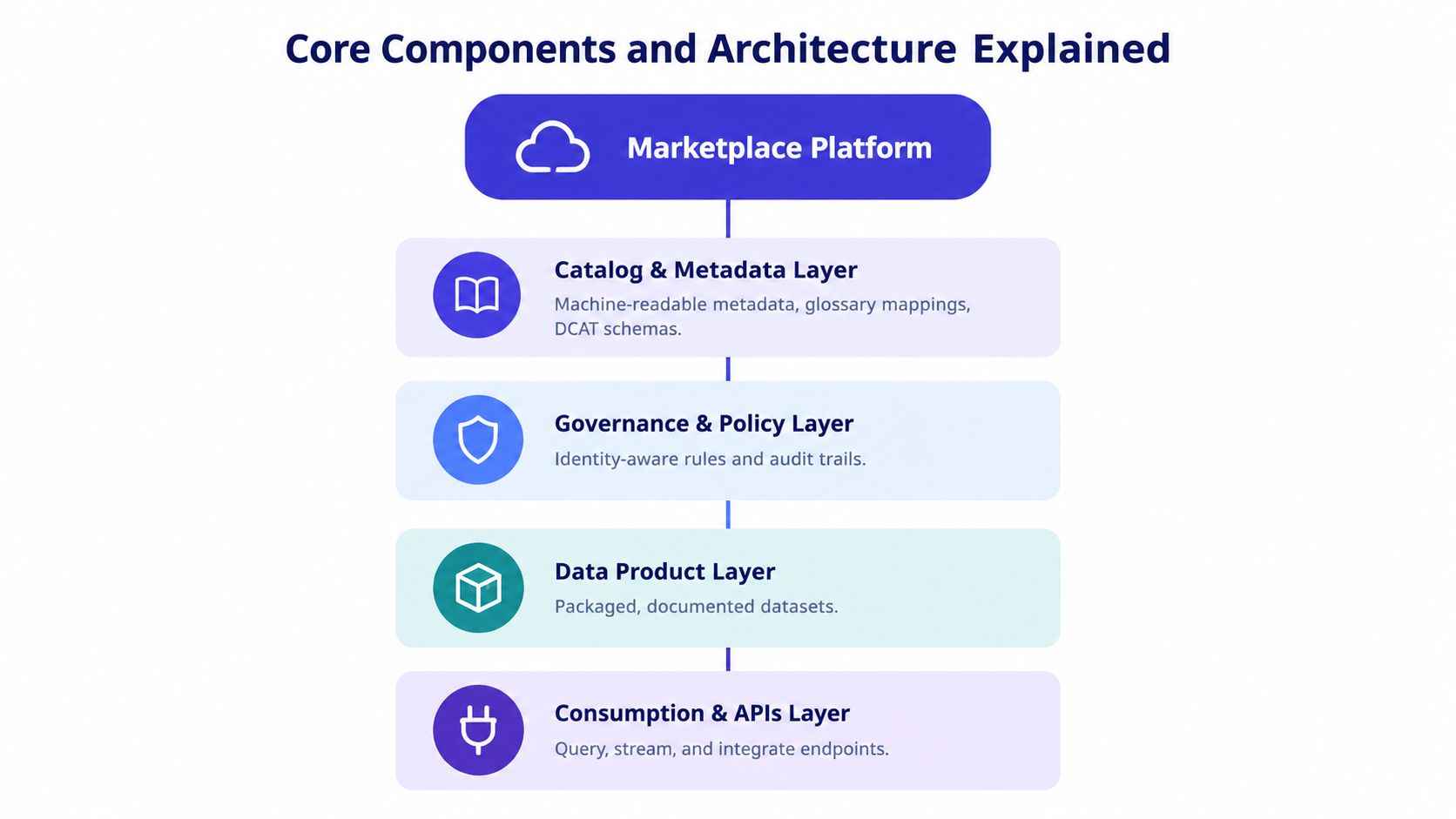
A marketplace is a chain of connected controls. Each layer should remove a specific source of friction between discovery and use.
Metadata makes evaluation possible
The catalog and metadata layer needs more than column names. It should combine machine-readable metadata, business glossary mappings, ownership, source information, freshness, classification, sample usage, and relationships to other products.
Business glossary mappings translate technical fields into terms a finance manager or analyst can understand. Standards such as DCAT can improve cross-domain discoverability and interoperability, particularly when different teams publish products through different systems. Federated metadata can preserve local domain context while still allowing enterprise-wide search.
The effect is direct: better metadata reduces the time a consumer spends guessing what a dataset means and whether it is relevant.
Policy connects identity to access
The governance layer determines who can access which product, for what purpose, under which conditions. Identity-aware authorization can use a person's role, business unit, location, project, or declared use case rather than applying one broad permission to everyone.
A practical marketplace should record approvals, denials, policy decisions, and changes to access. It should also enforce restrictions such as sensitive-data handling, retention requirements, partner limitations, and licensing terms.
Contracts turn datasets into services
The data-product layer packages the asset with a schema, definitions, data contract, quality expectations, lineage, and service-level commitments. A contract might specify required fields, acceptable freshness, validation rules, supported formats, and the contact responsible for incidents.
Lineage explains where the product came from and which downstream products depend on it. Schema contracts protect consumers from silent breaking changes. Together, they turn an undocumented table into a service that can be operated and improved.
Consumption needs more than a download button
Consumers may need SQL access, a governed file export, a stream, an embedded dashboard, or an API. The consumption layer should expose the appropriate interface while preserving authorization and usage monitoring.
Usage monitoring shows which products are active, which queries fail, which consumers encounter policy denials, and which products cost more to operate than their use justifies. Some organizations also add internal billing or chargeback so that the cost of storage, processing, support, or external licensing is visible to the teams creating demand.
In a data-mesh design, domain teams own and publish data products, a shared self-service platform standardizes publication, and federated governance enforces enterprise requirements. Producers remain accountable for domain semantics and service quality. Platform automation handles registration, authorization, validation, observability, and policy checks.
For teams evaluating supporting infrastructure, distributed-system design concerns can be useful context. A practical overview of building a distributed system can help stakeholders understand why reliability, interfaces, and failure handling matter beyond the marketplace user interface.
Governance and Compliance Without the Bottleneck
Governance becomes a bottleneck when every request requires a specialist to interpret policy manually. A better design turns common rules into automated decisions and reserves human review for ambiguous or high-risk cases.
The marketplace should classify data, evaluate the requesting identity, check the declared purpose, verify required approvals, and record the result. Automated validation can run before access is granted, while policy-denial logs and lineage provide evidence for later investigation.

Divide responsibility clearly
A federated model works only when people know which decisions belong to them.
- Data producers define domain meaning, acceptable quality, supported use cases, and escalation contacts.
- Data stewards help maintain definitions, classifications, and policy alignment.
- Security and privacy teams set controls for sensitive information, identity, retention, and approved environments.
- The platform team automates registration, authorization, validation, observability, and audit evidence.
- Consumers use products within the stated terms and report defects or changes in their decision needs.
This division prevents the central governance team from becoming the owner of every domain's semantics. It also prevents domain teams from publishing data without the controls needed for safe reuse.
A governed workflow should make the permitted path easier than informal sharing. The user sees usage restrictions, requests access through a defined process, receives a policy decision, and consumes the product through an approved interface. Auditors can inspect the same chain later.
Compliance evidence should be operational
Useful evidence includes data lineage, access history, policy decisions, licensing terms, validation results, version history, and records of remediation. The evidence shouldn't live in a separate folder that someone assembles months after an incident. It should be generated as the product is published and consumed.
Privacy requirements may also change the product itself. A marketplace might expose masked fields, aggregate measures, or a deidentified version rather than the underlying records. The product page must explain that limitation so consumers don't mistake a restricted product for a complete source.
Governance can still slow a request when the proposed use is novel or the risk is high. That's appropriate. The goal isn't to approve everything instantly. The goal is to make routine access predictable, auditable, and safe.
A governed marketplace is faster than ad-hoc sharing because the decision path is explicit. It reduces repeated interpretation, prevents inconsistent exceptions, and gives producers a visible way to manage their obligations.
The following video offers additional visual context for how secure data handling can be represented in a governed workflow.
How SourceX Can Help
SourceX is a different kind of transaction layer. It helps companies license operational datasets to AI labs and other data buyers while keeping the supplier in control of sourcing, rights validation, preparation, contracting, delivery, and payment.
That focus matters when an enterprise has useful records but lacks a repeatable way to determine whether they can be licensed. SourceX can begin with a fit assessment without requiring uploads, then create a private inventory that maps datasets by source, depth, fields, and availability. The inventory can work with exports from systems such as Zendesk, Salesforce, GitHub, Jira, SharePoint, and Google Workspace.
Where the service fits
SourceX addresses several problems that a general internal marketplace may not solve:
- Rights uncertainty: It reviews provenance and documents supplier permissions and intended use before presenting data to buyers.
- Privacy preparation: It applies dataset-specific deidentification, removes personal details, and records the preparation steps.
- Deal complexity: It supports pricing, selection periods, exclusivity windows, contracting, invoicing, packaging, and delivery coordination.
- Buyer matching: It connects qualified enterprise records with AI labs and other data buyers evaluating operational data for model training.
- Evidence requirements: It assembles an evidence packet covering the system of origin, licensing rights, defined purpose, and usage constraints.
Suppliers retain ownership of their original data, while agreements define rights in prepared datasets and permitted uses. Nothing is shared until the supplier explicitly authorizes the release, and the signed agreement contains the scope and restrictions.
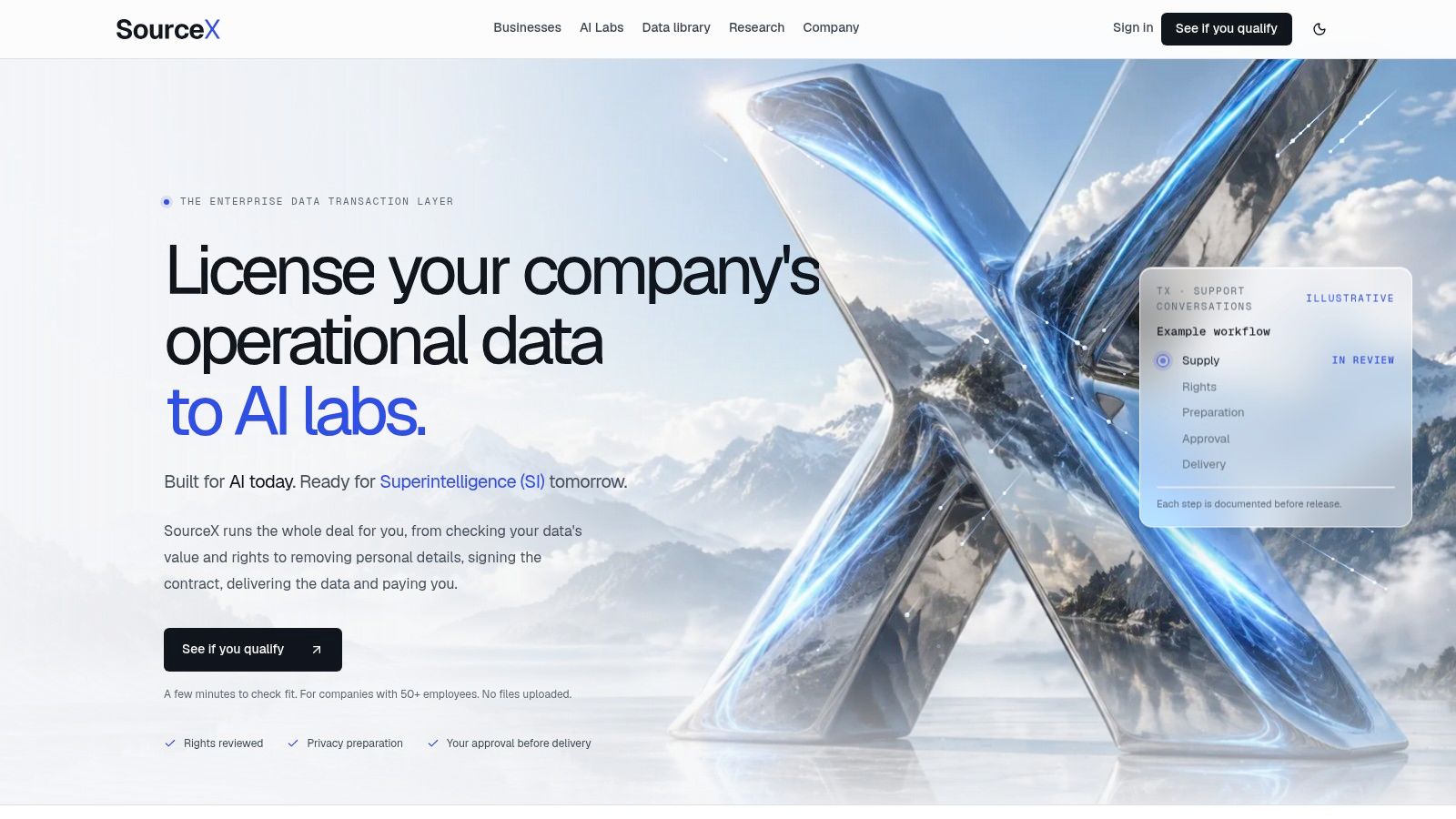
For readers comparing an internal exchange with an external licensing workflow, SourceX's enterprise data marketplace resource is useful when the objective is to commercialize rights-cleared operational data rather than just share governed assets between internal teams.
SourceX is the right choice when supplier authorization, provenance, deidentification, buyer outreach, and contract execution are central requirements. It isn't a substitute for an internal analytics marketplace if the primary need is self-service access for employees. It is better understood as a controlled commercial layer for moving enterprise data from inventory to licensed delivery.
Implementation Roadmap and Integration Patterns
A marketplace should start with a business need, not a platform purchase. The sequence below creates evidence at each stage and gives leadership a clear reason to continue or stop.
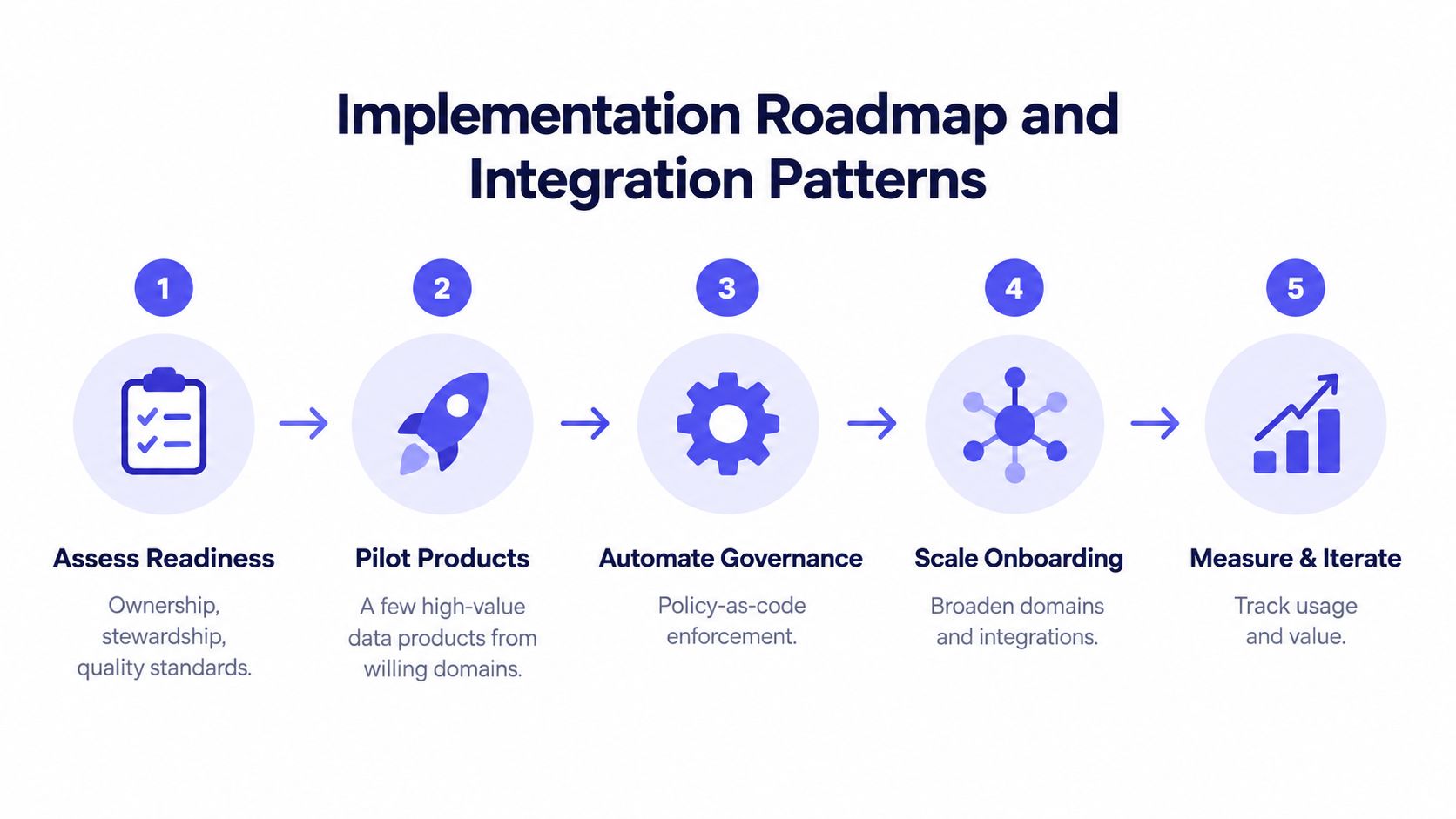
Start with readiness
List the business questions that repeatedly trigger data requests. Identify candidate products, their domain owners, current quality checks, consumers, legal constraints, and existing delivery methods.
Deliverable: a readiness register covering ownership, stewardship, quality standards, access rules, and intended consumers.
Exit criterion: every pilot candidate has a named accountable owner and a stated decision use case.
Pilot products with willing domains
Choose a small set of high-value products from teams that want reuse. Avoid selecting assets solely because they're large or technically interesting. A product with a clear consumer, stable meaning, and visible business need teaches more than a large inventory with no audience.
Deliverable: published product pages, data contracts, access workflows, usage guidance, and an initial support process.
Exit criterion: target consumers can discover, evaluate, request, and consume the products through the defined path.
Automate the repeatable controls
Encode validation, authorization, classification checks, lineage capture, and change notifications into publication and access workflows. Keep exceptions visible rather than allowing users to bypass the process through private exports.
Deliverable: automated policy and quality checks with audit records.
Exit criterion: routine requests no longer depend on manual coordination across every participating team.
Scale publication and connections
Add domains gradually. Connect the marketplace to BI tools for governed exploration, pipelines for scheduled transformations, applications for embedded use cases, and APIs for programmatic consumption.
A pipeline may retrieve a versioned product after an approved registration. A BI tool may query a governed view while preserving row or column restrictions. An application may call an API that applies authorization and records usage per request.
AI agents create another reason to prioritize machine-readable metadata and predictable interfaces. An agent can search for a product only if definitions, policies, schemas, and access requirements are exposed in a form it can interpret.
Deliverable: reusable onboarding templates and integration patterns.
Exit criterion: a new domain can publish a product without redesigning the process from scratch.
Measure and iterate
Review active consumption, failed deliveries, access friction, policy denials, quality incidents, and consumer feedback. Retire products that no longer have a defensible use case, and improve products that attract demand but create repeated confusion.
Deliverable: an operating review with actions, owners, and deadlines.
Exit criterion: the marketplace has a repeatable mechanism for improving or retiring products, not just adding them.
Measuring Value and ROI Beyond Dataset Counts
A large inventory can hide a weak service. Counting registered datasets measures publication activity, not whether consumers can make better decisions with the products.
Survey evidence points toward a more useful standard. A 2024 Enterprise Strategy Group survey of 220 IT and line-of-business respondents reported that 84% of organizations deliver data products to increase consumption of trusted, high-value data, 86% model the data products they provide, and 95% were either planning to develop or already operating a self-service data marketplace (Enterprise Strategy Group survey summary). The same research reported a 71% year-over-year increase in data-marketplace adoption. These figures support a shift from inventory measurement toward productized supply and repeatable consumption.
Use a health scorecard
| Metric | What It Tells You |
|---|---|
| Assets with named owners | Whether someone is accountable for meaning, quality, support, and change |
| Contract and SLA coverage | Whether consumers receive explicit service commitments |
| Median time from discovery to approved access | Whether the marketplace removes or reproduces request friction |
| Successful query or delivery rate | Whether approved consumers can actually obtain usable data |
| Freshness and quality-SLA compliance | Whether products remain fit for their stated purpose |
| Lineage completeness | Whether teams can assess impact and support audit requests |
| Policy-denial rate | Whether controls are working and where access expectations are misaligned |
| Monthly active consumers | Whether the marketplace supports ongoing use rather than one-time browsing |
These metrics should be read together. A short access time paired with poor quality isn't success. High monthly consumption paired with repeated policy violations isn't healthy adoption. A product with few consumers may still be valuable if it supports a critical decision, while a popular product may need investment if its support burden is excessive.
Make failure economically visible
Every published product needs commitments that a consumer can understand. These might cover freshness, schema stability, availability, quality checks, incident communication, and escalation. The producer also needs a defined response when those commitments fail.
Possible controls include remediation deadlines, consumer notifications, temporary suspension, version rollback, cost allocation, and retirement. Chargeback can make support and processing costs visible, but it should not punish teams for responsible publication. Internal economics should encourage useful reuse while exposing products that create sustained cost without demand.
The difficult question isn't whether a producer can publish. It's what happens after publication when the product is stale, incomplete, or misused.
Data contracts clarify responsibilities, but they don't automatically create incentives, compensation, remediation priorities, or retirement rules. Leadership must decide those policies before marketplace growth makes failures politically difficult to resolve.
For broader thinking about product-level value and business operations, payment business strategy can provide a useful comparison point. The same principle applies here: a transaction is not valuable merely because it occurred. It must support a reliable outcome at an acceptable cost.
Common Pitfalls, Vendor Selection, and Real-World Examples
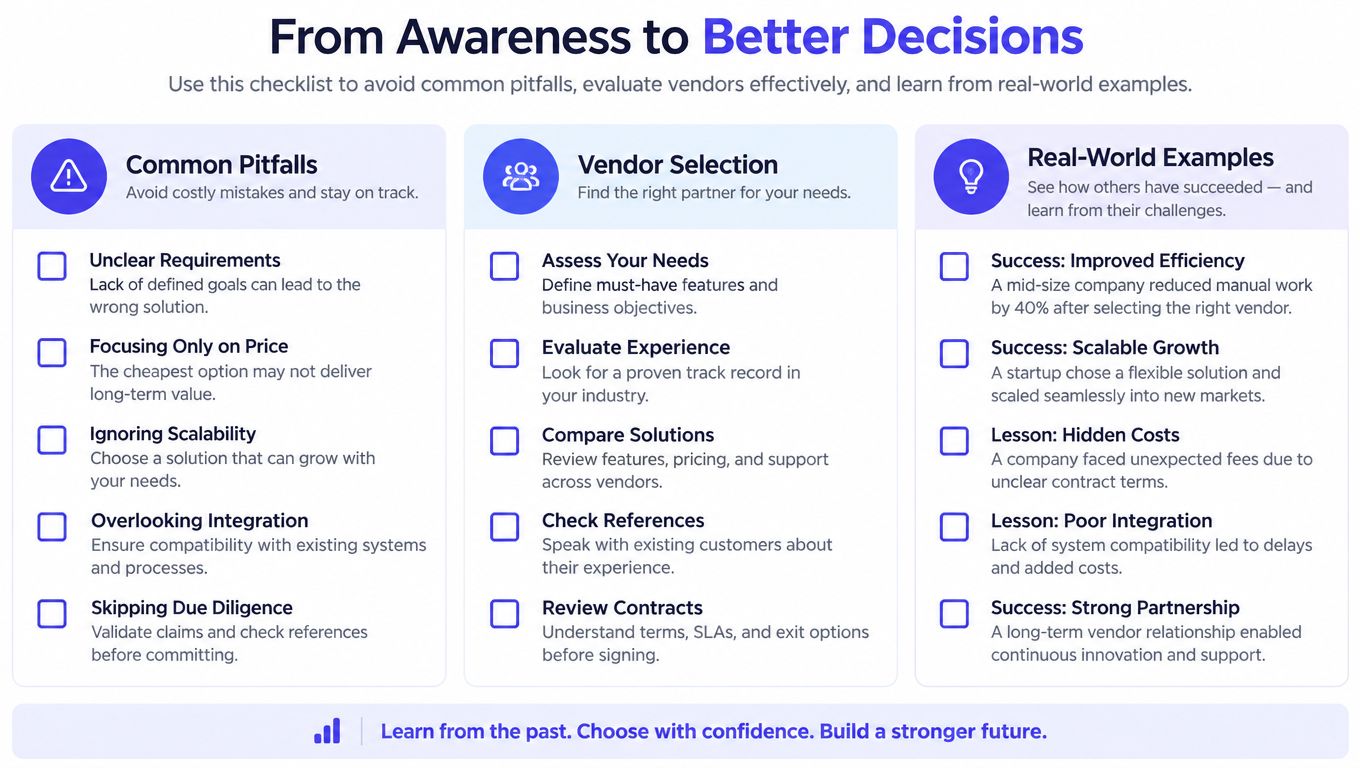
The most common failure is a catalog graveyard. An organization publishes undocumented tables, adds search, and expects adoption to follow. Consumers still face inconsistent definitions, uncertain freshness, unclear ownership, and approval workflows that cross several technical teams.
A marketplace should work like an app store for governed data. A non-technical employee should be able to search with a business question, compare products, understand the evidence, and request access without reconstructing the source system. If that journey requires separate conversations with engineering, security, legal, and the data owner, self-service has not been achieved.
Apply the non-technical litmus test
Ask a business user to complete the full journey without coaching:
- Search using a business question rather than a table name.
- Compare two relevant products.
- Read definitions, provenance, freshness, quality evidence, and restrictions.
- Decide whether a product fits the intended decision.
- Request and obtain access through one comprehensible workflow.
- Use the product without discovering hidden technical prerequisites.
Failure at any step points to a product or operating-model problem. Adding more datasets will increase the inventory without improving adoption. The marketplace may need clearer product pages, better recommendations, simpler approvals, or consumption interfaces suited to the user's task.
Select vendors against operating behavior
Vendor selection should test the experience in practice, not rely on feature names in a presentation. Give a business user a realistic question and observe whether the platform supports the complete path from discovery to authorized use.
Evaluate these capabilities:
- Product usability: Can producers publish structured products with business and technical metadata?
- Consumer clarity: Can non-technical users understand fitness, restrictions, and expected outcomes?
- Governance automation: Can identity, policy, validation, lineage, and audit records operate without repeated manual work?
- Interface coverage: Does the platform support BI, pipelines, APIs, files, and other required consumption modes?
- Contract discipline: Can owners define schemas, quality expectations, support contacts, and change rules?
- Operational measurement: Can leaders see active consumers, successful deliveries, quality compliance, denials, and cost?
- Lifecycle control: Can teams version, deprecate, remediate, and retire products?
- Commercial support: If external data is involved, can the system manage rights, licensing, privacy preparation, and delivery evidence?
Ask vendors to demonstrate how a user finds a product, interprets its definitions, checks quality evidence, requests access, and receives the result. Also ask who owns each step when a request is denied, a contract changes, or a delivery fails. These answers reveal whether the platform supports an operating model or only provides a polished catalog.
What productized consumption looks like
A decision-oriented data product should not force every consumer to understand its entire source system. A website technology detection service, for example, can expose a developer API that accepts a site for analysis and returns an explainable result. Users do not need to inspect source files, headers, assets, and scripts manually.
The value lies in the interface and the explanation. The consumer receives an output designed for a specific task, together with enough evidence to judge its relevance and limitations. That is closer to a marketplace product than an undocumented export.
A useful technical comparison appears in this API-based marketplace service example, which shows how an API can package a focused result for direct consumption. It is not a model for every enterprise product. It does demonstrate the central test: can a consumer connect the output to a decision without rebuilding the underlying system?
The final selection question is direct: Can a non-technical employee independently determine whether a product is fit for a decision and obtain access through one understandable workflow? If the employee cannot complete both tasks, the platform is still operating as a catalog.
Your Next Steps Toward a Working Marketplace
Begin with one important business question, not a broad promise to “democratize data.” Identify the product that could answer it, then name the person accountable for its meaning, quality, access rules, support, and lifecycle.
Before publishing widely, require a usable product page, a data contract, quality evidence, an access path, and a monitoring plan. Design the experience for a business user who doesn't know the source table, schema, or internal team structure. If that person can't evaluate the product independently, improve the experience before expanding the inventory.
The operating model also needs an answer to the uncomfortable question: What happens when a data product fails its commitments? Set remediation deadlines, escalation routes, consumer notifications, versioning rules, cost responsibilities, and retirement criteria before incidents expose the gaps.
Readiness depends on explicit ownership, stewardship, quality standards, and usage monitoring. Success depends on active consumption and useful decisions, not the number of assets displayed in a portal.
An enterprise data marketplace can become shared infrastructure for analytics, AI, compliance, and commercial data exchange, but only when it behaves like a dependable service. Audit one high-value data flow this week, define it as a governed product, and pilot the complete journey from discovery to decision. If competitive research is part of that pilot, use AI Website Detector to turn website technology signals into a structured, explainable data product rather than another undocumented export.