Content Writer vs Copywriter: Roles, Skills & Hire Guide
Most advice on content writer vs copywriter starts with a tidy distinction: blogs belong to content writers, ads belong to copywriters. That framing is easy to remember and often wrong in practice. A landing page can require serious research, a blog post can generate qualified demand, and an email can educate for weeks before it asks for a sale.
The useful distinction is more commercial. Who owns the funnel stage, the asset, and the business metric? Content writers usually build discoverability, authority, and audience understanding over time. Copywriters usually turn existing attention into a measurable action, such as a click, lead, signup, or purchase. The format matters, but the accountable outcome matters more.
Copywriting has existed as a formal commercial discipline for more than a century. Early advertising agencies treated it as persuasion-focused sales writing, and direct-response methods were already being systematized through headline testing, mail-order advertising, and conversion-oriented writing by the 1920s and 1930s, as summarized by Best Writing's history and market overview. Digital publishing later expanded the separate content track, creating modern teams that need both demand creation and conversion execution.
Table of Contents
- Why the Actual Divide Is Not What Most Posts Claim
- Content Writer and Copywriter at a Glance
- Skills, Deliverables, and Day-to-Day Workflows
- How Each Role Is Measured and Paid
- Matching the Role to Your Project Type
- Pricing, Rates, and Salary Reality in 2026
- Where AI Is Collapsing the Middle of These Roles
- Which Role Should You Hire and When
Why the Actual Divide Is Not What Most Posts Claim
The familiar “long-form versus short-form” rule misclassifies writing because length says little about commercial responsibility. A detailed product comparison can rank in search, educate a buyer, and move that buyer toward a sales call. A short homepage headline may carry more revenue responsibility than an entire article library.
Use funnel position to assign the role. Content writing generally supports the earlier stages of the journey. It answers questions, organizes a topic, earns attention, and gives prospects enough context to return, subscribe, or consider a solution. Copywriting generally supports the decision stage. It clarifies the offer, addresses objections, creates appropriate urgency, and makes the next action obvious.
The metric reveals the role
Content writers are commonly evaluated through organic traffic, keyword rankings, time on page, scroll depth, backlinks, and social shares. These signals measure discovery and engagement, while a content asset may also assist later conversions. Copywriters are more often evaluated through click-through rate, conversion rate, cost per acquisition, revenue, and assisted conversions, according to the metric comparison from HumanText.
The distinction should shape the brief. “Write a 2,000-word article” describes production. “Increase qualified organic discovery for this topic and support the nurture path” defines a content objective. “Improve the percentage of qualified visitors who request a demo” defines a copy objective.
Hiring rule: Assign the business metric before you assign the writing title.
The market also reflects separate commercial jobs. The global content marketing market was valued at $524.73 billion in 2025 and is projected above $603.2 billion by 2026. The global copywriting services market was valued at $29.28 billion in 2025 and is forecast to reach $48.89 billion by 2032, at a 7.6% CAGR, according to the market figures compiled by Oliver Munro. The markets overlap, yet their work enters the funnel at different points. Content creates demand at scale. Copy captures demand at the point of action.
Content Writer and Copywriter at a Glance
Use this table as a hiring guide, not a rigid taxonomy. One writer may handle both an SEO article and a landing page, yet each assignment needs a primary outcome and a clear funnel role.
| Dimension | Content writer | Copywriter |
|---|---|---|
| Primary purpose | Inform, educate, entertain, or instruct | Persuade a reader to take a specific action |
| Funnel position | Awareness and consideration | Consideration, decision, and conversion |
| Typical deliverables | Articles, pillar pages, white papers, ebooks, newsletters, case studies | Landing pages, sales emails, paid ads, product pages, scripts, taglines |
| Main channels | Search, editorial publications, resource hubs, email education | Websites, paid media, lifecycle email, sales collateral, product journeys |
| Owned metrics | Organic traffic, rankings, engagement, backlinks, assisted conversions | Click-through rate, conversion rate, cost per acquisition, revenue |
| Impact horizon | Usually cumulative and longer-term | Usually more immediate and easier to isolate |
| Typical team home | Content, SEO, editorial, or broader marketing | Growth, brand, demand generation, or performance |
| Editorial lifecycle | Brief, research, outline, draft, edit, optimize, publish | Research, positioning, concepts, variations, review, launch, test |
A content writer builds attention and understanding through the earlier funnel stages. The work may include a search-led article, topical series, technical guide, or customer education newsletter. Its value can appear across several visits and channels, so Neal Schaffer's comparison correctly points to a broader performance view than a single conversion report.
A copywriter shapes a decision at a defined point in the journey. The asset may ask for a purchase, demo request, email click, or reply. Because the intended action is narrow, the team can compare versions more directly and connect performance to the relevant response.
The middle of the funnel needs both disciplines. A product-led article can answer a technical question, introduce the product's approach, and end with a focused demo invitation. A nurture email can teach one useful concept, address an objection, and use a persuasive call to action. The writer must switch between explanation and motivation without weakening either.
Evaluate the assignment by its outcome rather than its format. Hire a content writer when the priority is building informed demand. Hire a copywriter when the priority is turning existing attention into action. For hybrid assets, choose the person whose strongest skill matches the stage carrying the business risk.
Skills, Deliverables, and Day-to-Day Workflows
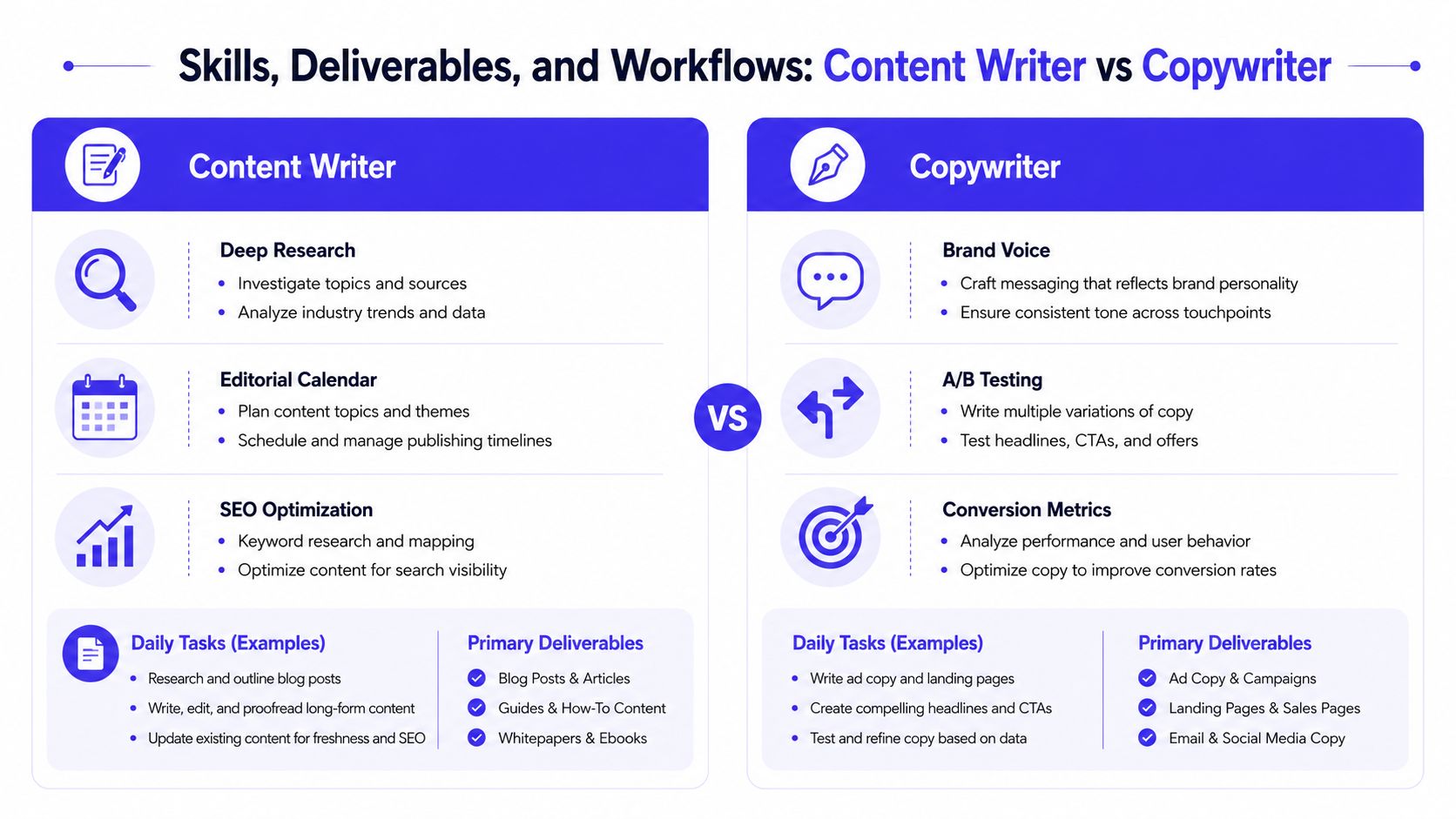
Content writers spend more time building a reliable information foundation. They research the audience, study search intent, review competing coverage, interview subject-matter experts when access is available, and decide how the argument should unfold. Strong writers also create useful internal links, distinguish primary questions from related questions, and protect the brand from shallow or unsupported claims.
A typical content workflow looks like this:
- Brief: Define the audience, search intent, business context, target topic, and desired reader action.
- Research: Gather source material, expert input, product information, and first-hand detail.
- Structure: Build an outline that answers the main question before expanding into supporting points.
- Draft: Write the article in the brand's voice, with clear examples and useful transitions.
- Edit and publish: Check accuracy, clarity, links, on-page SEO, formatting, and the handoff into the next funnel stage.
A content writer might deliver a 2,400-word comparison guide optimized for a target keyword cluster. The value isn't the word count by itself. It lies in the writer's judgment about what the reader needs, what the company can credibly say, and how the page supports future discovery.
Copywriters work from a tighter commercial brief. They need to understand the offer, the audience's objections, the competitive position, the proof available, and the action the campaign requires. Their work depends on positioning, customer psychology, offer framing, headline development, hook creation, brand voice, and testing discipline.
The copy workflow is deliberately iterative
A copywriter may produce multiple headline, subhead, CTA, or subject-line options in one session, then place those options into an approval and testing loop. The deliverable could be five landing-page variants plus three email subject lines tied to one offer. The copywriter isn't just making the words sound better. They're creating alternative routes to the same commercial action.
Content writing rewards depth and synthesis. Copywriting rewards precision under pressure. Both roles need research, but they use it differently. A content writer uses research to explain a subject accurately and in detail. A copywriter uses research to identify the promise, objection, proof point, or emotional tension that can move a buyer.
Before approving either role, review the writer's ability to distinguish persuasion from unsupported hype. A practical resource such as Mailadept's guide to spam trigger words can help email teams identify language that may create deliverability concerns, but it shouldn't replace audience research or editorial judgment.
For teams building an AI-supported editorial process, this guide to AI SEO tools is a useful adjacent reference. The tool can accelerate research and organization, but the writer still has to decide whether the resulting page deserves publication.
How Each Role Is Measured and Paid
Compensation follows decision proximity. Content writers earn their value through research depth, subject knowledge, editorial reliability, and assets that build search visibility and audience trust over time. Copywriters earn more when they can sharpen positioning, judge tests, and carry responsibility for a message tied directly to commercial action.
Content teams should connect performance to the buyer journey rather than rely on one dashboard number. Organic traffic, keyword rankings, time on page, scroll depth, backlinks, social sharing, return visits, and assisted conversions each show part of the result. The useful question is whether the asset attracts the right audience, builds confidence, and helps prospects progress.
Copy teams usually track a tighter chain:
- Click-through rate: Does the message earn the next click?
- Conversion rate: Do qualified visitors complete the intended action?
- Cost per acquisition: Does the asset help acquire customers efficiently?
- Revenue: Does the campaign produce commercial value?
- Assisted conversions: Does the copy support a later conversion without receiving last-click credit?
A landing page often has one primary action and a defined testing window, so its contribution is easier to isolate. An article can influence discovery, repeat visits, brand familiarity, and later conversion while receiving no final-touch credit. Treating both roles as if they share the same KPI produces bad briefs and weak evaluations.
Rate follows accountability
A copywriter handling a landing page can charge more than a content writer producing a blog post of similar length because the work sits closer to a revenue event. The assignment may include offer decisions, customer research, stakeholder alignment, variant development, and post-launch testing. Word count does not price that responsibility accurately.
Set the measurement plan before approving a quote. For content, define the audience, search or distribution goal, quality standard, and review process. For copy, define the action, test window, qualification criteria, and commercial outcome. The closer the writer's decisions are to revenue, the more the brief should reward judgment rather than output volume.
Rate cards should therefore separate production from accountability. A writer who researches and drafts one asset is performing a different job from a specialist who shapes the offer, creates variants, interprets results, and revises the message after launch. Pay for the scope and risk attached to the assignment, not a word-count comparison alone.
Matching the Role to Your Project Type
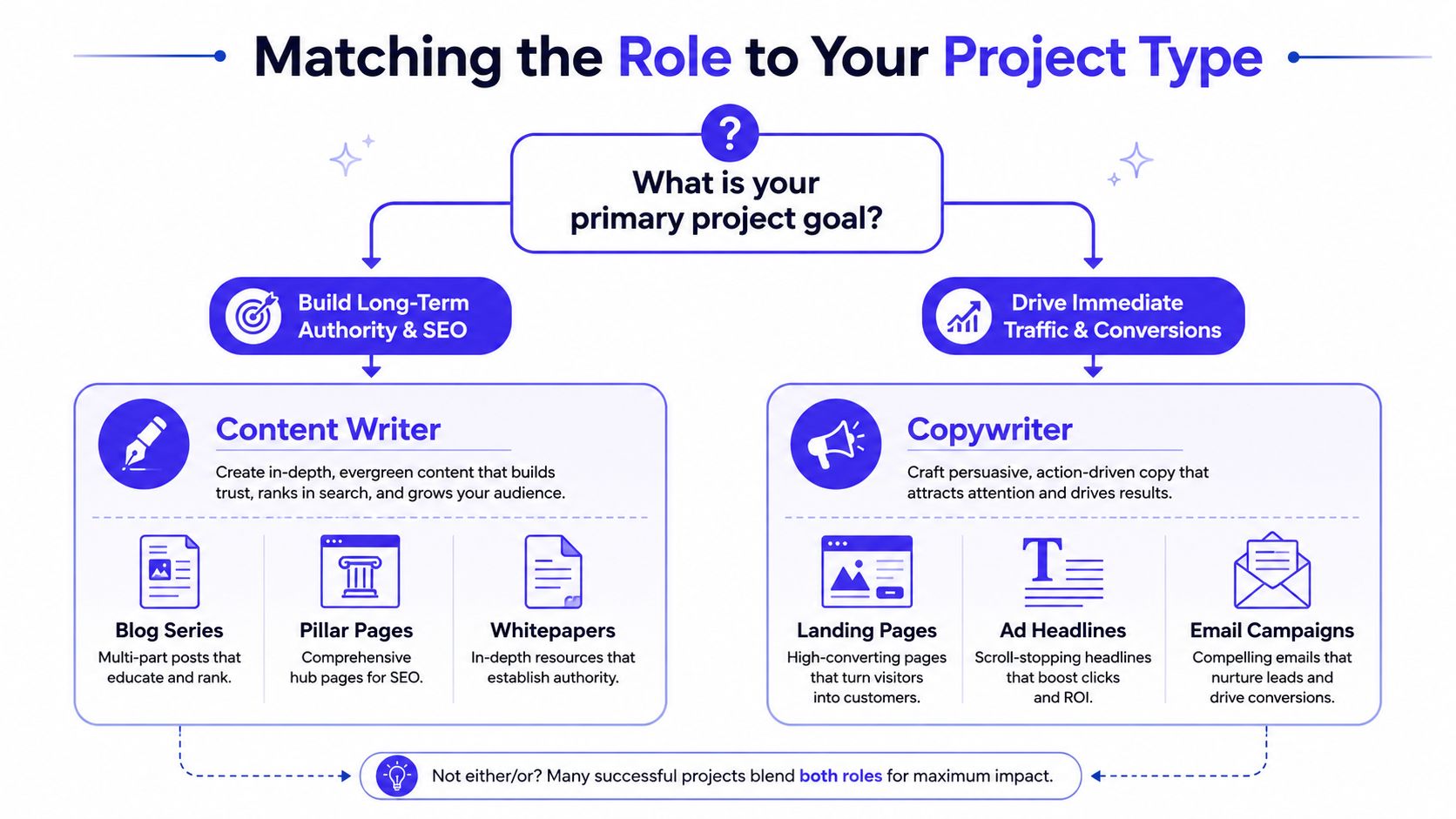
Assign the role by the funnel stage and the decision the asset must support. Content writers build understanding, qualified interest, and confidence before action. Copywriters turn existing intent into a click, sign-up, request, or purchase. That distinction matters more than format.
Choose a content writer for demand creation
Use a content writer when the brief requires research, explanation, editorial judgment, or search coverage. Typical assignments include:
- Long-form articles: Answer audience questions and build discoverability.
- Pillar pages: Structure a broad subject and connect related content.
- Thought leadership: Turn internal expertise into a clear point of view.
- Ebooks and white papers: Explain technical or complex subjects.
- Case studies: Document customer problems, decisions, and outcomes.
- SEO content briefs: Translate search intent into an editorial plan.
A SaaS comparison page shows the boundary clearly. If the page must explain competing workflows, define evaluation criteria, cite product capabilities, and help an informed buyer compare options, hire a content writer to build the evidence and structure. Give a copywriter the same page when the research already exists and the assignment is to sharpen differentiation, frame the offer, handle objections, and drive a demo request. For a high-value page, use both: content establishes trust, while copy turns that trust into action.
These projects usually involve subject-matter interviews, source checks, SEO review, and stakeholder feedback. Set the schedule around the number of decisions and review owners, not the word count.
Choose a copywriter for action
Use a copywriter when the reader understands the problem and needs a reason to choose your solution. The strongest fits are landing pages, paid ads, email sequences, sales letters and scripts, product pages, and taglines and campaign concepts.
The copywriter should connect the offer, proof, objections, and CTA into one argument. For ads, that argument must fit the channel's limited attention window. For email, each message should move the reader toward a defined next decision. For product pages, the work should clarify benefits, differentiate the offer, and reduce purchase friction.
Plan the review cycle correctly
Do not assign a writer by label alone. Give the brief an audience, funnel stage, primary action, evidence requirements, and approval path. If the asset educates first and sells later, hire a content writer; if it sells first and educates only when necessary, hire a copywriter. Shared assignments need a named owner, or research and conversion responsibilities will blur.
Pricing, Rates, and Salary Reality in 2026
Freelance pricing varies by scope, evidence requirements, and accountability. A 2026 survey of freelance writers reported an average content-writing rate of $0.42 per word and $53 per hour. The U.S. Bureau of Labor Statistics figure summarized earlier places the median annual wage for U.S. writers and authors at $72,270 in 2024. Use these benchmarks as context, not as a guaranteed freelancer rate or an employer's budget ceiling.
Match the price to the scope, using the factors below before comparing quotes.
Price the work you need
A content quote should cover research intensity, subject-matter complexity, interviews, source checking, SEO planning, editing, publishing support, and revisions. A copy quote should account for customer research, positioning, offer development, page architecture, variants, stakeholder review, and post-launch testing.
Role titles still hide meaningful differences. A reported breakdown found that 85% of copywriters produce marketing materials and content, 59% create digital and SEO content, and 38% write ad copy. Many practitioners work across the funnel, so assess portfolios by process, decision quality, and business outcomes rather than by title alone.
Put these terms in the contract before work begins:
- Revision cap: Define how many substantive revision rounds the fee includes.
- Kill fee: State what the client owes if the project stops early.
- Performance bonus: Specify the baseline, measurement window, attribution method, and payment trigger.
- IP transfer: Clarify when ownership transfers and whether the writer can display the work.
- Scope boundary: Separate research, strategy, writing, editing, design, implementation, and testing.
The rate should rise with the number of decisions the writer owns. A researched article with expert input and source review requires a different fee from a lightly edited draft. A landing page tied to testing and conversion accountability deserves a different budget from copy delivered without implementation or performance responsibility.
AI-assisted production is putting pressure on commodity drafting, while expertise-led work still depends on judgment. Review broader adoption patterns in this AI adoption statistics guide, then budget for the human work accountable for accuracy, positioning, approvals, and business results. In 2026, those responsibilities are where the price difference remains easiest to justify.
Where AI Is Collapsing the Middle of These Roles
AI is reducing the value of undifferentiated execution. It can help a content writer create a research scaffold, cluster questions, generate an outline, draft a meta description, or adapt an existing article for another format. It can help a copywriter produce headline variations, subject-line options, product-description edits, and first-pass ad concepts.
That doesn't make the roles identical. AI can generate plausible language, but it doesn't own the brief, understand the political constraints inside a company, validate expert claims, or decide whether a promise is safe and credible. It also struggles with original perspective, narrative structure, precise brand-voice calibration, and compliance-sensitive language unless a qualified human reviews the work.
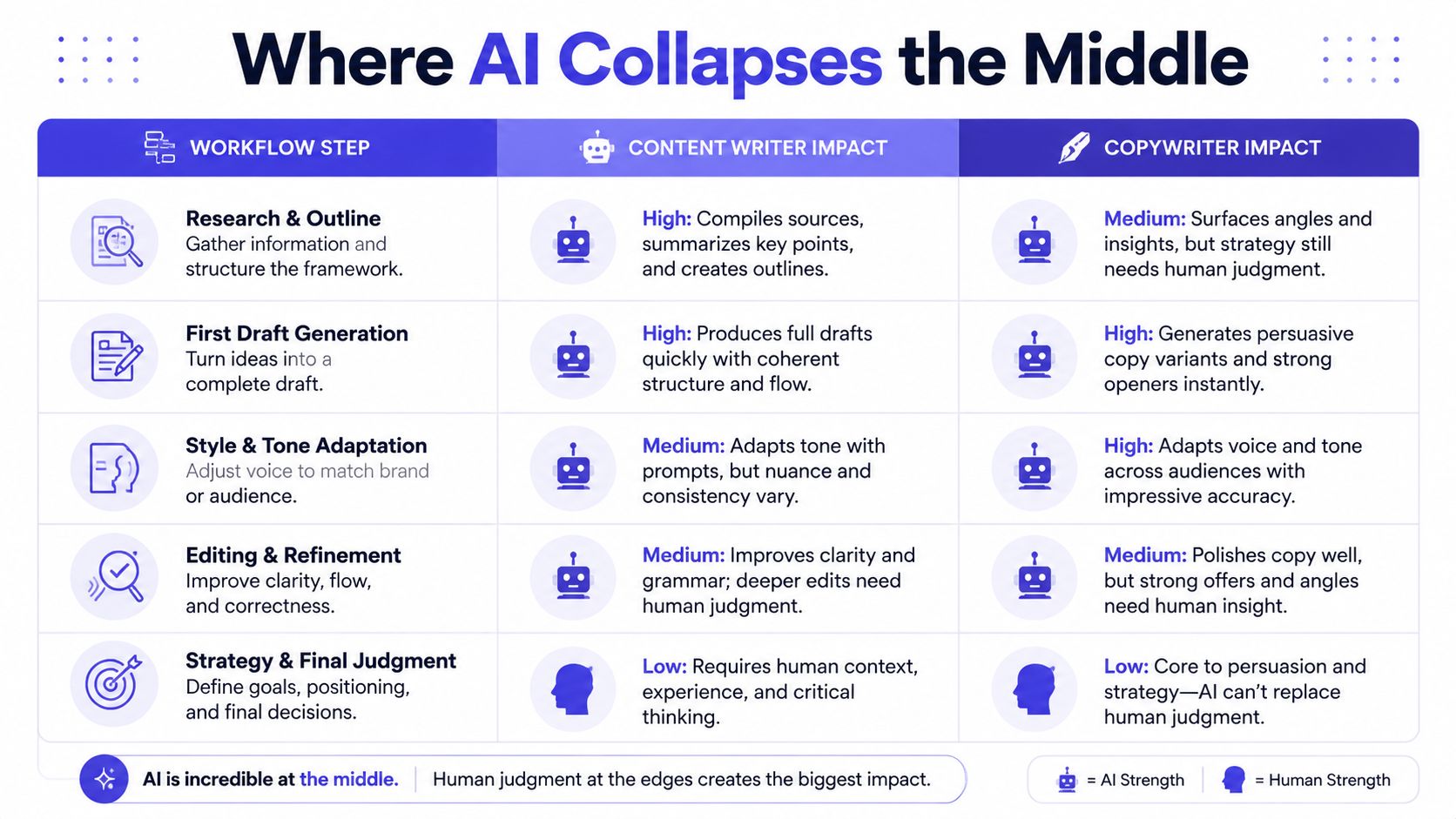
The execution layer is converging. Both writers increasingly need prompt orchestration, source validation, editing, and repurposing skills. The outcome layer isn't converging. Content still has to earn discovery and trust. Copy still has to make a measurable action more efficient.
Teams learning how to master AI content in 2026 should treat AI as a co-pilot rather than a substitute for accountability. A separate AI fact-checking guide can support a verification workflow, but no tool removes the need for a human to approve claims before publication.
The durable skills are brief interpretation, editorial judgment, customer insight, strategic prioritization, and measurement. Raw prose production is becoming easier to automate. Knowing what to say, who should hear it, where it belongs, and how to judge the result is becoming more valuable.
Which Role Should You Hire and When
Hire a content writer when the assignment is an evergreen pillar, SEO article, white paper, newsletter, thought-leadership piece, or case study. Give that writer a clear discovery or education objective, access to subject-matter input, and a dashboard that includes search visibility, engagement quality, and assisted pipeline.
Hire a copywriter when the assignment is a landing page, paid campaign, email sequence, sales script, product page, or conversion-focused website section. Give that writer a defined offer, a specific audience, access to proof and objections, and a conversion or revenue metric they can influence.
Use this decision rule
- Build authority: Choose a content writer.
- Capture existing demand: Choose a copywriter.
- Create a mixed-funnel asset: Pair them or hire a writer who can demonstrate both disciplines.
- Run a short campaign burst: Use a contractor when the workload is temporary and tightly scoped.
- Build a recurring editorial engine: Favor an in-house content lead when the organization needs consistent prioritization, governance, and publishing ownership.
- Manage a distributed writing bench: Follow a documented process for how to manage a ghostwriter for your brand, especially around voice, approvals, confidentiality, and source access.
For scaling teams, the strongest default is usually a hybrid staffing model. Keep content strategy and editorial standards close to the business, then retain a specialist copywriter for campaigns, launches, landing pages, and conversion testing. That arrangement preserves compounding search work without forcing one generalist to master every commercial channel.
Review portfolios against the metric you need. A polished blog sample doesn't prove landing-page ability, and a strong sales page doesn't prove research discipline. Ask candidates to explain the brief, the audience, the intended action, the review process, and how they would judge success.
AI Website Detector helps you inspect whether a site was built with AI-first tools, traditional CMS platforms, or a custom and AI-augmented stack, with explainable signals behind the result. Visit AI Website Detector to analyze websites and sharpen the technology research that supports your content, SEO, and conversion decisions.