
Active to Passive Converter: Rules, Examples & Simple Method
You're halfway through an email, essay, or report when one sentence starts to feel awkward: The manager approved the request sounds direct, but perhaps the request matters more than the manager. An active to passive converter can help you change the sentence without changing its basic meaning, provided you understand what the conversion does.
The key is choice. Active voice usually highlights the person or thing performing an action. Passive voice highlights the person or thing receiving it. Once you can identify that shift, you can convert sentences accurately and decide whether the new version serves your reader.
Table of Contents
- Why Switching Voice Changes How a Sentence Reads
- The Core Rules That Drive Every Conversion
- A Four-Step Method You Can Reuse on Any Sentence
- Worked Examples Across Different Tenses and Styles
- When Passive Voice Actually Helps Your Writing
- Limits, Edge Cases, and When to Skip the Conversion
- A Portable Checklist and Common Questions
Why Switching Voice Changes How a Sentence Reads
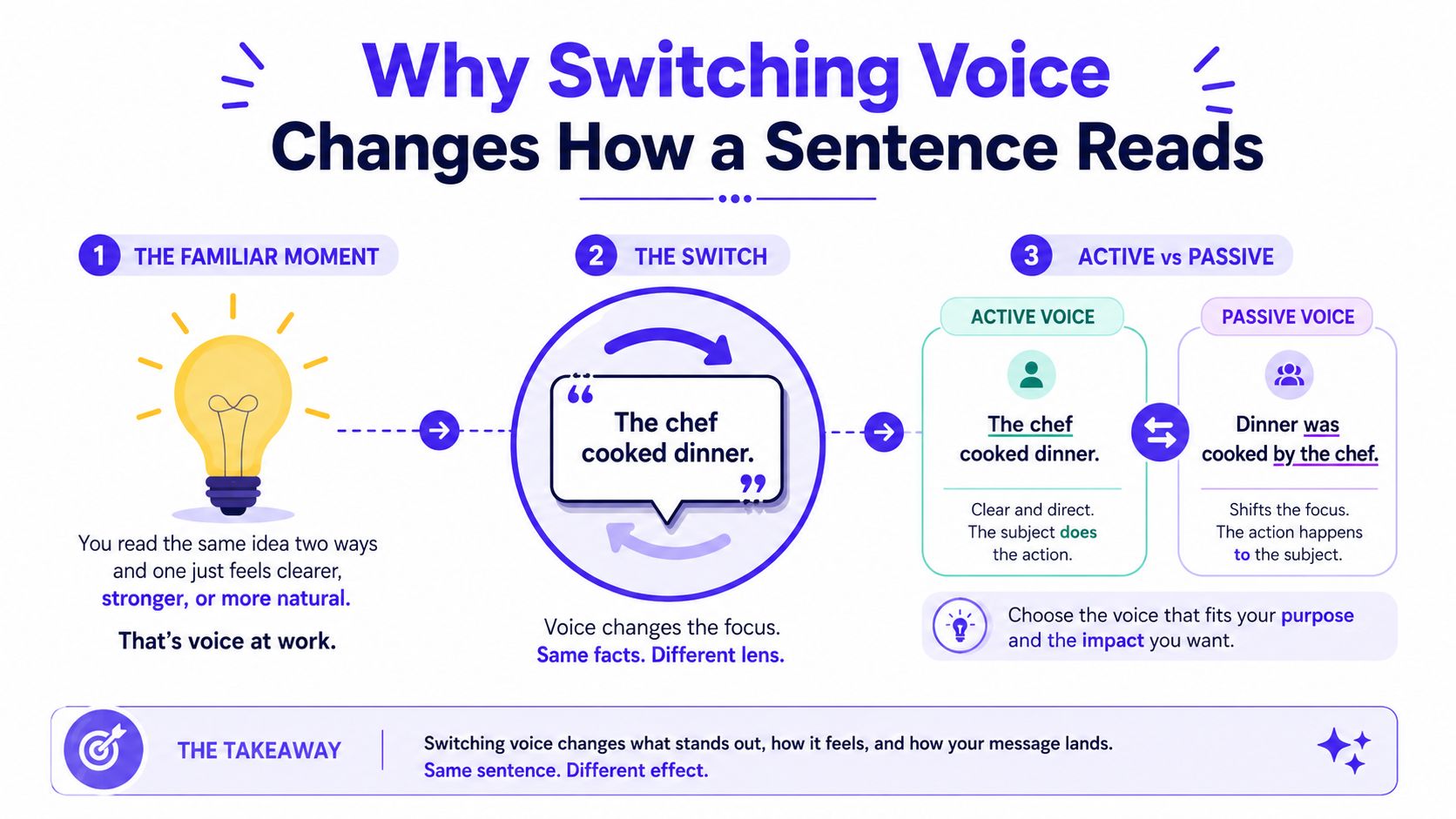
Start with one familiar sentence:
- Active: The editor revised the article.
- Passive: The article was revised by the editor.
Both sentences describe the same action. The active version leads with the editor, so the reader notices who acted. The passive version leads with the article, so the reader notices what changed.
That difference affects more than grammar. Active voice often creates a quicker, more personal rhythm. Passive voice can sound more formal or neutral, and it can help when the action or result matters more than the actor. In a research report, for example, The samples were tested under controlled conditions may fit the purpose better than The researchers tested the samples under controlled conditions.
What changes inside the sentence
In active voice, the usual order is:
Subject + verb + object
In The editor revised the article, the editor is the subject, revised is the verb, and the article is the object.
In passive voice, the object moves into the subject position:
Object + form of be + past participle + by + original subject
That produces The article was revised by the editor. The original subject can disappear entirely if it isn't important, unknown, or obvious: The article was revised.
Reader-focus rule: Choose active voice to foreground the actor. Choose passive voice to foreground the action, result, or receiver.
A passive sentence doesn't always hide responsibility, but it makes the actor optional. The password was changed tells readers what happened, while The administrator changed the password identifies who did it. The best version depends on what your audience needs to know.
The Core Rules That Drive Every Conversion
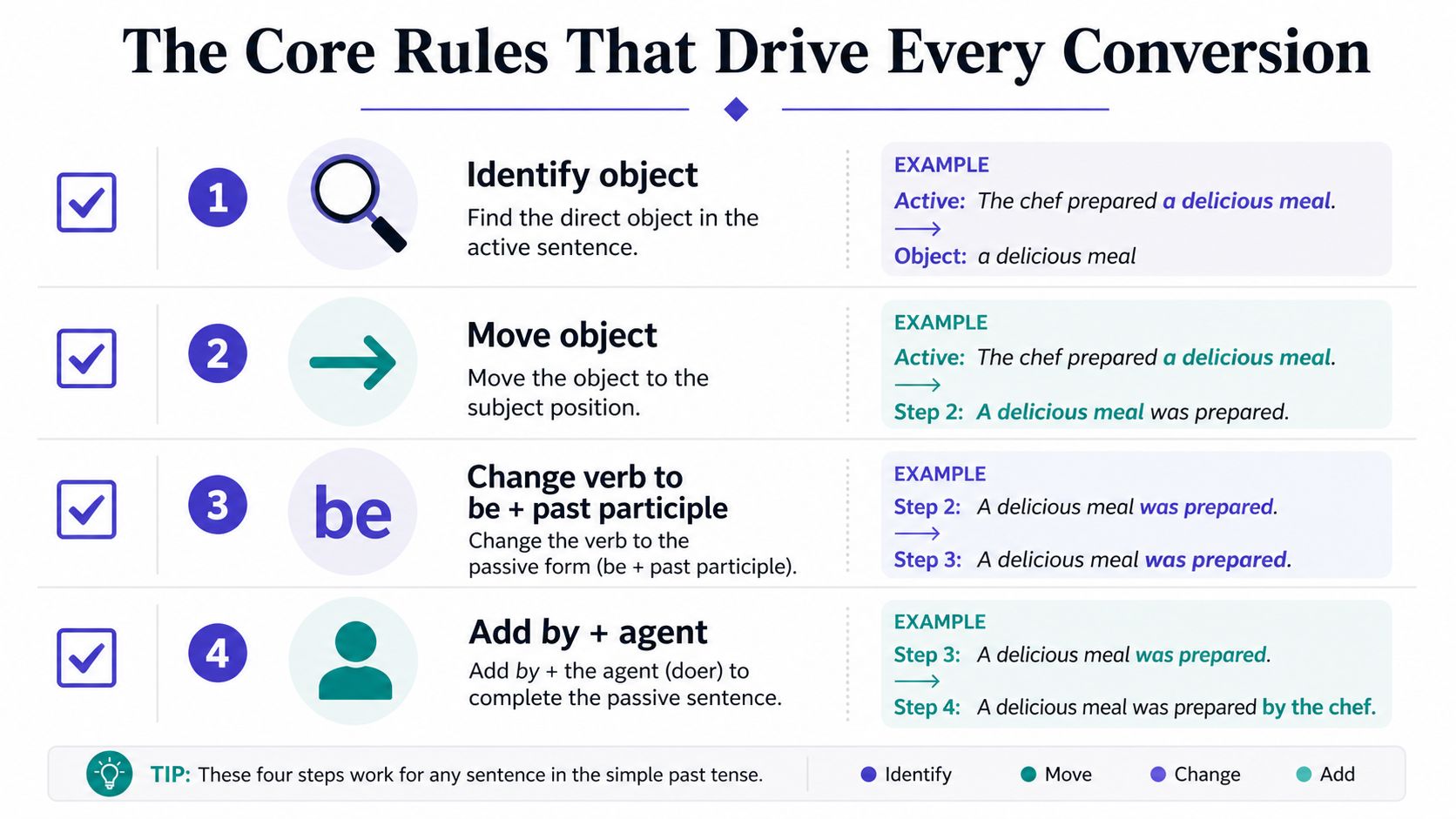
An accurate conversion follows two anchor moves. Move the active object into the subject position, then change the verb to the correct form of be plus the past participle.
Rule one, find the object
Only a sentence with a suitable direct object can normally become passive. In The technician repaired the printer, the printer receives the action, so it can move forward.
The conversion begins like this:
The printer …
Rule two, preserve the tense
The tense doesn't disappear when you convert the sentence. It moves into the form of be.
- Simple present: The team delivers the report. → The report is delivered by the team.
- Simple past: The team delivered the report. → The report was delivered by the team.
- Present perfect: The team has delivered the report. → The report has been delivered by the team.
- Future: The team will deliver the report. → The report will be delivered by the team.
The past participle remains central, but the supporting verb changes with the tense.
Rule three, handle modals carefully
After a modal verb such as can, should, or must, use be plus the past participle:
The assistant can prepare the invoice.
→ The invoice can be prepared by the assistant.
Don't write can is prepared or can prepared. The modal stays unchanged, and be introduces the passive structure.
Rule four, check the verb type
Intransitive verbs don't take a direct object, so they generally can't form a standard passive sentence. The baby slept has no object to move into the subject position. By contrast, The baby opened the window can become The window was opened by the baby.
For another guided explanation of sentence transformation, you can review this grammar-focused conversion resource. A visual explanation can help you notice the object and auxiliary verb before you start editing.
A Four-Step Method You Can Reuse on Any Sentence
Guessing often causes small but important errors. A reliable active to passive converter method gives you a sequence to follow, so you won't drop an auxiliary, lose the tense, or use the wrong participle.
Use this sentence:
The committee will review the proposal.
1. Identify the object
Ask, “What receives the action?” The committee reviews the proposal, so the proposal is the object.
Move it to the front:
The proposal …
2. Decide the tense
The active sentence uses the future because it contains will review. The passive sentence must keep that future meaning.
3. Build the matching be-form
For a future passive, use:
will be + past participle
The verb review becomes reviewed:
The proposal will be reviewed …
4. Add the agent only if it helps
The original subject is the committee. Add it with by:
The proposal will be reviewed by the committee.
The complete transformation is therefore:
The committee will review the proposal.
→ The proposal will be reviewed by the committee.
A quick accuracy check
Read the result in this order:
- Did the object become the new subject?
- Did the original tense remain visible?
- Did you use the correct past participle?
- Did you add by only where the actor matters?
For example, The chef has prepared the meal becomes The meal has been prepared by the chef. The auxiliary sequence has been carries the present perfect tense. Removing been would produce an incorrect sentence.
This procedure works in a customer email, a university essay, a workplace report, or a product update. It also works when the passive sentence should omit the actor: The proposal will be reviewed tomorrow. In that version, the timing and process matter more than the committee.
Worked Examples Across Different Tenses and Styles
The table below keeps the meaning consistent while showing how the supporting verb changes. Focus on the be-form column, because that is where tense information usually moves during conversion.
| Tense | Active sentence | Passive conversion | Be-form used |
|---|---|---|---|
| Simple present | The team checks the records. | The records are checked by the team. | are |
| Simple past | The team checked the records. | The records were checked by the team. | were |
| Present continuous | The team is checking the records. | The records are being checked by the team. | are being |
| Present perfect | The team has checked the records. | The records have been checked by the team. | have been |
| Modal | The team must check the records. | The records must be checked by the team. | must be |
The present continuous example causes frequent trouble. The active form is checking needs is being checked in the passive. The word being shows that the action is in progress. Without it, The records are checked changes the sentence to a simple present meaning.
The present perfect also needs care. Has checked becomes has been checked, not has checked and not has being checked. The subject determines whether you use has or have: The record has been checked, while The records have been checked.
If you're comparing several rewrites or trying to preserve the original meaning while changing the wording, AutoSEO's Quillbot paraphrasing tool review can provide useful context about paraphrasing workflows. Still, a paraphrasing tool isn't a substitute for checking the object, tense, and emphasis yourself.
When Passive Voice Actually Helps Your Writing
Passive voice works well when the receiver of the action deserves the first position. Consider a marketing email:
We have updated your account settings.
That active sentence emphasizes the company. If the customer needs to notice the result, this version may be more useful:
Your account settings have been updated.
The passive construction puts the customer's account at the center. It doesn't hide a meaningful actor because the company may already be obvious from the email.
Research writing
A research abstract may focus on procedures rather than personalities:
The researchers collected responses through an online questionnaire.
A passive alternative is:
Responses were collected through an online questionnaire.
The second version makes responses and the collection process more prominent. It can support a formal tone, especially when the identity of the researchers adds little information in that sentence.
Status updates
A project lead might write:
The deployment team resolved the configuration issue.
If stakeholders care most about the outcome, the update could say:
The configuration issue has been resolved.
That sentence is concise and outcome-led. However, if accountability matters, the active version is clearer because it tells readers who acted.
Clarity test: If readers need to know who made the decision, completed the task, or caused the problem, keep the actor visible.
Passive voice becomes weak when it removes useful information. The payment was rejected may be appropriate in a customer notification, but an internal report may need The payment gateway rejected the transaction. Voice isn't a quality score. It's a way to control emphasis.
Writers who want a broader editing routine can also explore this writing improvement system. The same habit applies here: revise for the reader's needs, not because one voice is always considered better.
Limits, Edge Cases, and When to Skip the Conversion
Some sentences can't undergo a normal passive conversion because they don't contain a direct object. In The children laughed, laughed has no object. You can't move anything into the subject position, so the active sentence should remain active.
The same caution applies to commands and questions. Close the window can sometimes become Let the window be closed, but that version sounds formal and unnatural in ordinary conversation. Who wrote the report? can become By whom was the report written?, yet the passive question is often stiffer than the active one.
Common conversion mistakes
- Dropping the auxiliary: The report completed by Ana is missing a form of be. Write The report was completed by Ana.
- Changing the tense: The team is reviewing the file must become The file is being reviewed by the team, not The file was reviewed.
- Using the wrong participle: The manager chose the vendor becomes The vendor was chosen by the manager. The correct participle is chosen, not choosed.
- Adding an awkward agent: If by the team contributes nothing, remove it. The records were checked may be the cleaner sentence.
A useful self-check is simple: if hiding the actor hides information your reader needs, don't convert the sentence. For editing projects that involve comparing versions and spotting structural changes, you can also use this document comparison guide.
A Portable Checklist and Common Questions
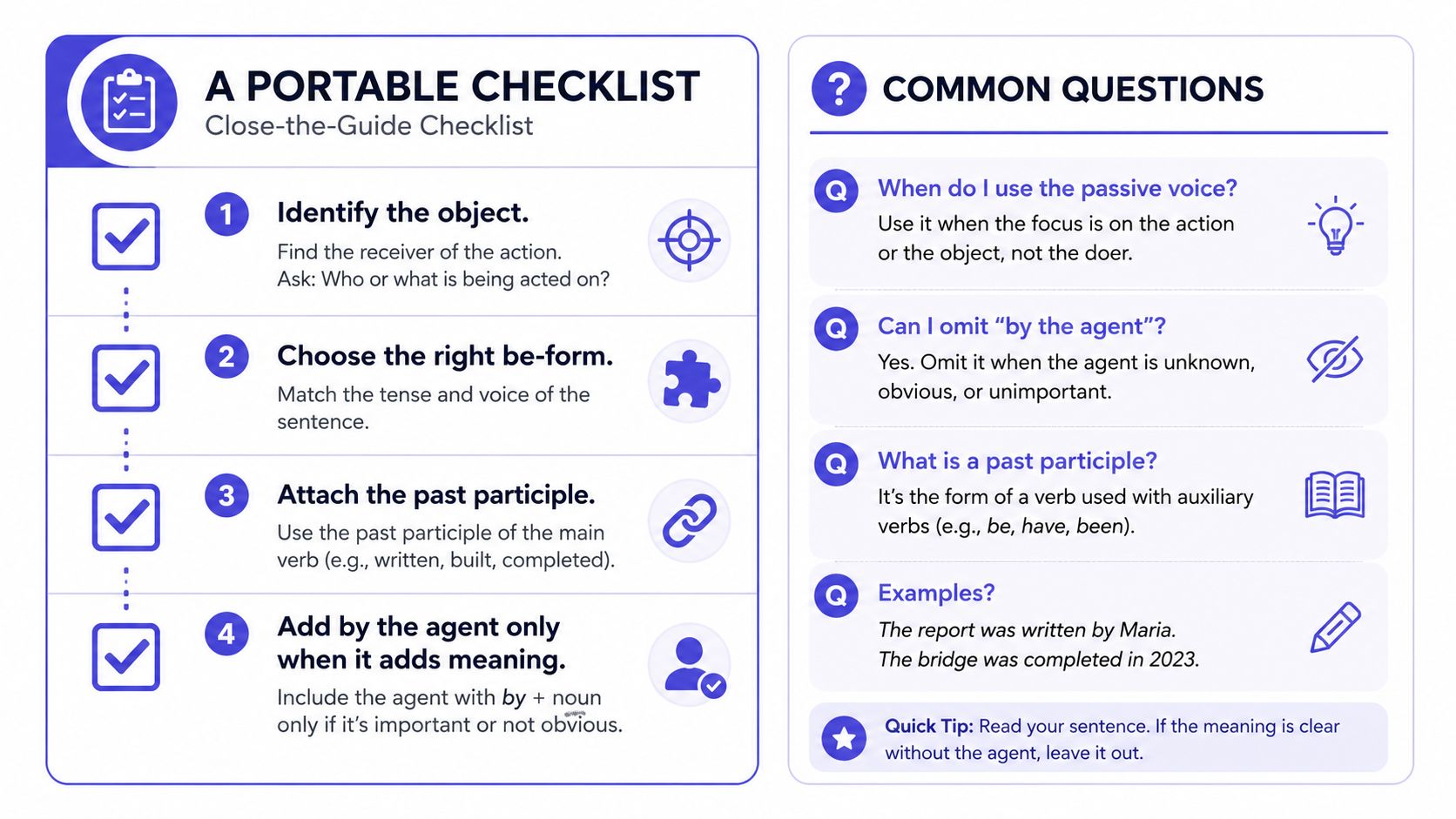
Keep this checklist beside your draft:
- Identify the object: Find who or what receives the action.
- Choose the be-form: Match the original tense or modal.
- Attach the past participle: Use written, made, chosen, or another correct form.
- Add the agent selectively: Use by only when the original subject matters.
- Read aloud: Confirm that the sentence sounds natural and keeps the intended emphasis.
What if there's no object?
Keep the sentence active when the verb is intransitive, as in The guests arrived. There's no receiver of the action to move forward.
How do modal verbs work?
Keep the modal, add be, and use the past participle: The staff should review the form becomes The form should be reviewed by the staff.
Should you use an online converter?
An online tool can quickly suggest a structure, especially when a sentence has a complicated tense. You should still verify the meaning, actor, and emphasis manually. For final cleanup after conversion, this guide to fixing copy-paste errors fast may help, and a separate grammar checking resource can support a final review.
AI Website Detector analyzes websites for AI-built platforms, CMSs, frameworks, hosting, and other technology signals, while showing the evidence behind its findings. Visit AI Website Detector to examine a site's stack and practice reading the same kind of evidence-based structure you've applied to sentence conversion.