Create a Rhyme from Words: Practical Techniques and Tips
You've got a word in front of you and the rhyme just won't come. You try spelling it out in your head, you scan the last letters, you chase words that look similar, and the line still sounds awkward when you say it aloud. That's the moment most writers get stuck, and it's also the moment where a sound-first method saves the draft.
Table of Contents
- Understanding What Makes Words Rhyme
- The Anatomy of a Rhyme Family
- A Step by Step Method for Generating Rhymes
- Choosing Between Perfect Rhymes and Near Rhymes
- Common Mistakes That Kill Your Rhymes
- When to Use Rhyme Generators and Digital Tools
Understanding What Makes Words Rhyme
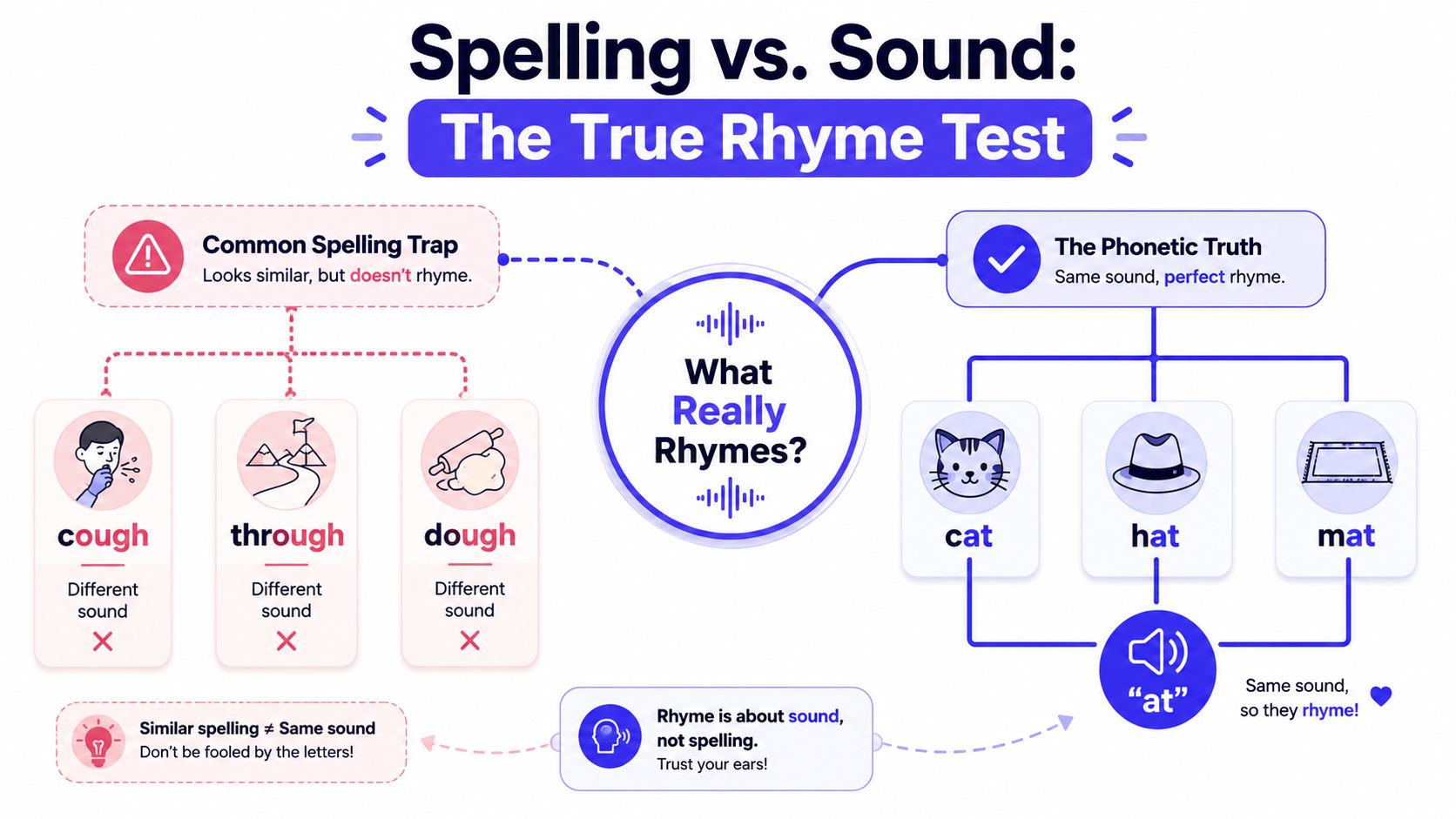
The fastest way to create a rhyme from words is to stop looking at the page and start listening to the ending sound. English rhyme is not based on matching the last letters, it's based on matching the stressed vowel and everything after it. That's why words can look unrelated and still rhyme cleanly, while words with similar spelling can miss each other completely. The standard linguistic definition treats rhyme as repetition of similar sounds in the final stressed syllable and any following syllables, and educational resources keep coming back to the same point, rhyme lives in sound, not spelling (Rhyme, Twinkl's rhyme overview).
A quick example clears up the confusion. Cat and hat rhyme because the ending sound matches, while words like cough and bough don't rhyme just because they share letters. The visual pattern is a trap. Once you train your ear to hear the final stressed syllable, you stop guessing and start testing pairs against a real phonetic target.
Hear the ending, not the letters
If you want a practical rule, use this one. Say the word out loud, find the stressed syllable, then listen to everything from that vowel to the end. If that chunk matches another word's chunk, you've got a rhyme.
Practical rule: If you're reading silently and only checking spelling, you're likely to pick the wrong partner.
That's why blue and shoe work even though the spellings don't match neatly. The ear hears the same ending sound. Writers who get comfortable with this habit move faster because they're no longer asking, “What looks similar?” They're asking, “What sounds the same?”
The Anatomy of a Rhyme Family
A rhyme family is a sound cluster, not a random pile of similar words. The useful part sits in the rime, which includes the vowel and the consonants that follow it. The part you're free to change is the beginning, the onset. Once you see that structure, rhyming becomes a search for relatives, not a hunt for coincidences.
Computational work on the CMU Pronouncing Dictionary makes that structure obvious at scale. One Language Log analysis found 50,344 rhyme equivalence classes under the standard definition of rhyme, and 30,905 of those were singletons, meaning they held only one word or pronunciation pair. The same analysis found 26,841 monosyllabic spelling and pronunciation pairs grouped into 1,078 rhyme classes, with only 160 singletons, which shows how densely rhymable short words are compared with the lexicon overall. For 42,663 initial-stressed disyllabic pairs, the study reported 17,212 rhyme classes and 11,042 singletons, or 64% of rhyme sets (Language Log analysis of rhyme classes).
Why short words give you more room
That data matters for practice. If you start with a one-syllable anchor, you're more likely to find a useful family quickly. If you start with a long or unusual word, you may need to widen the search and allow yourself more flexibility with phrasing.
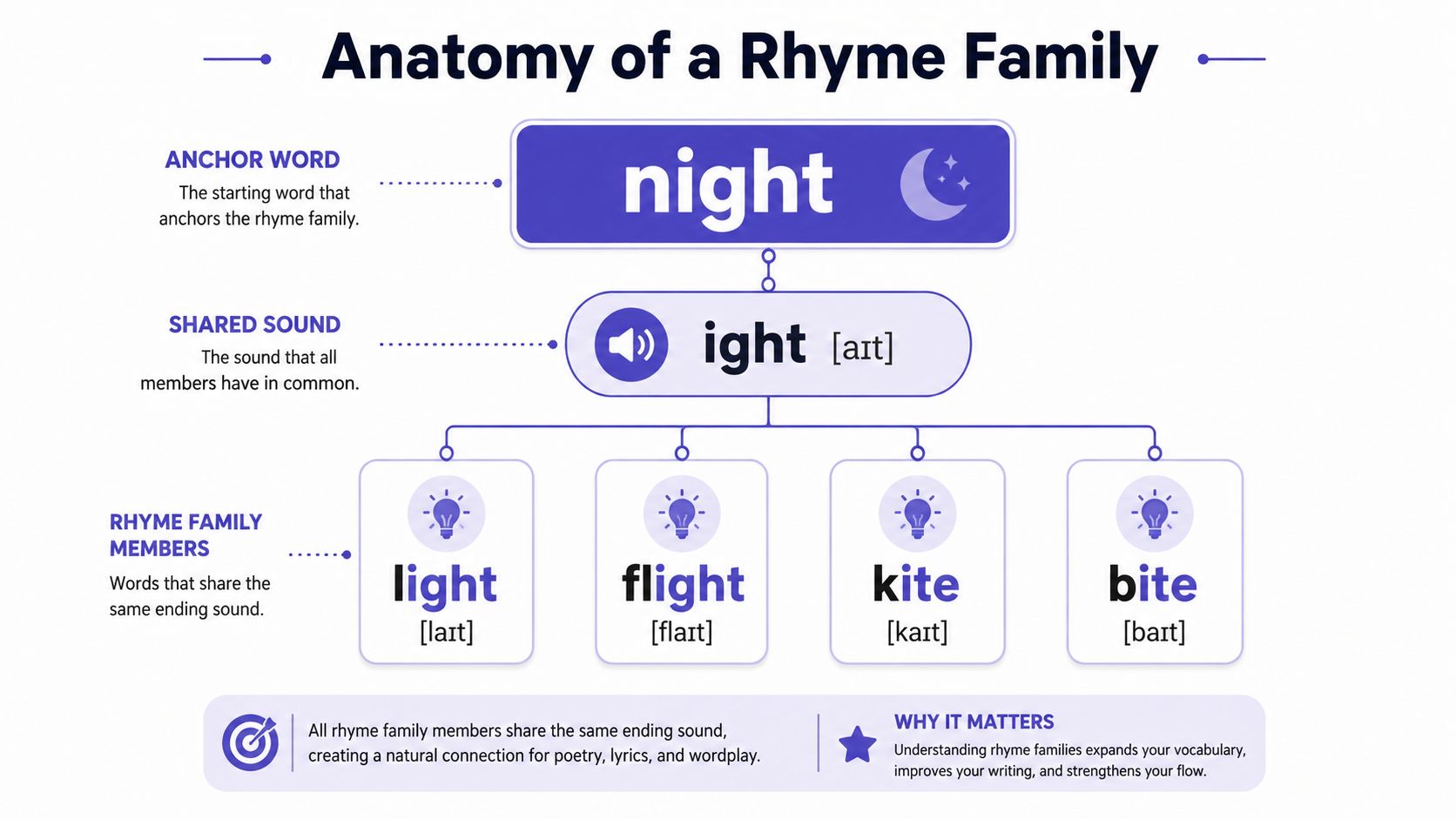
Here's the core move. Take a word like night, keep the -ight sound, and test new onsets: light, flight, bright, sight. The spelling changes, but the rhyme target stays stable. That's the same logic behind a family like bog, clog, frog. You're not matching letters, you're swapping the beginning while protecting the ending.
Useful habit: Separate the word into beginning sound, vowel core, and ending consonants before you start brainstorming.
That simple breakdown is the difference between brute-force guessing and controlled rhyme building. It also explains why some words feel easy and others feel stubborn. The “hard” word often isn't impossible, it just belongs to a smaller family, so you need a broader strategy.
A Step by Step Method for Generating Rhymes
You can start with a word you already know will carry the line. A short anchor gives you a clean sound shape, and a clean sound shape is easier to hear in your head before you write anything down. Once that anchor is in place, keep the ending steady and test different beginnings until the rhyme feels natural in speech.
A fresh example helps here. With day, you can try play and way. The ending stays stable, but the opening changes, so your ear can focus on whether the line still sounds smooth. If the word has more than one syllable, split it into parts and treat each part as a separate piece of sound. That gives you more control than trying to hold the whole word in your mind at once.
A simple practice loop
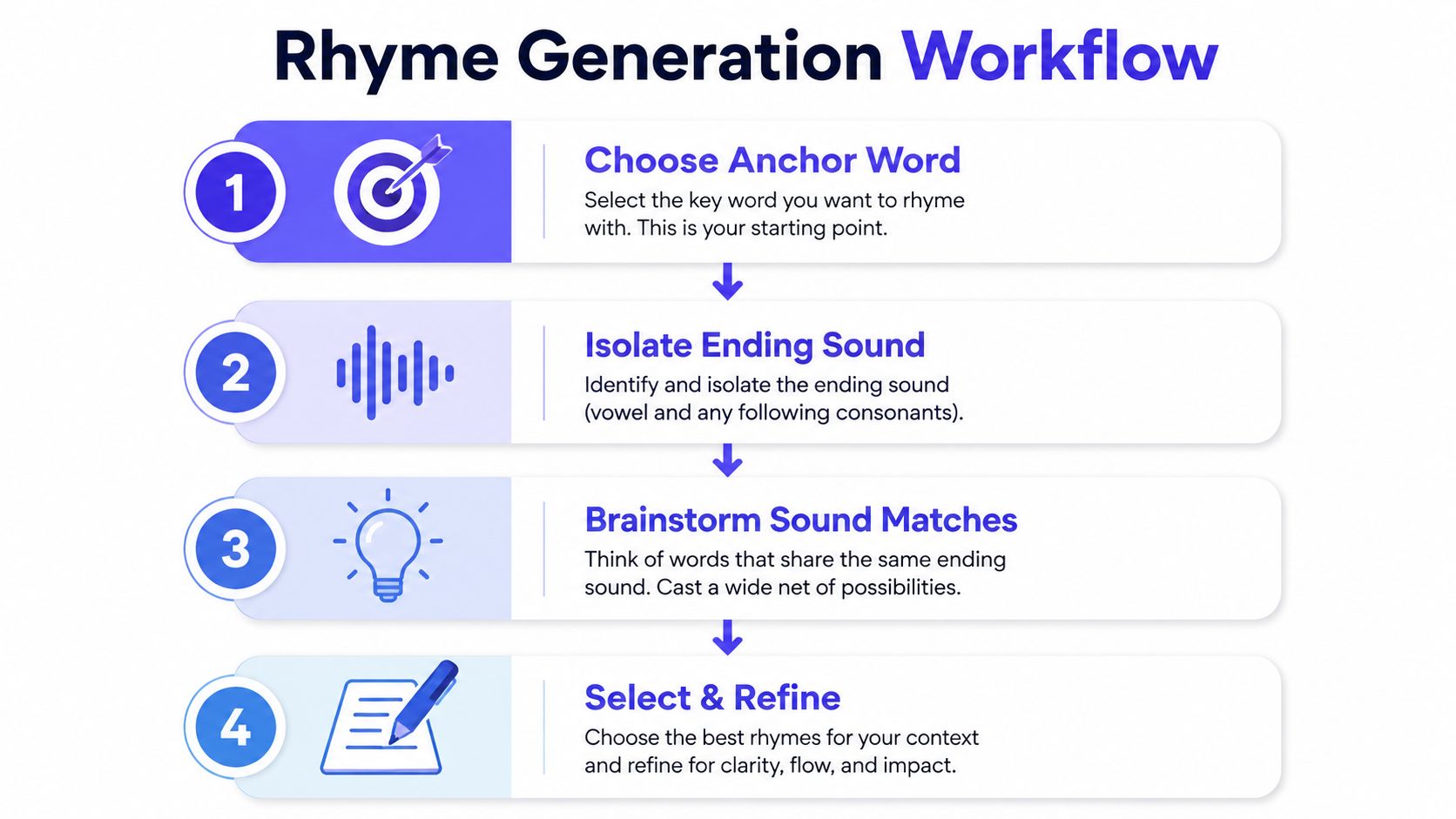
Use this sequence when a line stalls:
- Choose the anchor word. Pick the word that matters most to meaning, then leave it alone for a moment.
- Isolate the ending sound. Say the word aloud and hear the stressed vowel plus the consonants that follow it.
- Brainstorm sound matches. Write down rhyme-family members, related phrases, and alternate word orders.
- Select and refine. Read each choice aloud and keep only the one that sounds natural in the line.
That kind of loop is the same discipline used in a practical guide to rhyming from TCK Publishing. Draft the target line, test families built from the ending sound, use a rhyming dictionary when the ear stalls, and keep revising until the line speaks cleanly. The goal is not to pile up matches. The goal is to hear which option belongs in the sentence.
Read it out loud every time. A rhyme that looks right but lands awkwardly in the mouth still fails the page.
If you are working with a harder word, do not force the first match you find. Break the phrase apart, look for a different cadence, and rewrite the line around the sound you can support. That is how writers keep the meaning intact while still landing the rhyme.
If you want to check how a rhyme-heavy title or line reads in a real project, a tool like AI Song AI can help you review the wording before you commit. Use it as a check, then trust your ear for the final decision.
Choosing Between Perfect Rhymes and Near Rhymes
Perfect rhyme gives you closure. Near rhyme gives you freedom. If you're writing a nursery-style couplet, a perfect rhyme can make the line snap shut with satisfaction. If you're writing something more conversational, a near rhyme often sounds more human.
The main rhyme types at a glance
| Rhyme Type | Definition | Example | Best For |
|---|---|---|---|
| Perfect rhyme | The stressed vowel and following sounds match exactly | cat / hat | Clean endings, singable lines |
| Near rhyme | Sounds are close, but not exact | home / stone in some contexts, depending on delivery | Flexible verse, softer closure |
| Internal rhyme | The rhyme lands inside the line, not just at the end | A line that places matching sounds mid-line | Rhythm, momentum, subtle musicality |
The important point is not that one type is better. It's that each type solves a different problem. Perfect rhyme can sound tidy, but overuse can make a piece feel predictable or forced. Near rhyme helps you preserve meaning when the exact match doesn't cooperate. Internal rhyme adds motion without demanding a full end-stop.
Choose by job, not by habit
If the line needs a strong final click, use the exact match. If the line needs to keep breathing, loosen the sound relationship. Writers who treat rhyme as a single rule tend to corner themselves. Writers who treat it as a set of options can shape tone more precisely.
For multilingual or accent-sensitive writing, pronunciation matters even more than spelling. A rhyme that works in one speech community may feel loose or unnatural in another. That's not a flaw in the technique, it's a reminder that rhyme is heard by real people with real voices.
The old mistake is to use the first perfect rhyme that appears on the page. The better move is to ask what the line needs emotionally, rhythmically, and verbally, then choose the rhyme type that serves that need.
Common Mistakes That Kill Your Rhymes
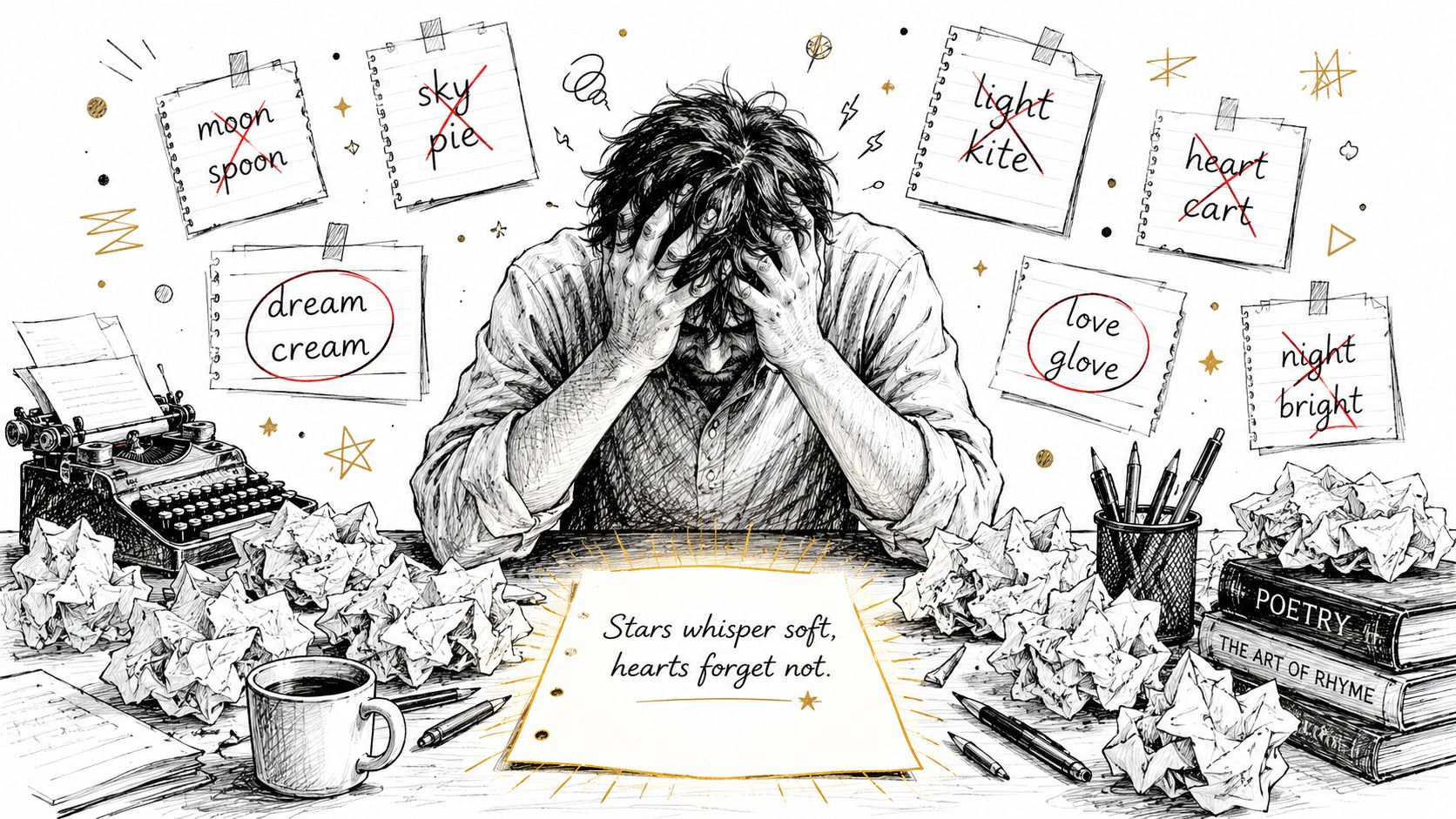
I've seen the same problems again and again in student drafts. The writer finds a word that rhymes, gets excited, and then bends the whole sentence around it. The result often sounds like the rhyme is driving the poem instead of supporting it.
One common trap is ignoring stress patterns. A pair can look close and still miss the ear if the stressed syllable doesn't line up. Another is relying too heavily on identical end sounds, which can make the writing feel mechanical. A third is letting rhyme outrank meaning, so the line says something just to land the sound.
A better recovery plan
When the rhyme dead-ends, don't keep pushing. Rephrase the sentence, switch to a near rhyme, or change the line break so the natural word order can breathe. Some words really are hard to rhyme, and that's normal. Skilled writers know when to widen the frame instead of hammering the same corner.
If the line sounds like you had to force it, your reader will hear that strain too.
Reading aloud catches more problems than silent proofreading ever will. It exposes stress mistakes, awkward phrasing, and endings that look clever but feel clumsy. That's why pedagogical writing guides keep repeating the same advice, sound first, then meaning, then polish. The line has to carry both.
If you want a useful internal check, compare the draft to a quick scan with AI text checking tools. Not because a tool can judge poetry for you, but because it can help you separate clean phrasing from awkward repetition while you're revising.
When to Use Rhyme Generators and Digital Tools
Manual rhyming builds judgment. Digital tools speed up the search. The strongest workflow uses both, because each one covers a weakness in the other. Your ear can tell you what feels natural, but a generator can surface options you wouldn't think of on your own.
That matters most when the target word is unusual, when you're writing in a language or accent you don't use every day, or when you want to compare exact rhyme with near rhyme quickly. The right tool can help you move from a blank page to a usable candidate list without turning the process into guesswork. For phrase-level writing, not just single-word lookup, the challenge is even bigger. You're not only matching sounds, you're protecting meaning, rhythm, and style across the whole line. That gap is why find anaphora examples for inspiration can be useful too, because repeated structure often gives you a cleaner path into a rhyme.
Use the tool, then trust the ear
Digital suggestions are only a first pass. Filter them by spoken rhythm, not by how clever they look in a list. A technically correct rhyme can still fail if it interrupts the sentence or drags the meaning off course.
For drafting support, a general AI text generator can help you explore alternate phrasing before you settle on the final rhyme. The value is not that it writes the poem for you. The value is that it gives you more raw material to edit, cut, and reshape with your own ear.
Best use of a generator, get options fast. Best use of your own skill, choose the line that still sounds like you when it's read aloud.
The healthiest habit is simple. Draft by hand, check with a tool when you're stuck, then return to the voice and rhythm of the piece. That mix keeps rhyme from becoming mechanical and keeps your writing from getting trapped in the first idea that appears.
If you're checking whether a site or writing tool is AI-built or just marketed that way, AI Website Detector can help you verify the stack and the signals behind it. It's a practical companion for creators who want to compare tools with confidence, and it fits naturally into a workflow where you care about how things are built, not just what they promise. Visit AI Website Detector when you want a clearer read on the technology behind the page.