AI Fact Checking: How to Validate Claims and Content in 2026
You've got an AI draft open in one tab, a meeting in ten minutes, and a sentence in front of you that sounds polished enough to ship. Then you notice the claim has a date, a number, and a source you haven't seen before. That's the moment where AI fact checking stops being a niche skill and becomes part of everyday work, especially for founders, marketers, analysts, and editors who need to decide what's safe to publish, share, or trust.
The hard part isn't spotting obvious nonsense. It's deciding what to do with a claim that feels plausible, reads cleanly, and still might be wrong. A useful way to think about that problem is to treat verification as a workflow, not a gut feeling, and to lean on practical frameworks like the false information detection guide when you need a broader literacy check alongside your own review. If you're also tracking how AI is changing publishing and discovery workflows, the patterns in AI adoption statistics help explain why verification has become a routine operational task, not an occasional editorial extra.
Table of Contents
- Why AI Fact Checking Has Become Essential
- The Three-Stage Pipeline Behind Automated Verification
- What the Data Reveals About AI Speed and Accuracy
- A Practical Workflow for Verifying AI-Generated Claims
- Where AI Fact Checking Breaks Down in Practice
- Choosing Tools and Approaches That Surface Real Evidence
- Building Your Own AI Fact Checking Decision Framework
Why AI Fact Checking Has Become Essential
A marketing lead asks an AI tool for a quick summary of a product trend, and the draft comes back confident, structured, and wrong in one subtle place. A founder copies that sentence into a pitch deck because it looks clean enough, and a week later someone asks where the number came from. That's the modern risk, the output doesn't look suspicious, it looks ready.
The bigger shift is scale. The global fact-checking ecosystem has moved beyond a few newsroom specialists, and the Poynter Institute's State of the Fact-Checkers reporting describes more than 100 fact-checking organizations in dozens of countries in a mature international network, not a niche practice (Poynter report). At the same time, automated verification work has become structured around a computational workflow, so AI fact checking is no longer just a prompt and a verdict, it's a process with stages, evidence, and handoffs.
Why ad hoc checking fails
The old habit was simple. If a claim sounded off, someone Googled it, skimmed a result, and moved on. That can still catch obvious errors, but it breaks down when the claim is buried in a chain of paraphrases, screenshots, or AI-generated summaries. The problem isn't only false information, it's the speed at which polished text enters drafts, internal docs, and social posts before anyone checks the source trail.
Practical rule: If a claim affects money, reputation, compliance, or public trust, it needs a verification step before anyone treats it as fact.
That's why this topic matters to more than journalists. Marketers need it for campaign copy, analysts need it for dashboards and market summaries, and product teams need it when AI drafts support content or release notes. When a workflow depends on speed, verification has to be built into the process, not added at the end when people are already ready to click publish.
The Three-Stage Pipeline Behind Automated Verification
The standard architecture in automated fact checking is surprisingly clean. It starts by finding a claim, then looking for evidence, then deciding whether the claim holds up. That structure appears in the automated fact-checking survey and the resources project as claim detection, evidence retrieval, and claim verification (MIT survey, Automated Fact-Checking Resources).
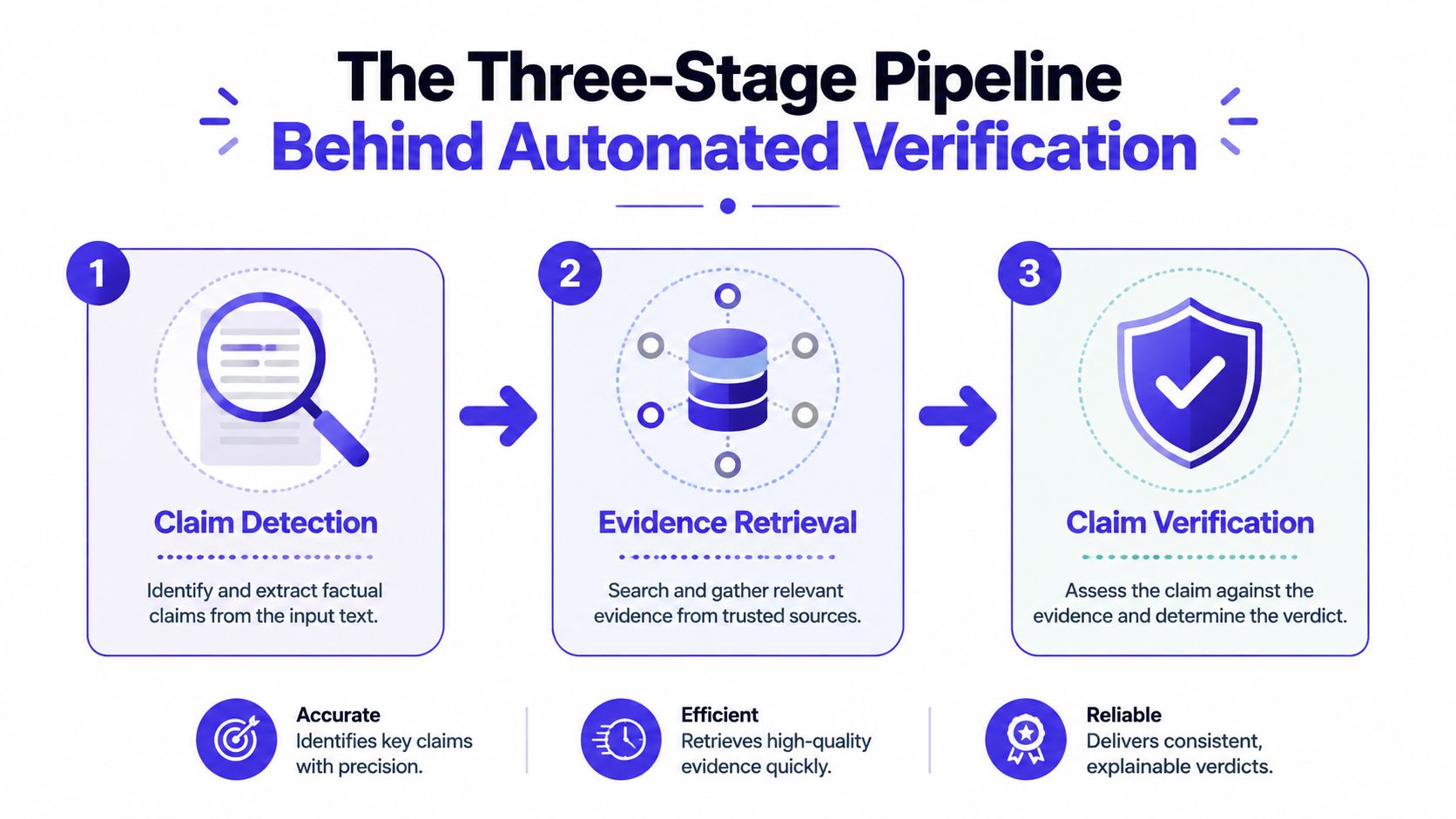
Stage one is claim detection
Think of this as the scanner. The system reads text, spots statements that are check-worthy, and separates them from opinion, framing, or background color. That matters because not every sentence deserves the same level of scrutiny. A system that flags every adjective is noisy, while one that misses a numerical claim can let a bad answer slide straight through.
Stage two is evidence retrieval
This is the evidence locker. The system looks for sources that might support or contradict the claim, and the quality of that retrieval sets the ceiling for everything that follows. If the wrong documents come back, even a strong verifier can only make a weak judgment.
Stage three is claim verification
This is the verdict stage, where the model decides whether the claim is true, false, misleading, or uncertain. Some systems stop there, but better ones also generate justification as a separate output rather than assuming classification is explanation. That distinction matters because a clean label without evidence is hard to audit, especially when the claim is high stakes.
A useful test is simple. If a vendor says a product does “end-to-end fact checking,” ask which of the three stages it actually covers, and ask what evidence you'll see at each step.
The same pipeline also helps you compare tools without getting distracted by branding. A browser extension, a newsroom workflow, and an LLM-based verifier can all look similar on the surface, but one may only detect claims while another retrieves evidence and explains its reasoning. Once you can name the stages, you can see the gaps.
What the Data Reveals About AI Speed and Accuracy
A newsroom editor facing a fast-moving claim feed sees the operational value of AI fact checking immediately. AI systems can surface a potential claim in minutes, while human reviewers often reach it much later, which changes what gets checked at all. In one 2026 study of AI fact-checkers, 20 AI writers accounted for 14.2% of all submitted notes between September 2, 2025 and May 9, 2026, and their share rose to 44.8% in the most recent period analyzed (study PDF).
That same study found AI writers contributed notes to 16.8% of fact-checked posts, and 74.4% of those posts were not checked by human writers (study PDF). For verification teams, that is a workflow signal, not just a model metric. AI is expanding coverage into areas human staff have not reached yet, which matters when the queue is growing faster than the reviewers.
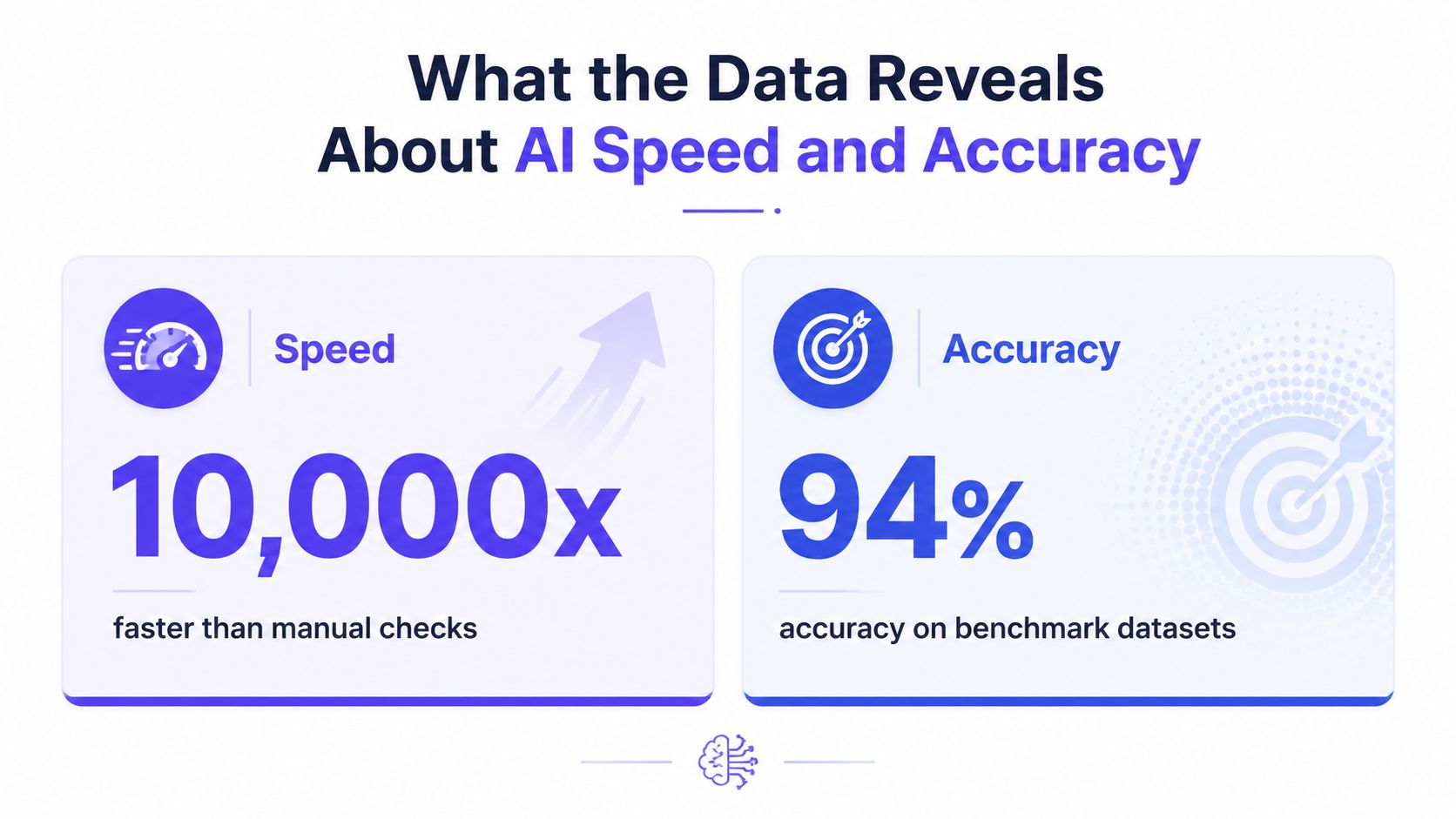
Speed is the key operational advantage
Timing is where AI changes the queue. AI writers typically submitted notes within minutes of posts entering the API feed, while human writers had a median lag of 11.9 hours. The median gap between AI notes was 7 minutes, compared with 98 hours for human experts (study PDF). That is a workflow shift, because it lets a team catch and sort claims while they are still circulating, rather than after the conversation has already moved on.
For editors and analysts, AI fact checking works best as a triage layer. It can flag likely errors, rank what deserves attention, and keep pace with incoming content. It provides weaker guidance for ambiguous claims that require nuanced judgment, especially when the wording depends on context, source intent, or a high-stakes decision.
Accuracy depends on context
Accuracy changes once the model gets better evidence. Research summarized in Frontiers article reports that GPT-3.5 and GPT-4 reached 63–75% average accuracy without context, improving to above 80% and 89% for non-ambiguous verdicts when context was added. A separate analysis in the IJCAI paper shows the same pattern, with retrieval and evidence framing pushing the model toward more dependable judgments.
That trade-off is why speed alone is only half the story. AI can sort claims quickly, but fast output without evidence context can still miss the mark. If you are evaluating a tool, ask two questions. What happens when the system gets stronger evidence, and how does it behave when the claim does not have a clean answer?
A Practical Workflow for Verifying AI-Generated Claims
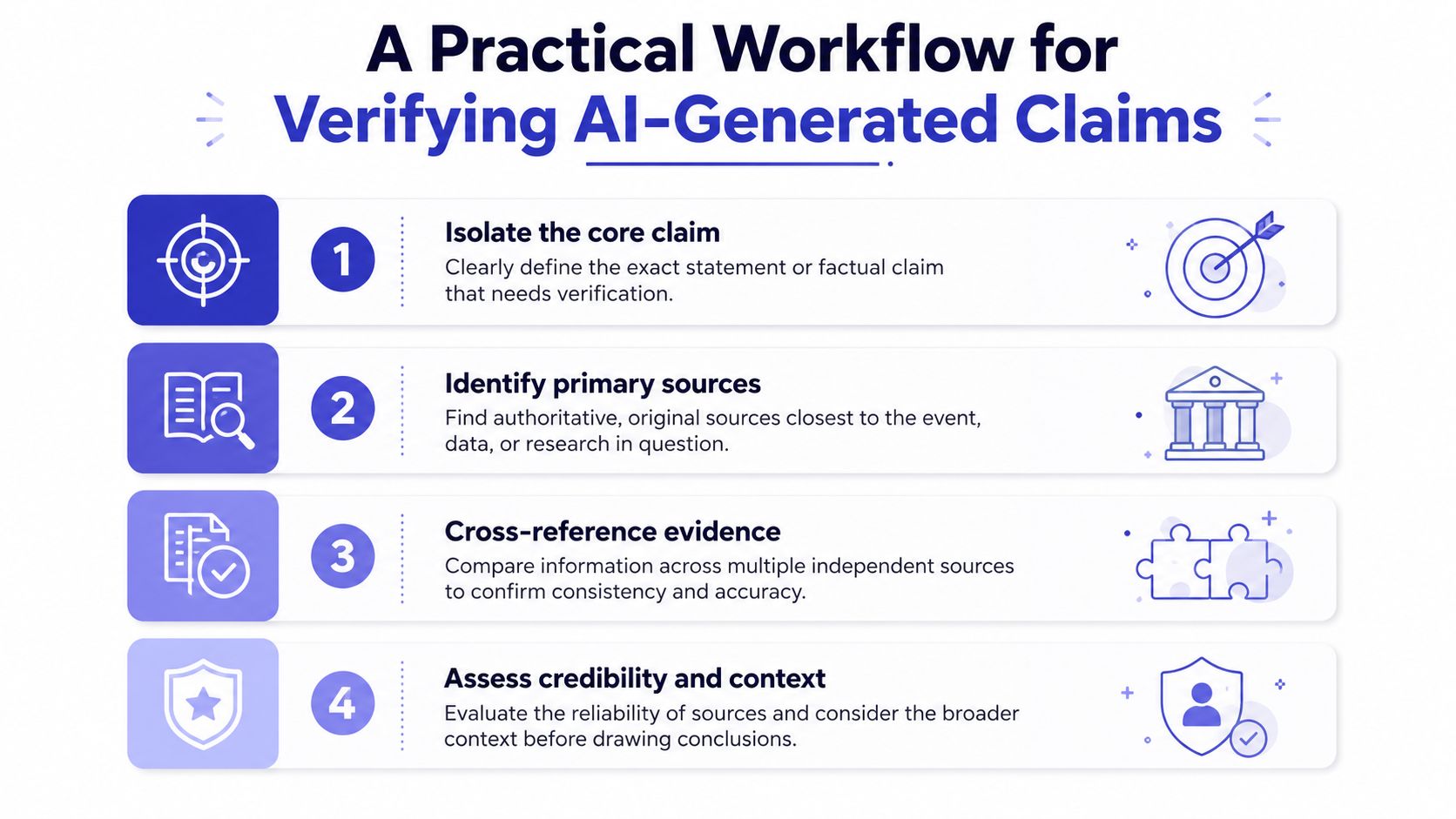
A useful verification workflow starts with a simple habit, split the answer before you trust it. The University of Maryland's guide breaks verification into fractionation, lateral reading, examining assumptions, and making a judgment call (UMD guide). That order matters because it slows the impulse to accept a polished response and makes you inspect what the model has bundled together.
Break the answer into testable parts
Fractionation means turning a long AI response into smaller factual statements. One paragraph can hide a date, a name, a definition, and a conclusion, and each piece needs separate attention. That matters most when the AI gives a polished summary that combines several claims into a single block of text.
The practical question is simple. What can be checked on its own, and what depends on surrounding context? A statement about a policy date can be verified differently from a broad interpretation of what that policy means.
Check the right claims first
A method from Forward Currents recommends verifying the top 3 factual claims, especially those involving numbers, dates, names, studies, or legal/medical content (Forward Currents). That priority order reflects how verification work happens in practice. A harmless opinion and a legally sensitive claim do not deserve the same amount of attention.
Once you have separated the claims, sort them by risk and clarity. Clear factual statements usually give you the fastest signal, while vague language often needs more source work before you can decide whether the answer holds up.
Read across sources, not just within one page
Lateral reading means opening new tabs and comparing the claim against other sources instead of staying on the page that produced it. That habit matters because a source can sound polished and confident while still being weak evidence for the claim. If you are checking a high-stakes answer, look for one primary source, one reputable secondary source, and an authoritative database if applicable.
For teams building verification routines, the human-AI handoff becomes visible. AI can help surface likely evidence quickly, but the reviewer still has to judge source quality, missing context, and whether the claim is being overstated. A practical companion to that workflow is transforming journalism with news extraction, which shows how structured extraction can support verification work without replacing editorial judgment.
A good mental model is to treat the AI output like a draft, not a conclusion. If you are evaluating a tool, ask which of the three stages it covers, and ask what evidence it can retrieve before a person makes the final call. That is the line between fast triage and real verification.
Connect the workflow to the tool, not the headline
The easiest mistake is to judge an AI fact-checking tool by how confidently it speaks. A better test is operational. Can it detect claims, pull evidence, and leave space for a human to verify the parts that depend on context or judgment? That question is especially useful when tools are marketed as if they can do the whole job on their own, including systems discussed in broader reviews of how AI website builders work, where the real question is often what the system can reliably inspect rather than what it can simply describe.
Where AI Fact Checking Breaks Down in Practice
A claim can look clear on the surface and still fail the moment context enters the picture. Research from the Reuters Institute says generative AI is proving less useful in small-language contexts, while human expertise remains essential because AI cannot fully grasp context, intent, or credibility (Reuters Institute). That matters in practice because verification is not just about spotting a statement, it is about understanding what the statement means in a local language, culture, or political setting.
The same pattern shows up in how teams use these tools. AI is often trusted to scan large volumes of obvious red flags, while humans are still preferred for judgments that depend on stitching together evidence or reading a complicated situation correctly. That split makes operational sense. AI can surface candidates for review quickly, but it is still weak at deciding what a claim means once context, tone, and source quality are part of the job.
Why the mixed model is gaining ground
Recent scholarship argues that fact checking is shifting toward a distributed model where AI handles initial classification and drafting, community contributors add fast contextual notes, and experts take on complex or high-stakes claims (Harvard Misinformation Review). That matches how newsroom workflows often work under pressure. One layer filters volume, another layer adds speed, and a final layer makes the judgment calls that need experience.
Human review is still the safeguard when the claim involves stakes, ambiguity, or context the model cannot reliably infer.
The same article also warns that automation can create informational-justice risks if the system is opaque or unevenly accurate across groups (Harvard Misinformation Review). That problem is easy to miss when a tool looks polished. If it performs well for one language, one region, or one type of claim, but not for others, the failure is not only technical, it changes who gets reliable information and who does not. The same caution applies when a system appears trustworthy on the outside but produces shaky outputs inside, the kind of failure discussed in efforts to avoid fabricated BI data, where clean presentation can hide weak evidence.
If you are comparing AI-generated websites or other AI-built outputs, the surrounding stack deserves the same scrutiny. A review of how AI website builders work is a useful reminder that automation can hide uneven quality behind a polished interface. The page may look finished, but the underlying evidence can still be thin.
Choosing Tools and Approaches That Surface Real Evidence
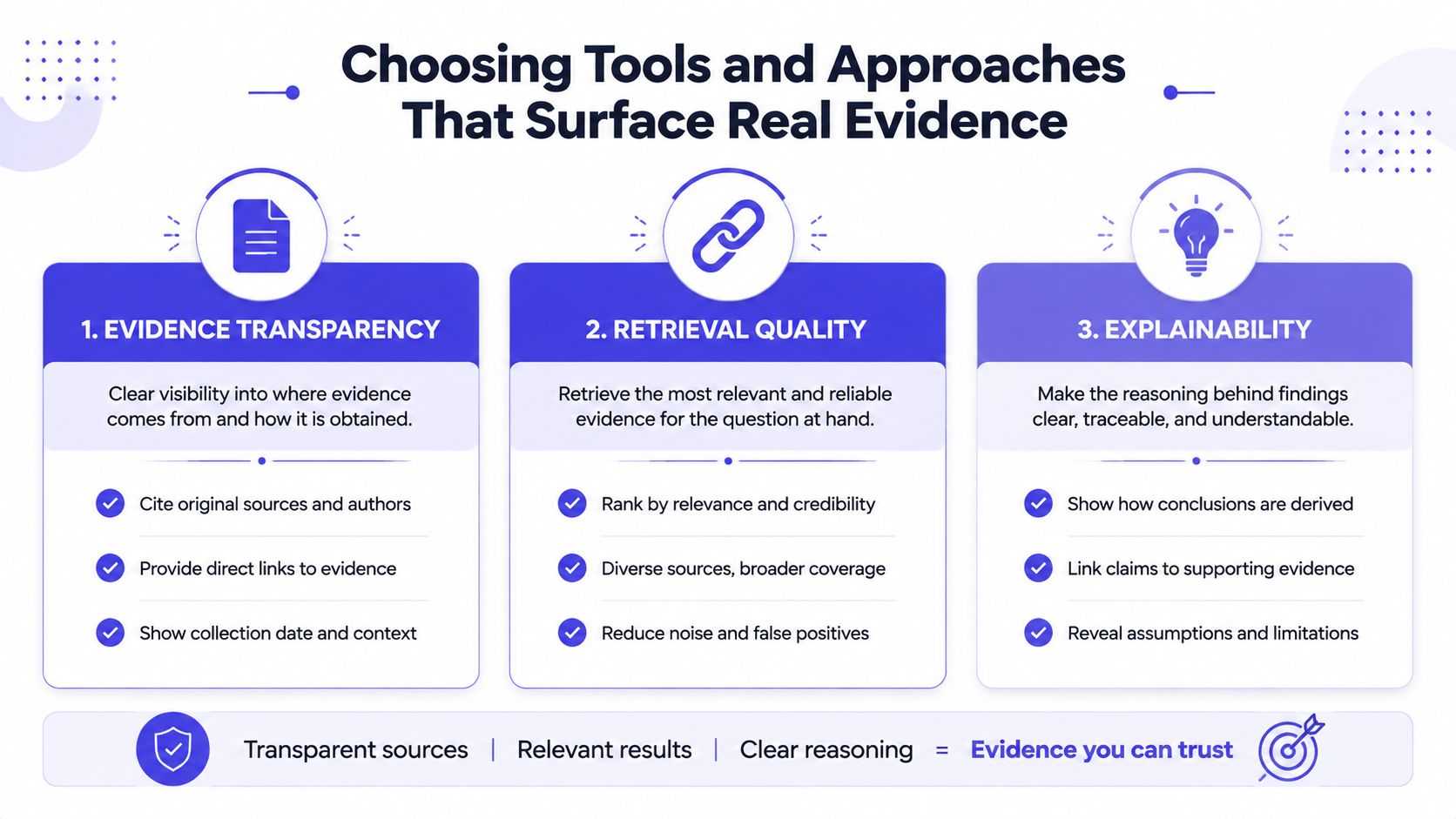
The best tools don't just give you a verdict, they show their work. An explainable fact-checking system should surface the sources it used, the way it ranked them, and the reasoning chain that led to the conclusion. In the IJCAI paper, one open-source system outputs a numerical veracity score, source counts, and average credibility ranking, which is exactly the kind of transparency that makes auditability possible (IJCAI paper).
Compare tools by evidence quality
An LLM-only verifier may sound smart, but it can be hard to audit when it produces a verdict without clear sourcing. A retrieval-augmented system is stronger when it links the answer to external evidence. Browser extensions and platform-native checks can be useful for quick screening, but they still need transparent source handling if you're going to trust them for more than surface-level review.
Look for explanations, not just scores
A confidence score can be useful, but a score without source detail is just decoration. Better systems expose why the model leaned one way, what evidence it found, and where uncertainty remains. That matters because a claim can be technically classified and still be poorly supported.
Match the tool to the job
A high-volume content team doesn't need the same review pattern as a compliance team. For low-stakes drafts, a lightweight checker may be enough to catch obvious mistakes. For legal, medical, or financial claims, you want a setup that preserves audit trails and lets a human reviewer inspect the evidence before anything goes live.
For readers who work with websites and content systems, it's also useful to think in stack terms. The same disciplined evaluation you'd use to inspect AI-generated content applies when you're comparing products, workflows, or site builders. The AI TXT checker is a good reminder that transparent evidence beats a glossy verdict every time.
Building Your Own AI Fact Checking Decision Framework
A useful decision framework starts with stakes. If the claim is low risk and easy to verify, AI can help you triage it quickly. If the claim is ambiguous, high impact, or tied to a sensitive domain, the final call should move to a human reviewer who can inspect the evidence, the context, and any missing assumptions.
The second question is whether the system shows its work. If a tool can't point to sources, doesn't explain how it reached the verdict, or behaves differently across languages or claim types, treat it as a helper, not a gatekeeper. That's especially important when you're reviewing outputs that could affect customers, clients, compliance, or your brand's credibility.
A simple rule set for teams
- Use AI for triage: Let it flag likely claims, obvious red flags, and items that need a faster look.
- Escalate human review for stakes: Send anything legal, medical, financial, reputational, or politically sensitive to a person.
- Audit for consistency: Compare how the system behaves across different languages, claim types, and source quality.
- Document the handoff: Keep a record of what AI flagged, what evidence was checked, and why the final judgment was made.
That framework keeps verification practical without pretending automation can do the whole job. AI fact checking works best when it narrows the pile, not when it replaces editorial judgment. The goal is a workflow that scales without losing accountability, and that's what the strongest teams are building now.
If you're comparing claims, websites, or AI-generated content and want a clearer read on what's automated versus what's built by humans, visit AI Website Detector for explainable analysis of the tech stack behind a site. It's a practical companion to the verification habits in this guide, especially when you need to test how much of a digital property is AI-assisted, AI-native, or fully manual.