Chatbot Detector Guide: How to Spot Bots in 2026
A founder opens the support inbox on a Monday morning and sees chat replies that sound polished in a way real agents rarely are. A recruiter sees candidate answers that feel rehearsed, but not obviously copied. A fraud analyst watches a live conversation slow down in odd places, then speed up again as if someone is hiding behind the keyboard. That's where a chatbot detector earns its keep, not by guessing from vibes alone, but by checking the surface, the timing, and the evidence trail before you decide what's human.
Table of Contents
- The Moment You Suspect the Chat Isn't Human
- What a Chatbot Detector Actually Evaluates
- A Layered Process to Expose a Chatbot
- Behavioral and Artifact Signals That Hold Up
- Verifying Chatbot Citations and Factual Claims
- Where Chatbot Detectors Quietly Fail
- Putting It All Together in a 15-Minute Investigation
The Moment You Suspect the Chat Isn't Human
The first warning usually isn't a dramatic tell. It's a support transcript that's oddly consistent, a sales chat that answers too quickly, or a candidate message that stays perfectly on script even after you ask something awkward. I've seen teams lose time chasing the wrong suspect, a vendor, a contractor, a compromised account, when the issue was that the conversation itself had been automated.
The cost of getting this wrong depends on the room you're standing in. In moderation, a false accusation can burn trust with a real user. In fraud screening, missing a bot can let abuse scale. In hiring or academic review, a bad call can turn into a credibility problem before anyone notices the detector was weak in the first place.
A good instinct is to separate “this feels artificial” from “I have evidence.” The feeling matters because it tells you to inspect further. The evidence matters because, as the MIT Sloan finding in the source set shows, bot-detection models can look strong on the data they were trained on and then perform little better than random guessing on a different dataset, which is a reminder that a verdict can collapse outside its original context (MIT Sloan).
Practical rule: if the consequence is serious, don't rely on one score or one transcript. Pull timing, metadata, and source evidence before you label anything.
That habit saves time later. It also keeps you from treating a polished response as proof of a machine, when it might just be a careful human, a template, or an AI-assisted workflow.
What a Chatbot Detector Actually Evaluates
A serious chatbot detector isn't one test, it's several different lenses pointed at the same target. Some systems score the writing itself, some score interaction behavior, and some inspect deployment artifacts like widget scripts, webhooks, CMS traces, and bundle fingerprints. If you only look at prose, you'll miss bots that paraphrase well or adapt across turns. If you only look at timing, you'll miss a human who pastes prepared answers.
Text, behavior, and artifacts are different signals
Text classifiers are useful when the output is a plain paragraph and the model behind it hasn't been heavily edited. They're weaker when the content has been paraphrased, split across turns, or edited by a person after generation. Behavioral detectors look at cadence, turn-taking, and response regularity, which is why they're more useful in live conversations than in pasted-text scans.
Artifact detectors answer a different question, whether the system itself is running on top of AI builders, injected widgets, or known automation infrastructure. That matters because the strongest evidence often isn't in the words at all, it's in the browser, the network requests, or the declared platform stack.
A practical framing is to match the layer to the problem. If you're checking a support widget on a site, you need deployment evidence. If you're checking a live chat transcript, you need timing and interaction patterns. If you're checking whether a response is trustworthy, you need citation verification. For a plain explanation of score logic in a website-analysis context, see how scores work.
Why layered evidence beats a single score
The reason layered analysis works is simple. Different automation styles leak different clues. A chatbot can rewrite its text, but it can't always hide consistent timing. It can vary timing, but it still leaves fingerprints in the site stack or message pipeline. It can even mimic a human better over a few turns, but it may still fail when you ask it to support a factual claim with a real source.
That's why the best detectors behave more like fraud tools than scorecards. They combine weak signals until the pattern becomes hard to dismiss. A confidence score can be a starting point, but it's not a conclusion.
A Layered Process to Expose a Chatbot
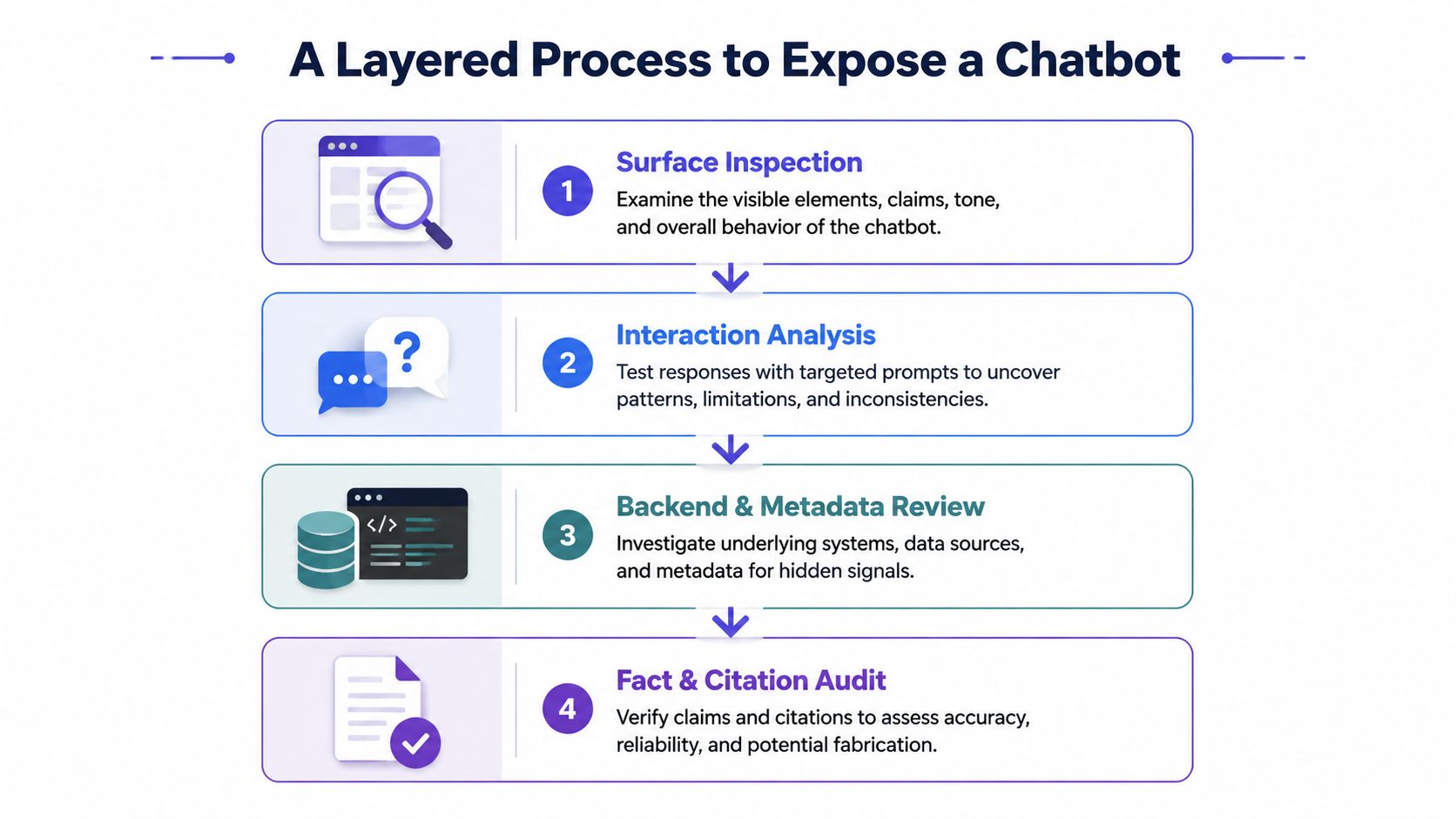
Start with the site itself. If you're auditing a chat product, inspect the page source, loaded scripts, embedded widgets, and any obvious provider markers. The goal is to see whether the conversation layer is stitched into a known service or custom stack. If you need to extract the page cleanly, a tool like scrape markdown api can help you preserve the surrounding structure for review without losing the evidence trail.
Then open the browser's network panel and watch the requests the conversation triggers. Look for XHR calls, headers, and backend endpoints that hint at an AI service or a third-party chatbot framework. Check metadata too, including visible tags, robots declarations, and any AI or LLM text files that might disclose the provider or its intended crawler behavior. For teams that already work with support automation, a guide to AI support automation can make the system architecture easier to recognize when you're comparing a real deployment against a claim.
| Layer | What you inspect | Best evidence type | Time required |
|---|---|---|---|
| Surface Inspection | Scripts, widgets, embedded providers | Deployment fingerprints | Short |
| Interaction Analysis | Timing, turn-taking, response length | Behavioral patterns | Short to moderate |
| Backend & Metadata Review | Headers, endpoints, tags, AI text files | Stack and service evidence | Moderate |
| Fact & Citation Audit | Claims, references, source support | Verifiable citations | Moderate |
Read the conversation like a trace, not a transcript
Once the surface tells you the chat is worth examining, capture the interaction as evidence. Timing matters, especially message size and the delay between turns. A predictable cadence often says more than the wording itself. In conversation systems, the USENIX entropy-based classifier uses message size and inter-message delay distributions, then checks entropy and entropy rate to separate regular bot-like flows from irregular human-like ones (USENIX).
That's useful because it catches coordination patterns even when the text is masked. But it's not enough on its own. A bot can randomize delay, and a human can type slowly, especially in a high-stakes setting.
Finish with pointed factual checks
The last layer is content. Ask a domain-specific question that forces the system to support itself. If the bot offers sources, verify them. If it cites studies, check whether the titles, authors, journals, and years exist and match the claim. If it can't support a factual statement, you've moved from suspicion to evidence.
A clean way to keep this organized is to record the findings under four headings, surface, behavior, backend, and facts. That makes later review easier, and it stops a weak signal from overpowering stronger ones.
Practical rule: record the weakest and strongest signal separately. A detector that only stores the final score is hard to defend later.
Behavioral and Artifact Signals That Hold Up
A pasted paragraph can sound human and still come from automation. In live support chats, the cleaner tells are usually in how the conversation moves and what the system leaves behind. That is where a chatbot detector becomes more useful: not by chasing style alone, but by checking cadence, deployment traces, and evidence that survives a rewrite.
Timing tells you more than style
In a live chat widget, timing has context. A human usually leaves uneven gaps, hesitates before harder questions, and shifts pace when the thread gets tense. A system that answers from a fixed workflow often keeps a steadier shape, even when the wording changes. That matters more in chat than in pasted-text checks, because the interaction is happening in real time, not as a static block of prose.
Pasted text is different. A copied answer can hide the source's original rhythm, so the delay between turns is less informative than the structure of the exchange itself. A live operator, a handoff, and an automated reply can all produce similar wording, but their response timing, interruption patterns, and turn ownership usually do not line up the same way. That is the part I pay attention to first.
Timing still cuts both ways. A bot can vary delays, and a human can respond in bursts under pressure. Treat cadence as one signal in a larger chain, not as a verdict by itself.
Artifacts survive where wording does not
On the technical side, stable artifacts are often more durable than the chat content. I look for deploy tokens, widget hashes, CDN hostnames, and bundle identifiers because they survive a lot of text-level obfuscation. Those traces can reveal whether a conversation is coming from a managed support stack, a custom integration, or a wider AI-enabled workflow.
For site-level review, AI Website Detector can surface AI-builder fingerprints, bundle evidence, and broader tech-stack signals. When I want a quick pass on whether a site exposes hidden builder traces, I also use the LLM TXT checker to compare what is publicly exposed against what the chat layer appears to be doing. I'd still pair that with manual review, because no scan replaces judgment on live interaction data.
Weak signals to treat carefully
Response latency alone is weak. A fast human exists. A slow bot exists. The same goes for generic politeness, long answers, or short answers. None of those should drive the final call by themselves.
A better triage set is usually two or three signals that agree, one from behavior and one from infrastructure, with content used as confirmation. If the chat is part of a support flow, I also want to compare it with the guide to AI support automation so I know whether the deployment pattern fits a known automation path. That mix is harder to fake and easier to defend.
Good practice: if the artifact evidence and the timing disagree, keep digging. Disagreement often means the system is hybrid, not purely automated or purely human.
Verifying Chatbot Citations and Factual Claims
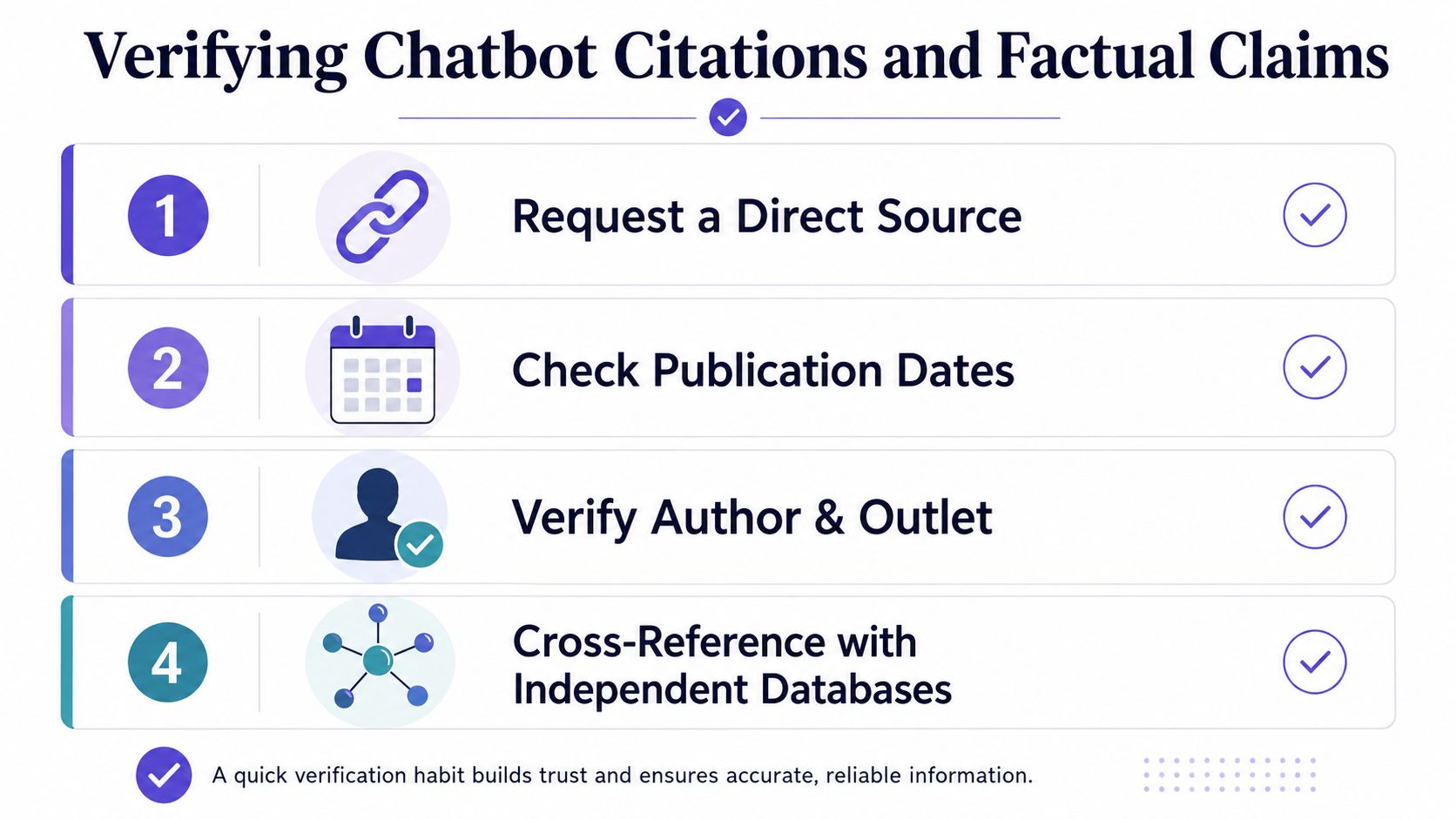
A chatbot that makes factual claims needs source verification fast. Pull the cited URL, then check whether the page supports the statement. A citation can look polished and still miss the point, or point to a source that only seems related.
Check the source, not just the format
Open the cited page and verify the title, authors, publication year, and outlet. Then compare the exact passage with the claim in the chat. If the claim concerns an external fact, the source has to support that statement directly, not just something adjacent. The EMNLP findings paper breaks verifiability into response quality, filtering sentences that do not need citation, and judging whether each statement is fully supported by the cited source, and it states that, in general, all statements about the external world require citation (EMNLP Findings).
That is the standard I use. A citation that exists but does not support the sentence is a failed citation.
Use a lightweight verification pass
If you are building this into a workflow, send the chatbot's claims through an external verification API before you trust them. Webcite describes a setup where chatbot responses are checked against real sources through a REST API client, and it says the integration can be implemented in fewer than 30 lines of code (Webcite). That is small enough to fit into a real operational pipeline.
For a quick manual pass, I also use a dedicated citation checker and a text checker together. A tool like AI TXT Checker helps surface unsupported or mismatched references before a human reviewer spends more time on them, and GetIntel's free AI citation checker does the same kind of narrowing from the citation side.
Look for fabricated or mismatched references
Medical and scientific use cases are where fabricated references show up clearly. A 2024 PMC study reported that more than two-thirds of the references ChatGPT supplied for a diverse set of medical questions were fabricated, even though they looked believable (PMC). A separate 2023 paper also documented fabricated or erroneous references in bibliographic citations generated by ChatGPT (Scientific Reports).
The practical check is plain. Review titles, author lists, journals, years, DOI data, and the exact sentence being cited. If any of those do not line up, the citation is evidence of failure, not evidence of authority.
Where Chatbot Detectors Quietly Fail
The biggest failure mode is overconfidence. A detector can hand you a polished score and still be wrong for the exact population you care about. That problem gets worse when the text comes from non-native writers, stylistically formal writers, or users whose language doesn't match the detector's training distribution. Independent commentary has noted that detectors can over-flag non-native English writing, which is one reason I don't trust them for hiring, grading, or compliance without human review (Calvin Risk).
The dataset problem is just as serious. The MIT Sloan result in the source set shows why a model that looks accurate in one environment can fail badly in another, because reported accuracy doesn't automatically generalize across platforms and contexts (MIT Sloan). That's a warning for anyone buying into a score-only product.
Paraphrasing breaks a lot of detectors
The second trap is paraphrasing. Once the generated text is edited, the easy fingerprint often disappears. The source set also notes that benchmark accuracy can drop sharply when AI text is paraphrased, which is exactly why a detector that only sees final prose can miss the underlying machine involvement (Eyesift).
That doesn't make detection useless. It just means the target moved. You're not always detecting authorship. Sometimes you're detecting infrastructure, cadence, or unverifiable sourcing.
Use detectors as triage, not judgment
Single-question and disclosure-based methods are a promising research direction for conversation systems, but they're still uneven and context-dependent, especially when the bot adapts over multiple turns (arXiv). I treat those methods as screening tools, not courtroom evidence.
The rule I follow is simple. If the outcome affects money, access, or reputation, a chatbot detector should never be the only decision-maker. It can flag risk. It can't carry the whole verdict by itself.
Putting It All Together in a 15-Minute Investigation
Start with the surface scan, then move through timing, metadata, and citation checks. Capture the evidence trail as you go, because the final call is only as good as the notes behind it. If a site-level scanner like AI Website Detector surfaces AI-builder fingerprints or bundle artifacts, use that as your first pass, then confirm the conversation behavior manually before you escalate.
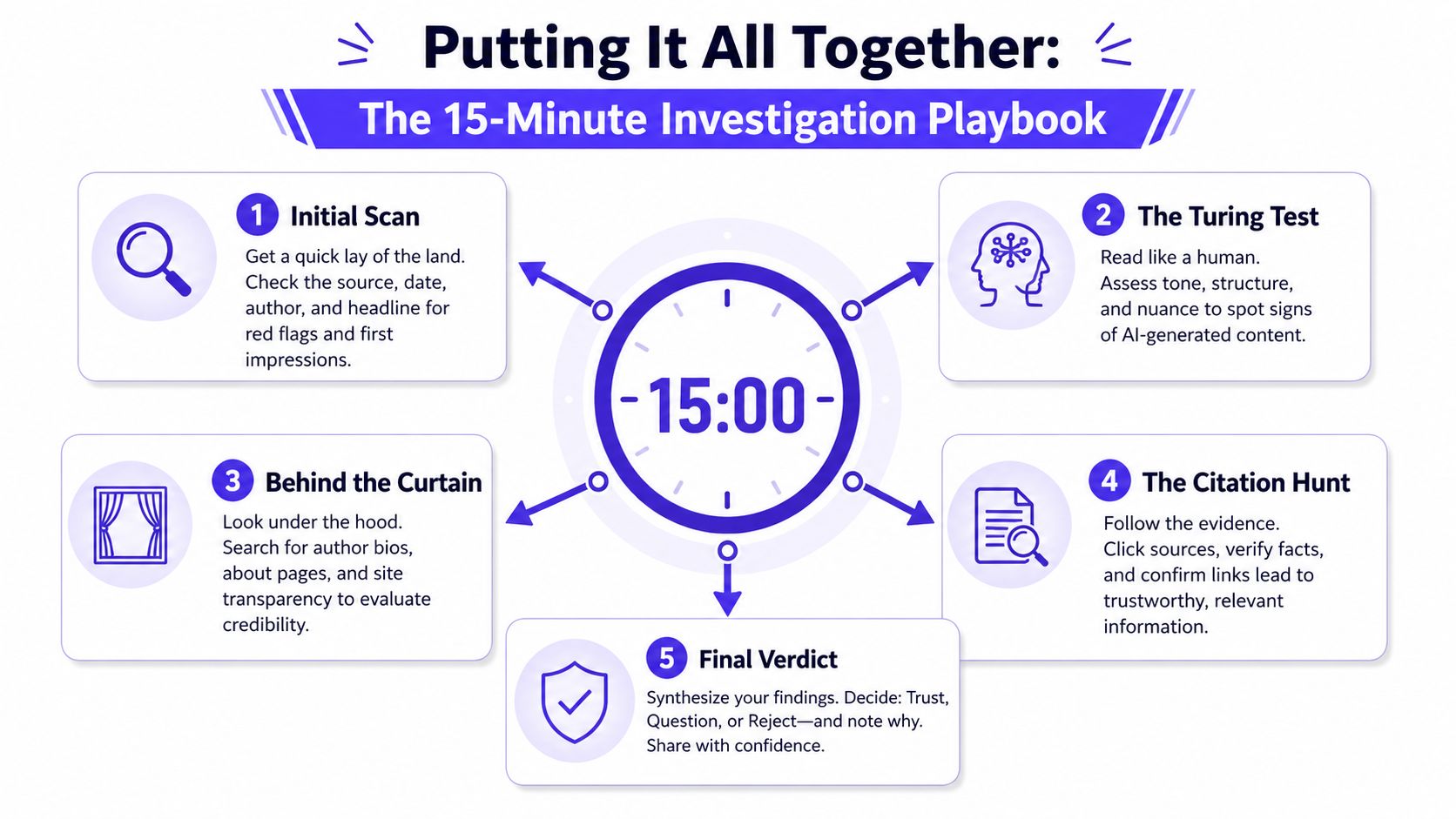
A solid verdict comes from agreement across layers, not from one impressive score. If the signals conflict, keep the case open. If they line up, document why, save the artifacts, and move on with a record that another reviewer can audit later.
If you need a chatbot detector that starts with the website itself, AI Website Detector can help you inspect the stack, surface AI-builder fingerprints, and separate artifact evidence from pure guesswork. Visit AI Website Detector to run a scan, compare the signals, and add a cleaner first pass to your investigation workflow.