
AI Website Examples: What They Look Like and How to Spot Them
AI-built websites are sites generated by platforms that use artificial intelligence to automatically create layouts, write copy, select color schemes, and structure pages, often in under 30 minutes. The leading builders producing these sites right now include Framer, Lovable, and Wix ADI, along with platforms like Webflow AI and Hostinger AI. These tools have made functional web presence accessible to anyone with a browser and a credit card, which is exactly why understanding what these sites look like, and how to identify them, matters for developers, marketers, and business owners doing competitive research.
Here’s what AI-built websites typically share:
- Template-driven layouts with predictable section order (hero, features, testimonials, CTA)
- Dark themes with vibrant accent colors, gradients, and abstract data visuals
- Micro-interactions and animated elements that ship as defaults, not custom decisions
- Hosted on the builder’s own infrastructure, leaving fingerprints in the source code
- Basic SEO setup (title tags, meta descriptions, mobile responsiveness) but limited depth
Table of Contents
- Why AI-built websites work well, and where they fall short
- Real AI-built website examples worth studying
- How to detect if a website was built with AI
- Case studies: AI-built websites that actually worked
- How top AI website builders compare on key features
- Where AI website building is headed in 2026 and beyond
- Key Takeaways
- Aiwebsitedetector gives you the competitive edge on AI-built sites
- FAQ
Why AI-built websites work well, and where they fall short
AI website builders generate a complete business website in 5–30 minutes, costing $0–$30/month, compared to weeks and thousands of dollars for custom development. That gap is why startups validating an idea, local service businesses, and anyone running a temporary event page reach for these tools first.

The speed and cost advantages are real. So are the tradeoffs.
Where AI builders shine:
- New businesses testing a concept before committing to custom development
- Personal portfolios and professional landing pages
- Local service companies that need a credible web presence fast
- Budget-conscious projects under $1,000
Where they hit a ceiling:
- AI-generated sites typically score lower on Google PageSpeed Insights compared to custom builds, due to bloated JavaScript and unoptimized assets.
- Advanced SEO, including structured data, dynamic sitemaps, and semantic HTML, is largely out of reach
- Platform dependency means your site is essentially rented, not owned; switching builders requires a full rebuild
- Long-term maintenance costs climb as AI-generated code accumulates technical debt
Cloud-based AI builders dominate the market revenue share, but businesses with higher revenue tend to migrate toward custom development. The pattern is consistent: AI builders get you to market, custom builds keep you competitive.
Real AI-built website examples worth studying
The clearest way to understand what AI-built sites look like in practice is to look at specific ones. The Framer AI gallery alone lists over 1,400 AI-powered sites, ranging from SaaS landing pages to agency portfolios.
A few standout examples across builder types:
| Site | Builder | Industry | Notable Design Feature |
|---|---|---|---|
| Synthesia | Framer | AI video generation | Bold purple gradient, client logos, product demos |
| Twelve Labs | Framer | Multimodal AI | Cinematic animated backgrounds, smooth motion |
| Cartesia | Framer | Voice AI | Dynamic gradients, playful typography |
| Simmer | Framer | Food tech AI | Deep colors, fluid motion, bold product imagery |
| PlayerZero | Framer | Developer tools | Dark interface, glowing accents, animated elements |
| Jasper | Webflow | AI marketing | Clean minimal layout, large CTAs |
| Quantified | Webflow | Sales coaching AI | Animated illustrations, case study integration |
AI website design across these examples follows a recognizable visual grammar: dark backgrounds, vibrant accent colors (indigo, purple, neon green), neural network graphics, and interactive demos. These aren’t arbitrary choices. They signal technical sophistication to a target audience of developers and enterprise buyers.
What separates the better-executed examples from the generic ones is human-curated content layered on top of the AI scaffold. Synthesia’s site works because the copy is sharp and the social proof is specific. Cartesia’s works because the motion design feels intentional, not default. The AI builder provides the structure; the brand voice and content strategy determine whether it converts.
You can browse a curated AI website gallery to see how these design patterns play out across dozens of real sites.
How to detect if a website was built with AI
Spotting an AI-built site is part pattern recognition, part technical analysis. Several signals appear consistently across builder outputs.
Visual and structural tells:
- Section order follows a rigid template (hero → features → social proof → pricing → footer)
- Typography choices are limited to the builder’s font library
- Spacing and padding feel uniform across the entire page
- Mobile layout is responsive but not custom-optimized
Technical indicators:
- Source code contains builder-specific JavaScript bundles (Framer’s runtime, Wix’s
_wixnamespace) - Hosting resolves to the builder’s CDN (framer.website, wixsite.com subdomains)
- AI-built sites show recognizable code patterns and limited custom functionality in the DOM
- Meta tags follow the builder’s default structure rather than a custom SEO configuration
Performance and SEO clues:
- PageSpeed scores in the 60–75 range suggest builder-generated code
- Structured data is absent or minimal
- Sitemap follows the builder’s auto-generated format
Pro Tip: Run a site through Aiwebsitedetector before manually digging through source code. It cross-references over 80 technology signals against a database of 164,864+ analyzed websites to identify the specific builder, hosting setup, and CMS in seconds, without requiring an account.
Case studies: AI-built websites that actually worked
The most instructive examples aren’t the flashiest ones. They’re the ones where the builder choice matched the business need precisely.
Cartesia (Voice AI, Framer): Launched a product site that communicates a complex technical concept, real-time emotional text-to-speech, through motion and typography alone. The Framer build let a small team ship a polished site without a dedicated front-end developer. The result looks custom because the design decisions were deliberate, even if the scaffolding wasn’t.
Quantified (Sales coaching AI, Webflow): Used Webflow’s AI-assisted layout tools to build a site that integrates customer case studies and animated product illustrations. The site’s credibility comes from the content, not the platform. Webflow’s flexibility gave the team enough room to customize beyond the default template.
Local service businesses using Wix ADI: Wix ADI’s strength is the speed-to-credibility ratio for businesses that need a professional web presence without a web team. A plumbing company or a yoga studio gets a mobile-responsive, SEO-basic site in an afternoon. The tradeoff, platform lock-in and limited performance optimization, rarely matters at that scale.
The consistent lesson across these cases: AI builders work when the site’s job is to establish presence or validate a concept. When the site’s job is to drive significant revenue, the limitations surface quickly.
How top AI website builders compare on key features
| Feature | Framer | Lovable | Wix ADI |
|---|---|---|---|
| Design flexibility | High | Moderate | Low |
| Code export | Yes (React) | Yes | No |
| SEO control | Moderate | Basic | Basic |
| Custom domain | Yes | Yes | Yes |
| AI content generation | Yes | Yes | Yes |
| Best for | Designers, SaaS | App prototypes | Small businesses |
| Pricing (starting) | Free tier | Free tier | Free tier |
Framer sits at the top for design control and is the builder of choice for most of the polished AI company sites you’ll find in galleries. Lovable targets developers building app prototypes quickly, generating functional React code rather than just visual layouts. Wix ADI optimizes for the non-technical user who needs a site today, not a platform to grow on for years.
The top AI-built websites by AI probability score skew heavily toward Framer, which reflects both its popularity in the tech and SaaS space and the distinctiveness of its output.
Where AI website building is headed in 2026 and beyond
The trajectory is toward less visible AI involvement, not more. The next generation of builders is moving from “AI generates your site” to “AI continuously optimizes your site,” adjusting copy, layout, and CTAs based on real user behavior. Framer has already shipped AI-assisted layout suggestions that respond to content changes in real time.
A few developments worth tracking:
- Multimodal AI inputs: Builders that accept a sketch, a brand brief, or a competitor URL and generate a full site from that context
- AI-generated personalization: Sites that serve different layouts to different visitor segments without manual A/B testing setup
- Tighter performance optimization: Builders addressing the PageSpeed gap by generating leaner code and smarter asset loading
- Detection arms race: As AI-built sites become harder to distinguish visually, technical detection tools become more valuable for competitive intelligence
The strategic divide between AI-built and custom sites will likely narrow on the design side and widen on the ownership and scalability side. Businesses that treat their website as a revenue-critical asset will still need custom development. Everyone else has more capable AI options every quarter.
Key Takeaways
AI-built websites from platforms like Framer, Lovable, and Wix ADI are fast and affordable but carry real tradeoffs in performance, SEO depth, and long-term ownership that make detection and analysis increasingly valuable for competitive intelligence.
| Point | Details |
|---|---|
| Speed vs. performance | AI builders launch sites in 5–30 minutes but typically score 60–75 on PageSpeed versus 90–100 for custom builds. |
| Best use cases | AI-built sites serve startups, local businesses, and temporary projects well; revenue-critical sites need custom development. |
| Visual fingerprints | Dark themes, gradient accents, templated section order, and builder-specific JavaScript bundles are consistent detection signals. |
| Ownership risk | AI builder sites cannot be exported for full portability; switching platforms requires a complete rebuild. |
| Aiwebsitedetector | Scans any URL against 80+ technology signals across 164,864+ analyzed websites to identify the specific AI builder, CMS, and hosting stack in real time. |
Aiwebsitedetector gives you the competitive edge on AI-built sites
When you need to know whether a competitor’s site was built with Framer, Lovable, or Wix ADI, manual source code inspection is slow and often inconclusive. Aiwebsitedetector cuts that process to seconds.
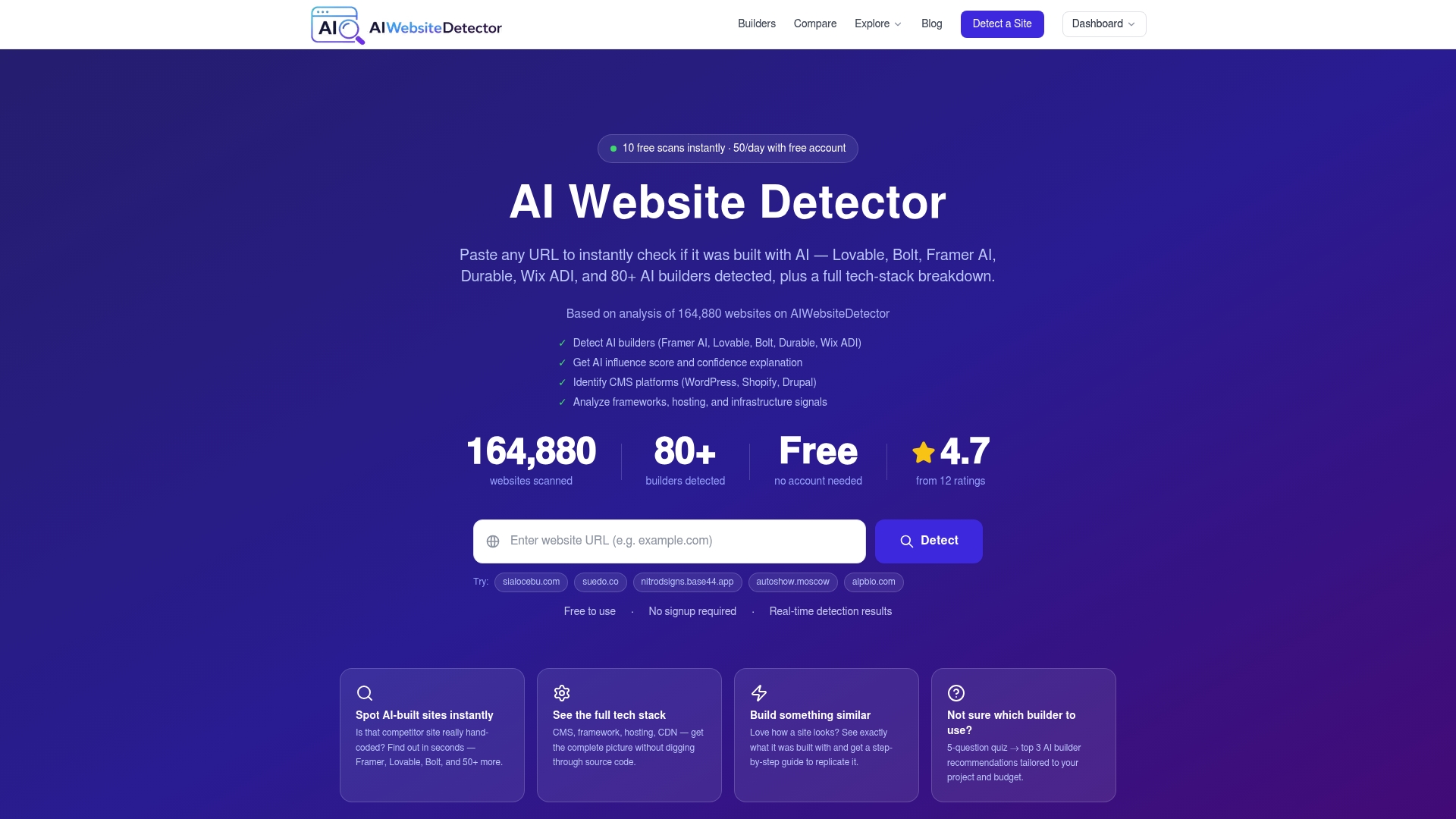
Paste any URL and get a full breakdown: the specific AI builder detected, an AI influence score with confidence rationale, CMS identification, hosting provider, frameworks, and plugins. No account required for quick checks. The analysis draws on signals from over 164,864 scanned websites, which means the detection is grounded in real-world pattern data, not guesswork. For developers and marketers running regular competitor audits, the API and subscription plans scale to handle bulk scanning without manual effort. Check any website now and see exactly what technology stack is running behind it.
FAQ
What counts as an AI-built website?
An AI-built website is one generated using an AI-powered builder like Framer, Lovable, or Wix ADI, where the platform automatically creates layouts, content, and design elements rather than a developer building from scratch.
How accurate is AI website detection?
Aiwebsitedetector applies over 80 technology signals against a database of 164,864+ analyzed websites, identifying the specific builder, CMS, and hosting stack with a confidence score attached to each result.
Can AI-built sites rank well on Google?
AI builders handle basic SEO (title tags, meta descriptions, mobile responsiveness) but struggle with structured data, dynamic sitemaps, and Core Web Vitals optimization, which limits ranking potential for competitive keywords.
Which AI website builder produces the most polished results?
Framer consistently produces the most design-flexible output and dominates the AI company website gallery space, making it the preferred builder for SaaS and tech brands that need a custom-looking site without a full dev team.
How do I tell if a site uses Wix ADI specifically?
Look for Wix-specific JavaScript namespaces and CDN patterns in the source code, or run the URL through Aiwebsitedetector’s Wix AI detection tool for an instant, confirmed result.
Recommended
- AI Website Detector — Detect if Any Website Was Built With AI
- Monthly AI Website Insights — Real Scan Data by Month | AI Website Detector
- All AI Website Builders — Detection Stats | AI Website Detector | AI Website Detector
- What AI Builder Made This Website? How to Identify AI Tech Stacks Instantly – AI Website Detector Blog